
Capilano Suspension Bridge and the forest span above North Vancouver
Published on 08/16/2026 at 14:56 | Editorial responsibility: Rafael Müller, Editor-in-Chief AD HOC NEWS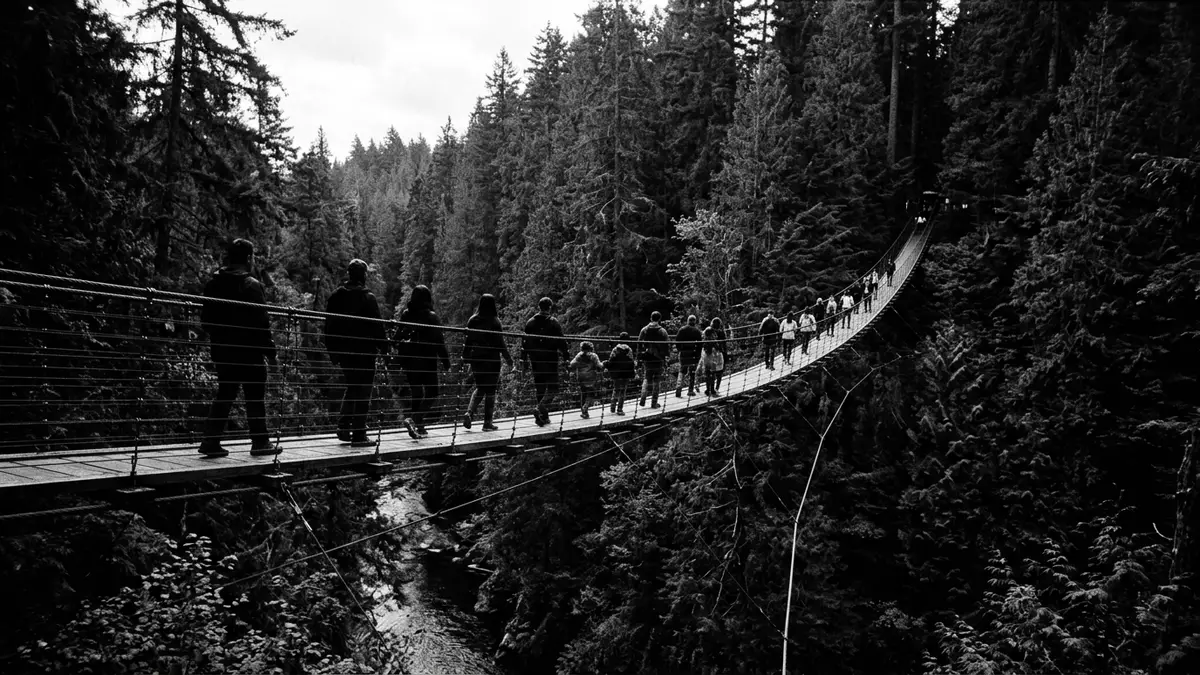
Capilano Suspension Bridge in North Vancouver spans the Capilano River as a high walkway of cables, timber and forest views. First built in 1889 by George Grant Mackay, it remains a striking crossing above a wooded canyon.
A bridge of cable and cedar
The bridge’s origin lies with George Grant Mackay, a Scottish engineer who first put a suspension crossing here in 1889. The span became part of the geography of North Vancouver itself, hanging above the river rather than sitting at street level.
Its long history includes a rebuild in 1903 and a complete reconstruction in 1956, both tied to the bridge’s changing structure and materials. The present crossing keeps the site’s core image intact: a narrow deck suspended between forested banks, with the river far below.
George Grant Mackay’s North Vancouver span
The bridge is part of a broader local landscape associated with Mackay’s early development around the Capilano River. In its first form, it used hemp ropes and cedar planks, a combination that gives the site a clear place in the region’s frontier engineering.
That early crossing was followed by later rebuilds as the structure took on a more durable form. The bridge’s history links North Vancouver to the practical, hand-built infrastructure of the late nineteenth century, when river crossings often depended on timber and cable rather than masonry.
The bridge in the Capilano River setting
The setting is as important as the span itself. The bridge crosses a wooded gorge above the Capilano River, with steep banks and dense evergreen cover shaping the view from the deck.
The place is now part of a larger park landscape, but the bridge remains the central feature. Its suspension form, timber deck and height above the river create the strongest visual contrast on site, especially against the dark tree line.
Visiting Capilano Suspension Bridge: what travellers from Western Europe should know
- Capilano Suspension Bridge is in North Vancouver, on the north side of Burrard Inlet. Local roads connect it with the city rather than with a rail station.
- The bridge crosses high above the Capilano River. The approach includes elevated walkways and forest paths on sloping ground.
- The official language is English and the currency is the Canadian dollar.
- Conditions on the bridge vary with weather and season; handrails and fixed pathways are part of the site.
Searching for Capilano Suspension Bridge on social platforms
These links open searches for Capilano Suspension Bridge on each platform.
Frequently asked questions about Capilano Suspension Bridge
Where is Capilano Suspension Bridge?
It stands in North Vancouver, above the Capilano River on the north side of Burrard Inlet. The bridge sits within a forested landscape rather than an urban square.
What does a visit feel like?
The site combines a suspension crossing with wooded paths and raised walkways. The river, steep banks and tall trees are the main features around the bridge.
What makes it distinctive?
Its identity comes from the long cable span, the height above the river and the link to George Grant Mackay and 1889. The bridge’s repeated rebuilds are part of its character, but the crossing remains the centre of the place.


