
Capilano Suspension Bridge in North Vancouver
Published on 09/21/2026 at 13:44 | Editorial responsibility: Rafael Müller, Editor-in-Chief AD HOC NEWS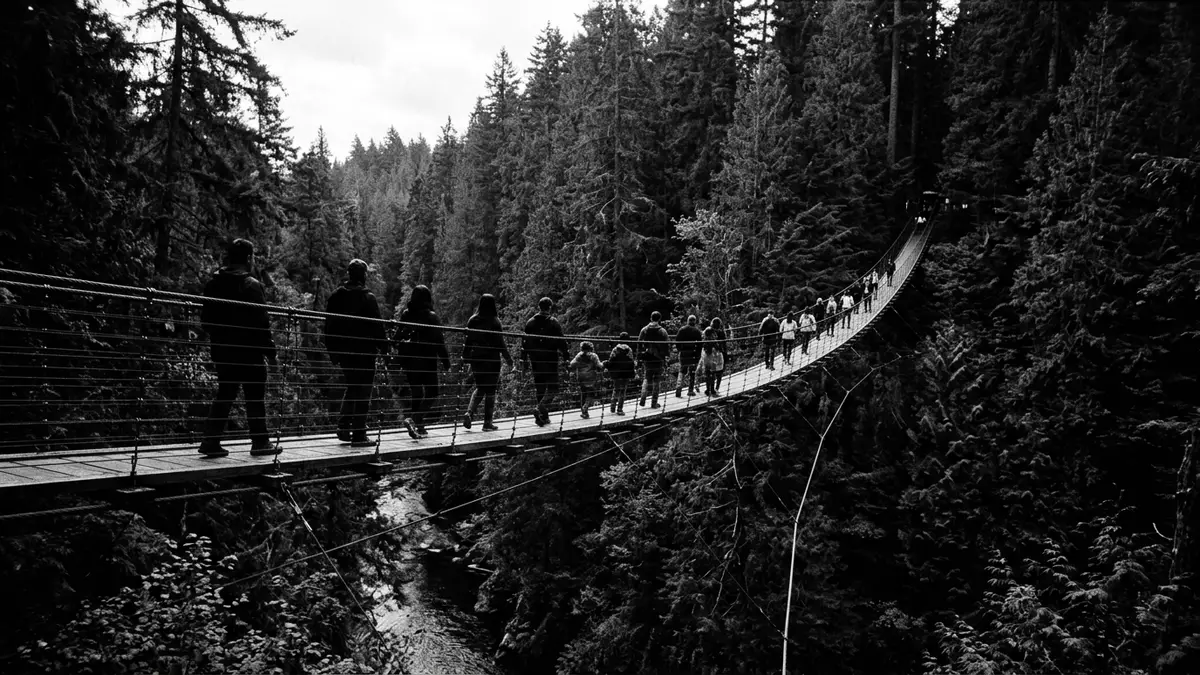
Capilano Suspension Bridge spans the Capilano River in North Vancouver and remains closely tied to George Grant Mackay, the Scottish civil engineer who first built it in 1889. Its present span belongs to a long bridge story that has moved from hemp ropes and cedar planks to steel cables and a stronger crossing.1889
A bridge above the river canyon
The bridge crosses a wooded canyon rather than a broad urban street, and that setting gives the structure its main visual force. The deck runs between steep banks, with the river far below and trees pressing close to the span.Capilano River
Capilano Suspension Bridge is part of a place that mixes a pedestrian crossing with a park landscape. The bridge itself is the clearest historical feature, but the wider setting brings together forest, canyon and the river corridor around North Vancouver.George Grant Mackay
From hemp ropes to steel cables
The earliest bridge used hemp ropes and cedar planks, a combination that belongs to the late nineteenth century rather than to a modern engineered landmark. The site’s later rebuilds introduced wire cables and, eventually, a complete reconstruction in 1956.wire cables
That long sequence of changes is part of the bridge’s identity. Even so, the essential idea remains easy to read: a suspended crossing above a deep green river corridor, carrying the memory of an 1889 beginning into a later structure.1956
The park landscape around the span
The bridge is only one element in a larger wooded site, where the canyon edge and forest floor frame the crossing. Totem poles and other park features give the place a cultural layer that sits beside the bridge’s engineering form.totem poles
Viewed as a whole, the site combines movement, height and landscape in a compact form. The bridge remains the central feature, but the surrounding park makes the place read as more than a single span.North Vancouver
Visiting Capilano Suspension Bridge: what travellers from Western Europe should know
- The bridge lies in North Vancouver, near the Capilano River and the forested canyon edge. It is reached by road from the city rather than by a mountain approach.
- The crossing is suspended above a steep-sided river gorge. The setting includes a narrow deck and an open span above the water.
- The wider site includes park paths and planted areas around the bridge. The terrain stays uneven and wooded rather than flat and urban.
- Capilano Suspension Bridge is in Canada, where the official language is English and French and the currency is the Canadian dollar.
- Entry requirements depend on your nationality; UK travellers can check the FCDO travel advice at gov.uk/foreign-travel-advice, Irish travellers the Department of Foreign Affairs at ireland.ie.
Searching for Capilano Suspension Bridge on social platforms
These links open searches for Capilano Suspension Bridge on each platform.
Frequently asked questions about Capilano Suspension Bridge
Where is Capilano Suspension Bridge?
It is in North Vancouver, by the Capilano River and the forested canyon that cuts through the site. The bridge forms part of a larger park setting.
What does a visit involve?
The main feature is the suspended crossing itself, together with paths and landscaped park sections around it. The ground is uneven and the bridge spans open space above the river.
What makes the bridge distinctive?
Its combination of an 1889 origin, George Grant Mackay’s name and a later steel-cable reconstruction gives it a layered history. The crossing also sits in a wooded canyon rather than in a purely urban setting.


