
Carrieres de Lumieres turns a limestone quarry into moving art
Published on 09/22/2026 at 07:30 | Editorial responsibility: Rafael Müller, Editor-in-Chief AD HOC NEWS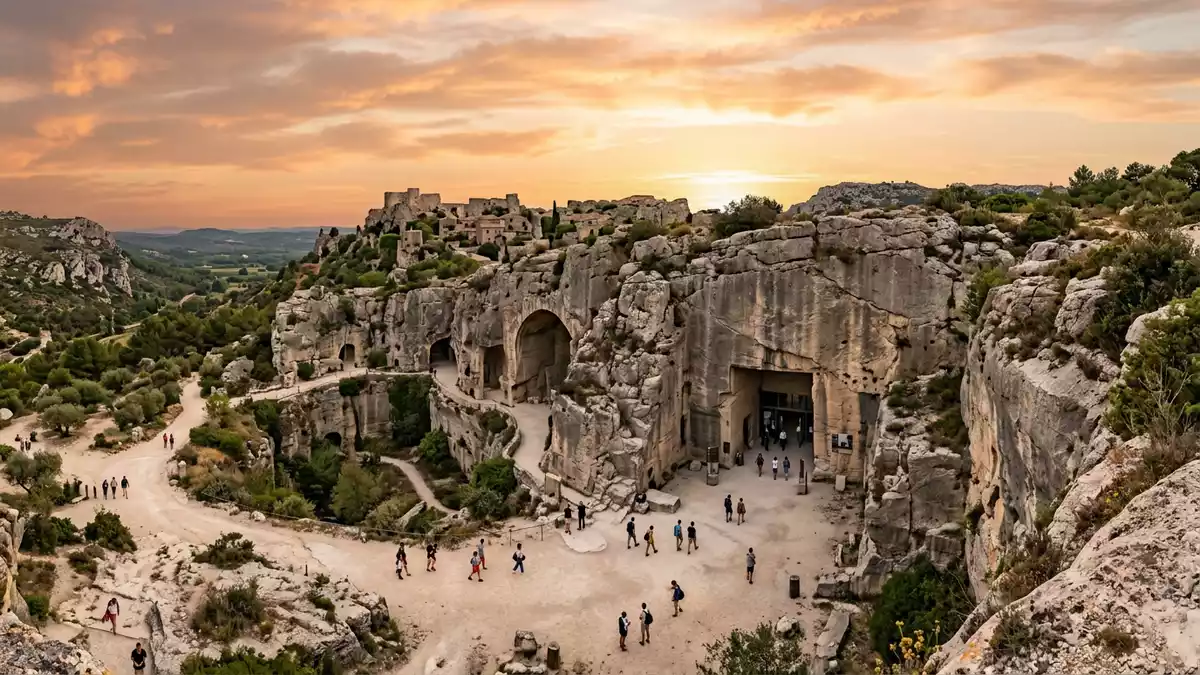
Carrieres de Lumieres occupies a former limestone quarry beneath Les Baux-de-Provence, where projected paintings cover rock walls, pillars and floors. The site combines the physical scale of an underground excavation with changing digital exhibitions, placing art inside the stone rather than inside a conventional gallery.
Les Baux limestone beneath the Alpilles
The quarries lie in the Val d’Enfer, at the foot of Les Baux-de-Provence in the Alpilles. Their pale limestone belongs to the geological history of the region and contains marine fossils. The rock formed through the compaction of calcium carbonate in calcareous sand, producing a fine-grained material known as Les Baux stone.
Local limestone supplied building material for Glanum, the medieval settlement of Les Baux-de-Provence and the Château des Baux. The quarry landscape therefore connects the digital exhibition with the architectural history of the surrounding territory. The broad excavated surfaces, vertical faces and remaining pillars retain the marks of stone extraction.
The quarry at Les Grands Fonds opened around 1800 during a period of strong demand for building stone. In 1821, the mineral bauxite was identified in the area and received its name from Les Baux-de-Provence. The stone industry ended at the quarry in 1935, after new construction materials changed the market for limestone.
From industrial excavation to an art venue
The rock chambers acquired an artistic association in 1959, when Jean Cocteau filmed sequences for The Testament of Orpheus at the site. The film brought the quarry’s walls, recesses and shadowed spaces into a work of cinema without altering their industrial character.
Albert Plécy established the Cathedral of Images project in the 1970s. Large images were projected onto the quarry walls, creating an early form of audiovisual presentation within the excavated chambers. The title changed, but the relationship between projected pictures and rough limestone remained central.
In 2012, the venue opened under the name Carrieres de Lumieres with an exhibition devoted to Paul Gauguin and Vincent van Gogh. Culturespaces manages the site, while Culturespaces Studio produces the digital exhibitions. The programme has included artists such as Monet, Renoir, Chagall, Klimt, Michelangelo, Leonardo da Vinci, Raphael, Picasso, Dalí and Cézanne. The quarry’s documented history records this passage from extraction to projected art.
How images occupy the quarry
The exhibition format treats the quarry as a continuous surface. Pictures extend across walls, pillars and floors, while music accompanies the changing sequence. More than 7,000 m² of floor space are used for projection, and the chambers’ height and depth give the images a scale unavailable in a standard exhibition room.
The visual field is not confined to a framed canvas. A painted landscape can cross a wall and continue across the ground; a portrait can appear beside a pillar; colour can occupy a whole chamber. The limestone remains visible beneath the projection, so the site presents two layers together: the worked rock and the reproduced artwork.
Each programme centres on an artist or a defined subject from art history. The exhibition names have included Van Gogh, Starry Night, Dalí, the Endless Enigma, Cézanne, Master of Provence and Egyptian Pharaohs, from Cheops to Ramesses II. This format places paintings, drawings and other images within a setting that was originally shaped by quarrying.
The result is neither a conventional museum nor an untouched geological chamber. Carrieres de Lumieres remains an industrial interior, but its surfaces function as a large-scale image field. The distinction between wall, screen and floor becomes part of the visible setting, while the former quarry supplies the venue’s defining material presence. Images cover the quarry surfaces across the chambers.
Visiting Carrieres de Lumieres: what travellers from Western Europe should know
- Carrieres de Lumieres is on Route des Carrières at Les Baux-de-Provence, in the Val d’Enfer. The site is reached by road through the Alpilles.
- The visit takes place inside a former limestone excavation with uneven rock surfaces, broad chambers, pillars and high walls. Practical footwear suits the quarry floor.
- The neighbouring village of Les Baux-de-Provence and the Château des Baux provide nearby historical landmarks. The Alpilles landscape surrounds the quarry.
- The official language is French and the currency is the euro.
Searching for Carrieres de Lumieres on social platforms
These links open searches for Carrieres de Lumieres on each platform.Frequently asked questions about Carrieres de Lumieres
Where is Carrieres de Lumieres?
Carrieres de Lumieres is in the Val d’Enfer beneath Les Baux-de-Provence, within the Alpilles region of southern France.
What does a visit involve?
A visit takes place inside former limestone chambers, where large projected artworks spread across walls, pillars and floors with accompanying music.
What makes the venue distinctive?
Its distinctive feature is the combination of industrial quarry architecture and digital projection. The limestone excavation acts as the continuous setting for changing art programmes.


