
Casco Historico de Toledo and its layered stone cityscape
Published on 09/23/2026 at 14:23 | Editorial responsibility: Rafael Müller, Editor-in-Chief AD HOC NEWS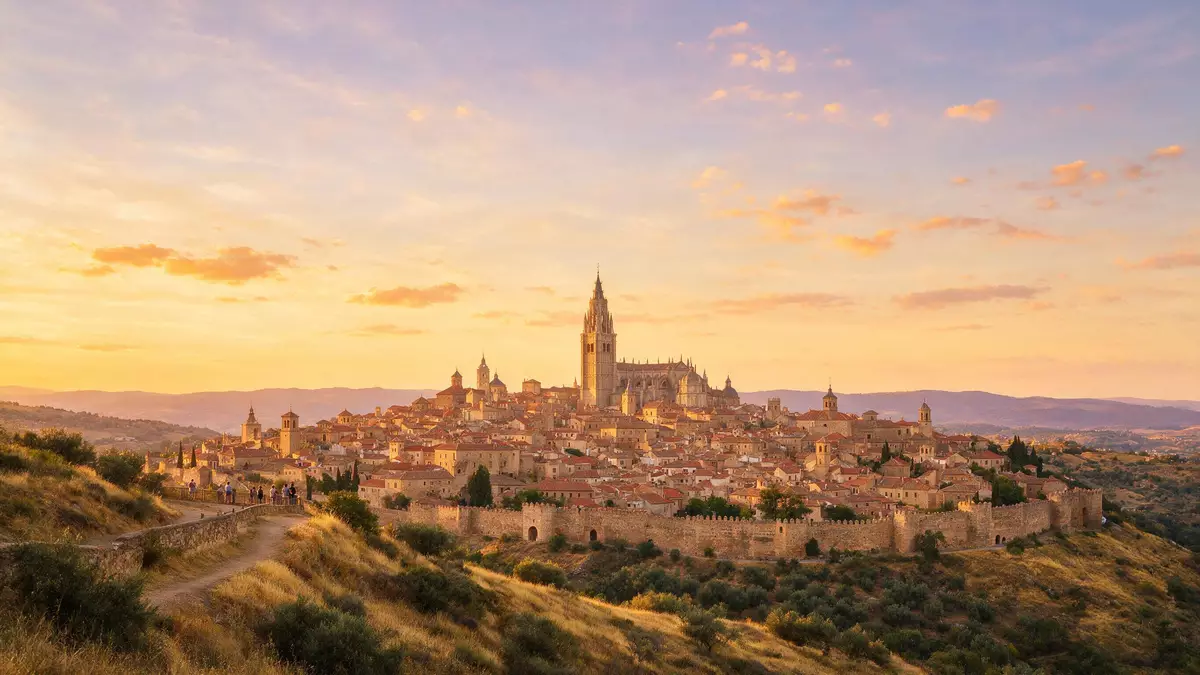
Casco Historico de Toledo occupies a rocky hill above a bend of the Tagus River, with walls, gates and narrow streets enclosing a city shaped by more than two thousand years of history. Roman, Visigothic, Islamic, Jewish and Christian buildings stand within the same historic quarter, giving Toledo its dense architectural character.
Casco Historico de Toledo on the rocky hill above the Tagus
The historic centre rises on a rugged promontory washed on three sides by the Tagus. Its urban fabric includes steep lanes, irregular junctions, small squares and stone buildings assembled across many centuries. The city’s protected historic area covers about 260 hectares, a scale that includes both monumental buildings and ordinary residential streets.
Parts of Toledo’s walls have Visigothic origins, while much of their surviving appearance reflects Islamic and Christian construction. Puerta Vieja de Bisagra belongs to the city’s medieval gateways, and Puerta Nueva de Bisagra marks another important entrance into the historic town. The bridges of Alcántara and San Martín connect the hill with the surrounding landscape.
Roman, Visigothic, Islamic and Christian layers
Toledo began as a Roman city and became the capital of the Visigothic kingdom in the sixth century. During Islamic rule, it formed part of the Emirate of Córdoba and retained fortified buildings, baths, mosques and houses. In 1085, Alfonso VI took the city for the Christian kingdoms.
The quarter’s religious buildings preserve this succession of cultures. The former mosque of Cristo de la Luz dates from the tenth century, while Santa María la Blanca and El Tránsito preserve the Mudéjar synagogue tradition. Toledo Cathedral, begun in 1226, represents Spanish Gothic architecture, and San Juan de los Reyes belongs to the late fifteenth-century Isabelline style. The Historic City of Toledo was inscribed on the UNESCO World Heritage List in 1986.
Toledo’s Mudéjar buildings and artistic inheritance
Mudéjar architecture developed through contact between Christian and Islamic artistic traditions. In Toledo, brick, plaster, horseshoe arches, patterned surfaces and timber details appear in churches, gates, synagogues and civic buildings. The result is not a single uniform style, but a sequence of buildings shaped by different communities and periods.
The Alcázar occupies a commanding position within the historic city. Its construction began in the sixteenth century under Charles V, and its later use as a military museum gives the fortress a distinct civic and institutional role. The cathedral contains chapels, choir stalls and monumental artworks, while the Church of Santo Tomé houses El Greco’s Burial of the Conde de Orgaz. Toledo also preserves the Hospital de Santa Cruz, the former synagogue El Tránsito and the church of San Román.
Toledo’s cultural history includes the School of Translators associated with Alfonso X in the thirteenth century. The city’s buildings therefore form more than a sequence of façades. They record changes in political power, religious life, artistic practice and urban use across the Roman, medieval and early modern periods. The historic centre’s winding streets retain the compact form of the hill city.
Visiting Casco Historico de Toledo: what travellers from Western Europe should know
- Casco Historico de Toledo lies in central Spain, south of Madrid. Rail services reach Toledo station, and roads connect the city with Madrid and Castilla-La Mancha.
- The historic centre occupies steep ground. Streets have gradients, rough surfaces and stairs, with the Plaza del Zocodover forming a central urban reference point.
- The Tagus surrounds the hill on three sides. The bridges of Alcántara and San Martín provide named crossings below the historic quarter.
- Spanish is the official language, and the currency is the euro.
Searching for Casco Historico de Toledo on social platforms
These links open searches for Casco Historico de Toledo on each platform.
Frequently asked questions about Casco Historico de Toledo
Where is Casco Historico de Toledo?
It is the historic centre of Toledo in central Spain. The quarter occupies a rocky hill above a bend of the Tagus River.
What can visitors expect to see?
Visitors encounter walls, gates, bridges, churches, synagogues, a former mosque, the cathedral and the Alcázar. Narrow streets connect monuments from Roman, medieval and early modern periods.
What makes the historic centre distinctive?
Its buildings preserve Jewish, Christian and Islamic architectural traditions within one compact hill city. UNESCO recognised the Historic City of Toledo as a World Heritage site in 1986.


