
Casco Viejo’s colonial streets and plazas
Published on 09/17/2026 at 20:02 | Editorial responsibility: Rafael Müller, Editor-in-Chief AD HOC NEWS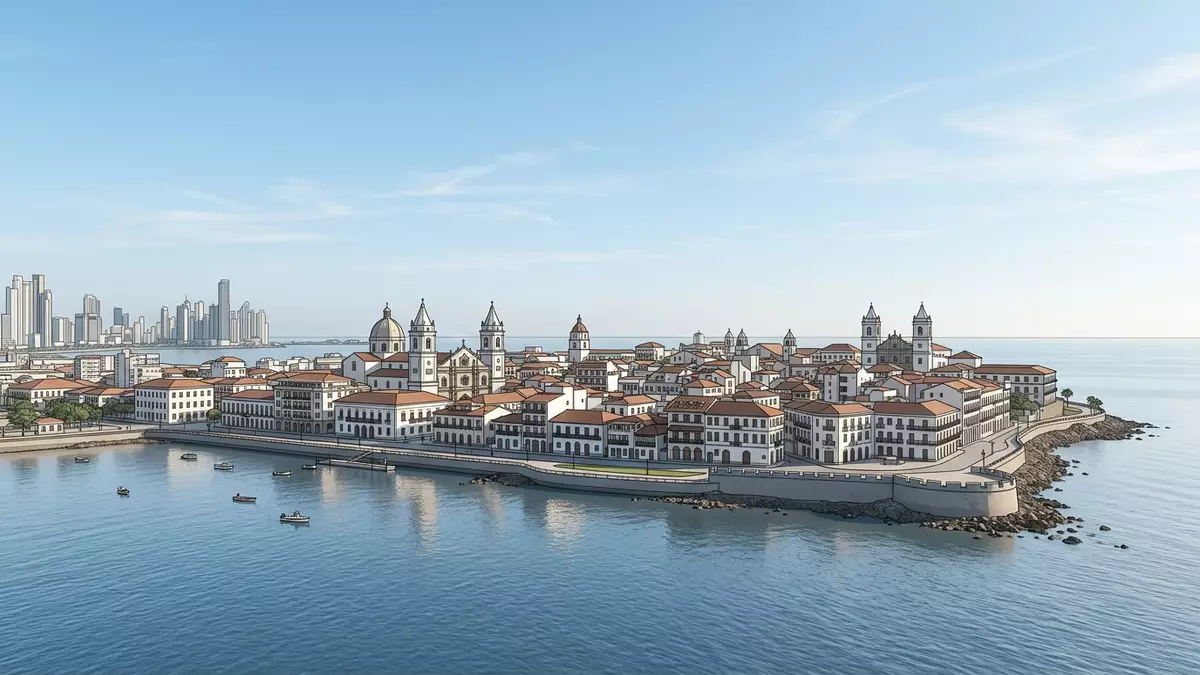
Casco Viejo is the historic quarter of Panama-Stadt, where compact streets, plazas and masonry fronts gather around a colonial core. Its historic status links it to the Spanish city founded in 1519 and the rebuilt district inscribed in 1997.
Casco Viejo’s layered street plan
The quarter is part of the Historic Centre of Panama City within Casco Antiguo, a heritage area on a peninsula at the foot of Ancon Hill. The setting gives the district a tight urban edge, with the sea and city meeting at close range.
Casco Viejo belongs to the UNESCO-listed property called Archaeological Site of Panamá Viejo and Historic District of Panamá. That listing was entered in 1997 and gives the old quarter a formal place in Panama’s heritage record.
Colonial walls and later additions
The district combines Spanish colonial, neoclassical and Caribbean architecture, with balconies, painted façades and solid ground-floor fronts in the same blocks. The mix is visible in the streets around the cathedral and the public squares, where different building phases sit beside one another.
The most important historical anchor is the Spanish settlement of Panamá City, founded in 1519, and the later quarter that rose after the earlier city was destroyed in 1671. Casco Viejo forms the surviving urban core associated with that shift, and its heritage designation reflects that continuity.
One of the clearest names tied to the district is Henry Morgan, whose invasion in 1671 marked the break between the first city and the later settlement. The historic centre was laid out on a peninsula and remains the urban face most closely linked with old Panama City.
Public squares and civic buildings
Casco Viejo is organised around plazas rather than long open boulevards, and those squares remain central to its character. Catedral Basílica Santa María la Antigua, Plaza de la Independencia, Plaza Bolívar and Plaza Herrera are among the names that anchor the district’s public life.
The streets are narrow and regular, and the old quarter keeps a clear relationship between church, civic square and domestic frontage. That pattern makes the area easy to read as a historic city centre rather than a loose collection of preserved buildings.
Visiting Casco Viejo: what travellers from Western Europe should know
- Casco Viejo lies in Panama-Stadt, on the peninsula that forms the city’s old centre. It is reached through the city streets, with the old quarter compact enough to explore on foot.
- The district’s pavements, short blocks and squares make walking the most direct way through it. Many streets stay narrow, so the scale changes quickly from one block to the next.
- English is not an official language in Panama, and the currency is the balboa, alongside the US dollar in everyday use.
- Entry requirements depend on your nationality; UK travellers can check the FCDO travel advice at gov.uk/foreign-travel-advice, Irish travellers the Department of Foreign Affairs at ireland.ie.
- The heritage area sits beside the waterfront edge of the city, and its grid is easy to follow once the main plazas are located. The cathedral, the main squares and the old street plan give it a clear orientation.
Searching for Casco Viejo on social platforms
These links open searches for Casco Viejo on each platform.
Frequently asked questions about Casco Viejo
Where is Casco Viejo?
Casco Viejo is the historic district of Panama-Stadt, on the peninsula at the foot of Ancon Hill. It forms part of the old urban core associated with Panama City’s colonial past.
What does a visit involve?
It involves streets, plazas, churches and civic buildings set in a compact grid. The district is best read as a walkable historic quarter with several named squares at its centre.
What makes Casco Viejo distinctive?
Its blend of Spanish colonial, neoclassical and Caribbean architecture sets the visual tone. The 1997 UNESCO listing and the city’s 1519 origins give the quarter its historical depth.


