
Castel Gandolfo above the volcanic waters of Lake Albano
Published on 09/17/2026 at 17:25 | Editorial responsibility: Rafael Müller, Editor-in-Chief AD HOC NEWS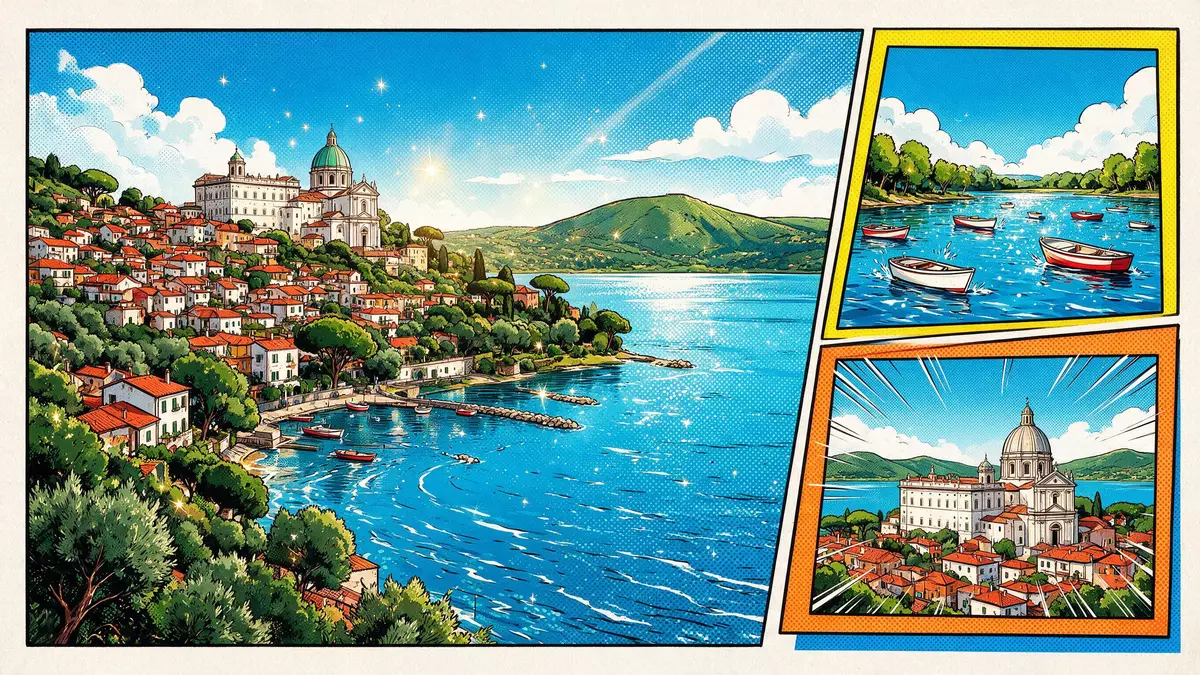
South-east of Rome, Castel Gandolfo gathers its houses and palaces along a ridge above the dark waters of Lake Albano, combining papal history with volcanic landscape. The small town in Lazio is closely associated with the Apostolic Palace, the long-standing summer residence of the popes since the seventeenth century, and with the crater lake that fills the valley below.
A papal town in the Alban Hills
Castel Gandolfo is a comune in the Italian region of Lazio, set in the Alban Hills above Lake Albano and forming part of the historic Castelli Romani area south-east of Rome. The town stands at an elevation of around 426 m (1,398 ft) above sea level, giving it a vantage point over the lake and the wooded slopes around it.comune in the province of Roma Within its boundaries lies the Papal Palace of Castel Gandolfo, a complex of buildings in a garden setting that has served for centuries as a summer residence and retreat for the pope.summer residence and vacation retreat
The town’s historic area clusters around Piazza della Libertà and the surrounding streets, with the palace and its villas forming a substantial presence in the urban fabric. Narrow lanes bend along the ridge, revealing views down to the lake and across to other settlements in the Castelli Romani. Churches, small civic buildings and houses sit close together, creating a compact centre that contrasts with the open gardens and agricultural land attached to the papal properties.
The Apostolic Palace and papal villas
The Apostolic Palace of Castel Gandolfo is part of a complex covering about 135 acres (54.6 ha), including the principal seventeenth-century villa, an observatory and farmland.135-acre complex of buildings The main villa, set above the town’s square, presents a restrained façade to the street and opens towards extensive gardens on the slopes behind. The papal villas include terraces, pathways, formal planting and cultivated plots, reflecting centuries of use as a rural retreat connected to Rome.
The palace complex enjoys extraterritorial status comparable to that of diplomatic missions, following arrangements set out in the Lateran Treaty of 1929.extraterritorial status as a property of the Holy See Within the grounds, buildings such as the astronomical observatory and farm structures stand among orchards and fields, making the papal estate a mixture of villa, scientific facility and agricultural landscape. In the town outside the palace walls, the association with the papacy is visible in plaques, street names and viewpoints that frame the palace against the lake and hills.
Lake Albano and the volcanic setting
Lake Albano, also known as Lago di Castel Gandolfo, is a volcanic crater lake lying directly below the town, enclosed by steep slopes that rise towards Monte Cavo and other heights of the Alban Hills.small volcanic crater lake in the Alban Hills Castel Gandolfo sits on the rim of this crater, with streets that follow the curve of the hillside and viewpoints where the water appears as an elongated basin between wooded sides. The lake’s shoreline includes small piers, boat landings and stretches of beach, reached from the town by roads that descend through the vegetation.
The wider landscape around Castel Gandolfo is part of a regional park that protects the Castelli Romani, with woods, walking paths and other lakes forming a varied terrain.edge of the volcanic Lake Albano From the town, the view takes in the curve of the lake, the opposite slopes and occasional villas on distant ridges. The contrast between the built-up ridge of Castel Gandolfo and the water-filled crater below is one of the defining visual experiences of the place, linking its papal architecture to the geological character of the Alban Hills.
Visiting Castel Gandolfo: what travellers from Western Europe should know
- Castel Gandolfo lies south-east of Rome in the Alban Hills, on the rim of Lake Albano, and is reached by regional trains and buses connecting the town with the capital.
- Within the historic centre, streets rise and fall along the ridge and include sections with steps and narrow pavements; approaches to the lakeshore use sloping roads with bends.
- The surrounding area forms part of a protected landscape of woods and crater slopes, and walking routes link the town with viewpoints above the lake and other Castelli Romani settlements.
- The official language is Italian and the currency is the euro.
Searching for Castel Gandolfo on social platforms
These links open searches for Castel Gandolfo on each platform.Frequently asked questions about Castel Gandolfo
Where is Castel Gandolfo located?
Castel Gandolfo is in Lazio, Italy, on the rim of Lake Albano in the Alban Hills, around 25 km south-east of Rome.
What can visitors expect on a visit?
Visitors encounter a compact hill town with papal villas, a central square, steep streets and views over a volcanic crater lake bordered by wooded slopes and small lakeside facilities.
What makes Castel Gandolfo distinctive?
The close relationship between the Apostolic Palace and the volcanic setting of Lake Albano gives Castel Gandolfo a combination of papal heritage and crater-lake landscape unusual among towns near Rome.


