
Castel Gandolfo and the papal palace above Lake Albano
Published on 09/22/2026 at 08:43 | Editorial responsibility: Rafael Müller, Editor-in-Chief AD HOC NEWS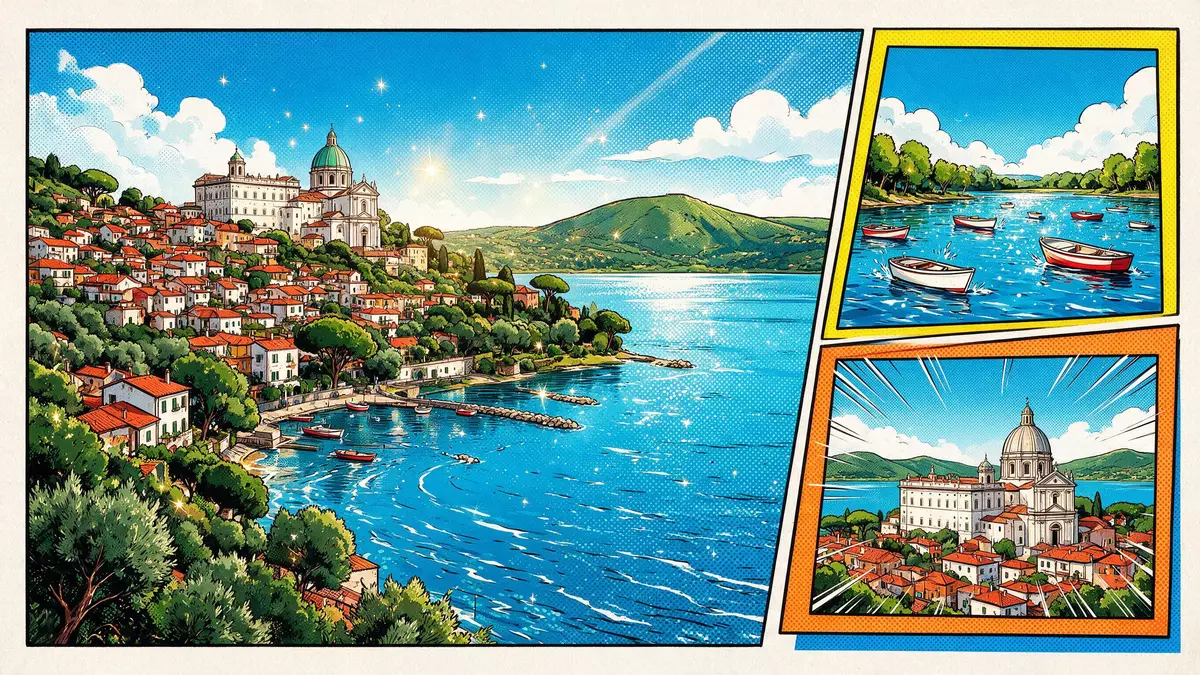
Castel Gandolfo rises in the Alban Hills south-east of Rome, above Lake Albano. Its identity rests on a visible combination of volcanic landscape, Baroque streets and the Apostolic Palace, whose long façade faces the town.
The settlement is also associated with the papal summer residence. Its buildings, gardens and lake views place ecclesiastical history within a compact landscape shaped by the Alban volcanic district.
Castel Gandolfo above a volcanic lake
Castel Gandolfo occupies the rim of the Alban Hills, a volcanic area south-east of Rome. Lake Albano fills a volcanic basin below the town, with wooded slopes rising around the water.
The town’s position gives its historic centre a strongly layered setting. Stone streets and piazzas sit above the lake, while the surrounding hills carry gardens, woodland and villas. The landscape belongs to the Colli Albani, a volcanic complex formed by eruptions over geological time.
The lake is part of the town’s visual character, but Castel Gandolfo is not a lakeside settlement. Its historic core remains on the elevated ground above the water, with roads descending towards the shore.
The Apostolic Palace and papal history
The Apostolic Palace of Castel Gandolfo is the principal historic building in the town. The palace forms part of a larger papal estate that includes gardens and associated buildings.
Pope Urban VIII commissioned the palace in the seventeenth century, and the architect Carlo Maderno worked on its design. Gian Lorenzo Bernini also contributed to the complex, linking Castel Gandolfo with the architectural culture of Baroque Rome.
The palace became a summer residence of the pope. Its rooms, courtyards and formal exterior express the ceremonial character of a papal retreat, while the estate extends beyond the main building into landscaped grounds.
The papal villas at Castel Gandolfo became part of the properties of the Holy See after the Lateran Treaty of 1929. The complex carries this legal and ecclesiastical history alongside its architectural identity.
Baroque streets, gardens and the town centre
Castel Gandolfo’s centre is organised around Piazza della Libertà and the Church of Saint Thomas of Villanova. Bernini designed the church, which was completed in the seventeenth century.
The church has a compact Baroque composition, with a prominent façade facing the piazza. Its presence gives the central square a clear civic and religious focus, while the palace occupies the opposite side of the urban space.
The Barberini Gardens form another major part of the papal complex. Their terraces, avenues, fountains and planting occupy ground above the lake. The gardens include archaeological remains associated with the ancient Alban settlement and the Roman imperial villa traditionally connected with Emperor Domitian.
The gardens are not a separate landscape from the town’s history. They belong to the same papal estate, but their planting and archaeological features create a different register from the palace and the Baroque piazza.
Visiting Castel Gandolfo: what travellers from Western Europe should know
- Castel Gandolfo lies in Lazio, south-east of Rome, above Lake Albano. Regional trains connect Rome with Castel Gandolfo station, and roads from Rome reach the town through the Alban Hills.
- The historic centre stands on elevated ground above the lake. Streets around the palace and piazza include slopes and steps, while the route towards the lake descends through the hill landscape.
- The official language is Italian and the currency is the euro.
- Castel Gandolfo is close to the other towns of the Castelli Romani, including Albano Laziale and Frascati. The Appian Way and Rome’s archaeological landscapes belong to the wider regional context.
Searching for Castel Gandolfo on social platforms
These links open searches for Castel Gandolfo on each platform.
Frequently asked questions about Castel Gandolfo
Where is Castel Gandolfo?
Castel Gandolfo is a town in Lazio, south-east of Rome, in the Alban Hills above Lake Albano. It belongs to the Castelli Romani landscape.
What can visitors expect in Castel Gandolfo?
The town combines a historic piazza, a Baroque church, the Apostolic Palace and landscaped papal gardens. Sloping streets connect the elevated centre with the volcanic lake below.
What makes Castel Gandolfo distinctive?
The town brings together papal architecture and a volcanic lake landscape. Its historic identity is tied to Pope Urban VIII, Carlo Maderno, Gian Lorenzo Bernini and the Barberini Gardens.


