
Castel Gandolfo and the papal villas above Lake Albano
Published on 09/02/2026 at 21:54 | Editorial responsibility: Rafael Müller, Editor-in-Chief AD HOC NEWS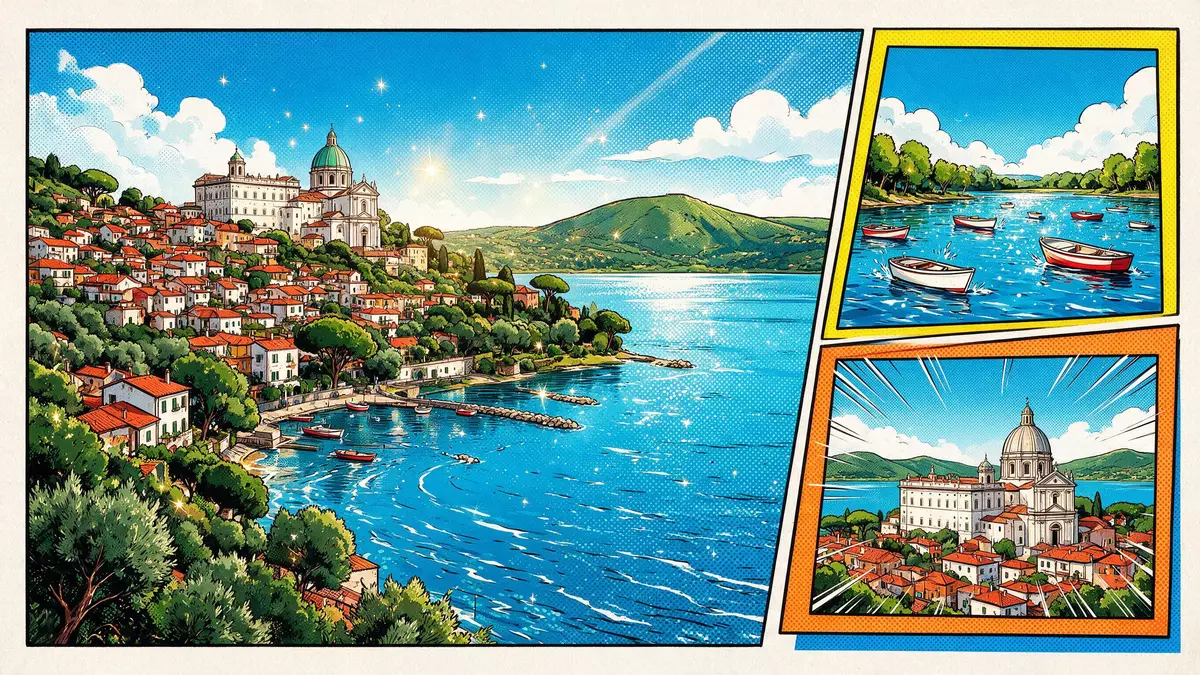
Castel Gandolfo is a compact hill town in Lazio, perched above Lake Albano in the Alban Hills south of Rome, where a cluster of papal villas crowns the volcanic rim. The Apostolic Palace and its expansive gardens give this small settlement a double identity: part Italian village, part extraterritorial seat of the Holy See, shaped by centuries of papal summers.
Lake, crater and hill town
Castel Gandolfo occupies a height on the Alban Hills, a volcanic area in central Italy whose softened crater slopes descend towards the countryside of Lazio.The village stands above Lake Albano, a deep crater lake that curves below the town’s terraces and viewpoints.The surrounding slopes form part of the Alban Hills and frame the settlement in layered greenery.
The town belongs to the Castelli Romani, a group of hill communities south-east of Rome arranged around volcanic basins and ridges.This regional landscape is protected as the Parco Regionale dei Castelli Romani, which encompasses the wooded ridges around Castel Gandolfo and the shores of Lake Albano.Within this setting the town’s historic streets and terraces cling to the hillside, giving long views across the lake and towards the plain beyond.
Papal palaces in a small Italian town
Within the boundaries of Castel Gandolfo lies the Apostolic Palace, also known as the Papal Palace, which developed in the seventeenth century as a summer residence for the popes.Pope Urban VIII Barberini ordered the construction of the Pontifical Palace between 1624 and 1626, with Carlo Maderno as the principal architect and Gian Lorenzo Bernini contributing to later phases.Over time the palace became the best known papal retreat outside Rome, its façades looking towards the lake and the surrounding countryside.
The Pontifical Villas of Castel Gandolfo extend beyond the palace itself to include Villa Barberini and Villa Cybo, linked within a single estate that covers more than 55 hectares (about 135 acres).These villas form a complex of residences and formal gardens, combining terraces, avenues, planted slopes and archaeological remains.The estate lies on ground overlooking Lake Albano and retains its status as property of the Holy See, giving this part of the town a distinct legal and administrative character.
Gardens, archaeology and a working observatory
The grounds of the papal villas follow the contours of the volcanic ridge, weaving formal parterres together with woodland, orchards and archaeological clearings where traces of earlier Roman occupation emerge between cypresses and stone walls.Visitors encounter long axial paths, clipped hedges and vistas that align with the lake and the distant plain, as well as areas where excavated masonry recalls the imperial villa of the emperor Domitian.Within the wider territory of Castel Gandolfo lie further archaeological sites, including the Emissario del Lago Albano and remains linked to Domitian’s Albanum.
The town also has a collegiate church dedicated to St Thomas of Villanova on its main square, designed by Gian Lorenzo Bernini in the seventeenth century with a clear, centralised plan and a restrained façade facing Piazza della Libertà.Nearby stands an astronomical observatory associated with the Vatican Observatory, continuing a scientific presence in the area that reflects the long-standing papal use of Castel Gandolfo.Together, the gardens, the papal residences and the church give the town a dense concentration of religious and scientific institutions within a relatively small footprint.
Visiting Castel Gandolfo: what travellers from Western Europe should know
- Castel Gandolfo lies south-east of Rome in central Italy, on the Alban Hills above Lake Albano, and is reached by regional rail or road connections passing through the Castelli Romani towns.
- The historic centre stands on a hilltop, with streets linked by sloping lanes and stairways, and approaches to the papal villas and viewpoints involving gradients and paved paths.
- The official language is Italian and the currency is the euro.
- Entry requirements depend on your nationality; UK travellers can check the FCDO travel advice at gov.uk/foreign-travel-advice, Irish travellers the Department of Foreign Affairs at ireland.ie.
Searching for Castel Gandolfo on social platforms
These links open searches for Castel Gandolfo on each platform.Frequently asked questions about Castel Gandolfo
Where is Castel Gandolfo located?
Castel Gandolfo stands in the Lazio region of Italy, about 25 km (16 mi) south-east of Rome, on a hill overlooking Lake Albano in the Alban Hills.
What can visitors expect in Castel Gandolfo?
Visitors encounter a compact historic town centre, the Apostolic Palace and papal villas, formal gardens on the volcanic ridge and wide views over the crater lake below.
What makes Castel Gandolfo distinctive?
The combination of papal residences, a working Vatican Observatory and a lakeside volcanic landscape in a small Italian hill town gives Castel Gandolfo a character found in few other places.


