
Castel Sant'Angelo, from imperial tomb to riverside fortress
Published on 09/19/2026 at 16:13 | Editorial responsibility: Rafael Müller, Editor-in-Chief AD HOC NEWS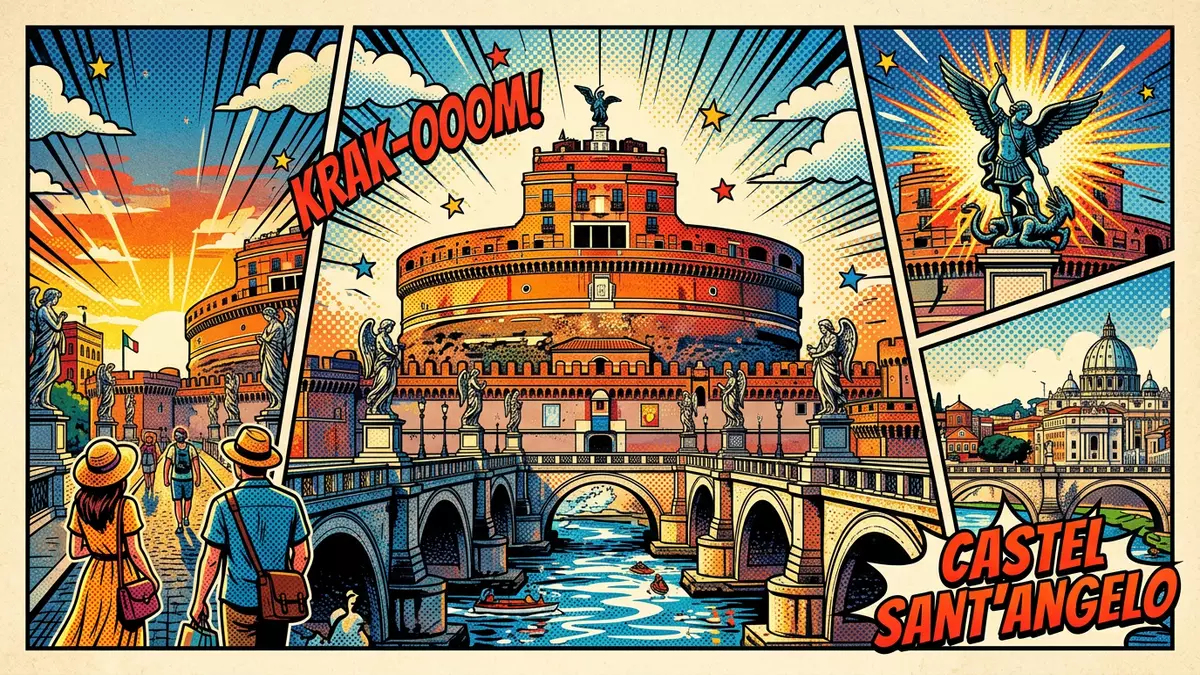
Castel Sant'Angelo in Rom is a fortress, former mausoleum and museum that condenses nearly two millennia of Roman history into a single cylindrical mass on the right bank of the Tiber.
From Hadrian’s mausoleum to papal stronghold
Castel Sant'Angelo began life as the mausoleum of Emperor Hadrian, conceived as a dynastic tomb for himself and his family in the second century AD.Emperor Hadrian’s mausoleum Construction is dated to the reign of Hadrian in the 130s AD, with completion under his successor Antoninus Pius.built in ad 135–139 In its original form the monument combined a powerful square base with a towering circular drum, creating a hybrid of cube and cylinder that still shapes the silhouette seen from the river embankment.a circle surrounded by a square
The mausoleum stood in a then suburban area known as Ager Vaticanus, linked to the city by Pons Aelius, the bridge now called Ponte Sant'Angelo.Ager Vaticanus Over the following centuries Rome’s rulers incorporated the tomb into the defensive system of the city, thickening its walls and reshaping it as a fortress controlling the river crossing and the approach to the Vatican area.converted into a fortress in the 5th century By the late Middle Ages and Renaissance, popes had adapted the interior for use as a residence and stronghold, decorating suites with frescoes and stucco work while maintaining courtyards, storage spaces and prison cells within the same complex.papal residence and prison
The layered architecture above the Tiber
Seen from the river, Castel Sant'Angelo presents a compact mass of brick and stone rising above the embankment, its cylindrical upper level resting on a broad square podium with bastions at the corners.lofty cylinder containing halls The lower parts reflect Roman construction techniques and materials, while the outer defences carry the imprint of medieval and Renaissance military architecture in their battlements and angular outworks.medieval military architecture Higher up, later additions include terraces and parapets, culminating in a rooftop platform that gives wide views over Rom, the Tiber and the dome of St Peter’s Basilica.
Inside the circular core lie a sequence of halls, chapels, apartments and courtyards arranged around the original burial axis of Hadrian’s tomb.halls, chapels, apartments Visitors move between the masonry of the Roman mausoleum and the decorated rooms created for papal use, where painted ceilings, stucco ornament and armorial symbols overlay the older structure.sumptuous rooms were decorated Elsewhere, utilitarian spaces such as storerooms and former cells show the building’s role as a citadel and prison, underlining how many different functions have been contained within the same cylindrical envelope.
Bridge, legend and museum life
Ponte Sant'Angelo is integral to Castel Sant'Angelo, carrying pedestrians across the Tiber directly towards the fortress and onwards to the Vatican quarter.Roman bridge in Rome The bridge, built under Hadrian and completed about 135 CE, rests on stone piers and spans the river in a series of arches, forming a processional route whose alignment still frames views of the castle’s mass.built over the Tiber River In the sixth century both bridge and tomb took on the name Sant'Angelo, linked to a story of an angel appearing above the monument during a plague, a legend that ties the massive stone structure to the figure of Michael the Archangel.name Sant'Angelo
Castel Sant'Angelo is now a state museum holding artworks, historic weapons and architectural fragments within its layered spaces.state museum Exhibits are integrated into rooms that themselves belong to different periods, from ancient Roman masonry to Renaissance decoration, so a visit combines object displays with an exploration of the structure of the building. The upper terrace has become one of Rom’s notable viewpoints over the Tiber and the historic centre, reinforcing the castle’s role not only as a monument to Hadrian and papal power but also as a vantage point within the cityscape.
Visiting Castel Sant'Angelo: what travellers from Western Europe should know
- Castel Sant'Angelo stands on the right bank of the Tiber in Rom, close to Ponte Sant'Angelo and within walking distance of St Peter’s Basilica.
- The approach from the riverside involves slopes and flights of stone steps, and movement inside the fortress includes stairways and corridors over several levels.
- The official language is Italian and the currency is the euro.
Searching for Castel Sant'Angelo on social platforms
These links open searches for Castel Sant'Angelo on each platform.
Frequently asked questions about Castel Sant'Angelo
Where is Castel Sant'Angelo in Rom?
Castel Sant'Angelo stands on the right bank of the Tiber River in Rom, close to Ponte Sant'Angelo and near the Vatican district.
What should visitors expect inside the fortress?
Visitors encounter masonry from Hadrian’s mausoleum, fortified courtyards, decorated papal apartments, museum galleries and a rooftop terrace with broad city views.
What makes Castel Sant'Angelo distinctive among Rom’s monuments?
Its combination of imperial tomb, fortress, papal residence and museum within a single cube-and-cylinder structure gives Castel Sant'Angelo an unusually layered architectural character.


