
Castello di Miramare and its white fortress above the Adriatic
Published on 08/19/2026 at 17:25 | Editorial responsibility: Rafael Müller, Editor-in-Chief AD HOC NEWS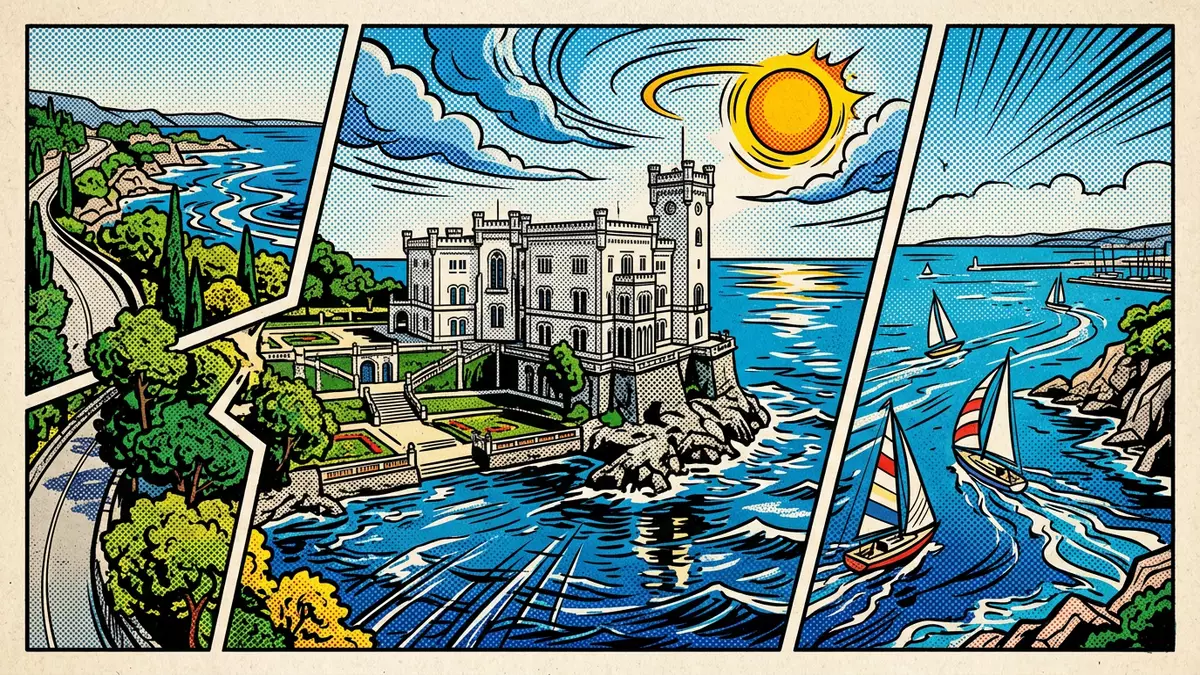
Castello di Miramare is a 19th?century seaside residence on the Gulf of Triest, built for Archduke Maximilian of Habsburg and Princess Charlotte of Belgium as a coastal retreat above the Adriatic.Miramare Castle Its pale Istrian stone walls, formal interiors and landscaped park create a single composition where architecture and sea face each other across a rocky promontory.
A white castle on a karst promontory
Castello di Miramare stands on the Grignano promontory north of Triest, on a karst outcrop that drops to the Gulf of Triest and offers long views along the Adriatic shoreline.the promontory of Grignano The castle and its terraces are arranged directly above the water, so that stone parapets, planted slopes and the sea form a continuous edge around the headland.
The building was constructed between 1856 and 1860 for Archduke Maximilian of Habsburg, the younger brother of Emperor Franz Joseph I, who later became Emperor of Mexico.built between 1856 and 1860 Designed by the Austrian engineer Carl Junker in an eclectic historicist style, it combines elements of a fortified residence with large windows, balconies and loggias that face the sea.
Habsburg residence turned state museum
Maximilian and Charlotte moved into Castello di Miramare in December 1860, using its first floor as a private residence while finishing works continued on the upper level.moved into the castle on the first floor Inside, visitors encounter suites furnished in mid?19th?century style, with panelled walls, maritime?themed rooms and a throne room preserved with original fittings from the Habsburg period.now a museum with original furnishings
After Maximilian’s death in 1867 in Mexico and Charlotte’s return to Belgium, Miramare hosted members of the Habsburg family for short stays, and the complex later passed to the Italian state following the end of the First World War.came under Italian government control In the 1930s it became the residence of Amedeo of Savoy?Aosta, and in the mid?20th century it was organised as a state museum, with rooms arranged to present both the Habsburg era and the later 20th?century adaptations.
Gardens between karst rock and Adriatic water
The park of Castello di Miramare covers a wide area around the castle, laid out with paths, terraces and planted slopes that descend towards the sea over former bare rock.ventidue ettari di splendido verde Trees, lawns and ornamental beds frame views to the castle, while stone stairways and balustrades lead down towards small harbours and piers on the shoreline.
The planting mixes evergreens with species introduced during the 19th century, arranged to create shaded walks and open clearings around the residence.the large park From many points within the park the white mass of the castle appears between trees with the Gulf of Triest behind it, underlining the way the ensemble ties together rock, vegetation, architecture and sea.
Visiting Castello di Miramare: what travellers from Western Europe should know
- Castello di Miramare stands on Viale Miramare, around the Grignano area north?west of central Triest, and is reached by coastal roads and local public transport that follow the Gulf of Triest.located about 8 km northwest of the city
- The castle and park occupy a rocky headland above the sea, with paths, stairways and gentle slopes; visiting involves walking on uneven surfaces and climbing exterior steps between terraces.
- The official language is Italian and the currency is the euro.
- Entry requirements depend on your nationality; UK travellers can check the FCDO travel advice at gov.uk/foreign-travel-advice, Irish travellers the Department of Foreign Affairs at ireland.ie.
Searching for Castello di Miramare on social platforms
These links open searches for Castello di Miramare on each platform.
Frequently asked questions about Castello di Miramare
Where is Castello di Miramare?
Castello di Miramare stands on the Gulf of Triest in north?eastern Italy, on the Grignano promontory north?west of the centre of Triest.
What can visitors expect inside Castello di Miramare?
Visitors walk through 19th?century halls furnished in Habsburg style, including Maximilian’s private rooms, formal reception spaces and a throne room preserved with historical interiors.
What makes Castello di Miramare distinctive among Adriatic residences?
Its combination of white Istrian stone architecture, a landscaped park and a position directly above the Adriatic gives Castello di Miramare a striking coastal profile near Triest.


