
Castello di Miramare and its white stone above Triest
Published on 09/24/2026 at 11:46 | Editorial responsibility: Rafael Müller, Editor-in-Chief AD HOC NEWS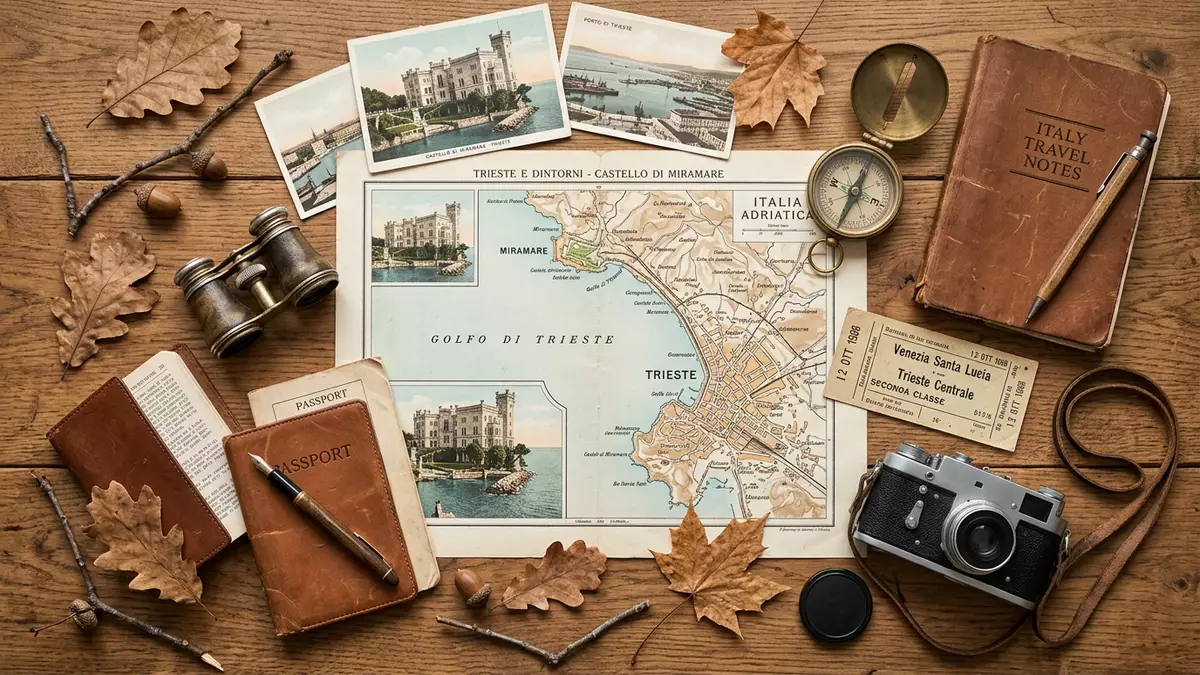
Castello di Miramare stands on the Adriatic coast near Triest as a residence of pale Istrian stone, surrounded by formal gardens and open sea. Built for Archduke Maximilian of Habsburg and Charlotte of Belgium between 1856 and 1860, it joins a compact palace with a coastal landscape.
Castello di Miramare on the Adriatic coast
The castle occupies the Miramare promontory at Grignano, north-west of Triest. Its position places the building directly beside the Gulf of Triest, with the shoreline forming part of the setting rather than a distant view.
Its exterior uses Istrian stone and an eclectic architectural language. Gothic, medieval and Renaissance references appear together in towers, battlements, framed openings and carefully ordered façades. The building is a nineteenth-century residence, not a medieval fortress, although its external vocabulary recalls fortified architecture.
The castle and park belong to the Museo Storico e Parco del Castello di Miramare. The grounds include paths, lawns, trees, sculptures and water features around the main residence. The nearby Castelletto and service buildings form part of the wider complex.
Maximilian, Charlotte and a nineteenth-century residence
Archduke Maximilian of Habsburg commissioned the residence in the mid-nineteenth century. The foundation stone was laid on 1 March 1856, and the main construction period ran from 1856 to 1860. Austrian engineer Carl Junker designed the castle.
Maximilian lived at Miramare with Charlotte of Belgium, whom he married in 1857. Their connection with the castle belongs to the brief period before Maximilian accepted the Mexican crown in 1864. He became Emperor of Mexico, while Charlotte became Empress Carlota.
The palace records this domestic and imperial history through its rooms, furnishings and decorative schemes. Private apartments, reception rooms and working spaces are arranged within the residence. The interiors remain closely connected to the people who commissioned and inhabited the building.
Maximilian was executed in Querétaro in 1867. Charlotte survived him by many decades, while Miramare continued as a Habsburg residence before entering the Italian state heritage system.
Rooms, park and the language of eclectic architecture
The interior presents a sequence of rooms with different functions and decorative moods. State rooms carry formal decoration, while private rooms are smaller in scale and more domestic. Wood, textiles, carved details and historic furnishings appear throughout the palace.
The building’s eclecticism is visible in the combination of references rather than in a single uniform style. The same residence can recall a medieval castle, a Gothic country house and a Renaissance palace. Its pale stone exterior gives these varied forms a coherent material character.
The park extends around the palace with planted areas, ornamental features and routes beside the coast. The landscape includes Mediterranean vegetation alongside trees from other regions. The relationship between the white building, dark foliage and blue water remains central to the visual identity of Miramare.
The Torretta, Castelletto and other structures add smaller architectural accents around the main palace. Together they create a residential ensemble rather than an isolated building. The sea-facing position, Istrian stone and eclectic details remain visible through every part of the complex.
Visiting Castello di Miramare: what travellers from Western Europe should know
- Castello di Miramare lies at Viale Miramare 349, in Grignano on the coast north-west of Triest. Local buses connect the site with the city, and the Trieste railway network provides access to the wider area.
- The estate combines palace interiors with park paths, planted ground and coastal viewpoints. Comfortable walking shoes are useful because the visit includes outdoor routes as well as rooms inside the residence.
- The official language is Italian and the currency is the euro.
- The castle stands beside the Gulf of Triest, while the railway and road corridor runs between the city and the Miramare promontory.
Searching for Castello di Miramare on social platforms
These links open searches for Castello di Miramare on each platform.
Frequently asked questions about Castello di Miramare
Where is Castello di Miramare?
Castello di Miramare is on the Miramare promontory at Grignano, on the Adriatic coast north-west of Triest. Its address is Viale Miramare 349.
What can visitors expect at the castle?
The visit combines furnished nineteenth-century rooms with a surrounding park, coastal paths, sculptures and views across the Gulf of Triest.
What makes Castello di Miramare distinctive?
Its identity comes from the meeting of Istrian stone, eclectic architecture, Habsburg history and a seaside setting. Carl Junker designed the residence for Maximilian of Habsburg and Charlotte of Belgium between 1856 and 1860.


