
Castelvecchio in Verona where medieval walls meet Scarpa’s museum
Published on 09/24/2026 at 09:31 | Editorial responsibility: Rafael Müller, Editor-in-Chief AD HOC NEWS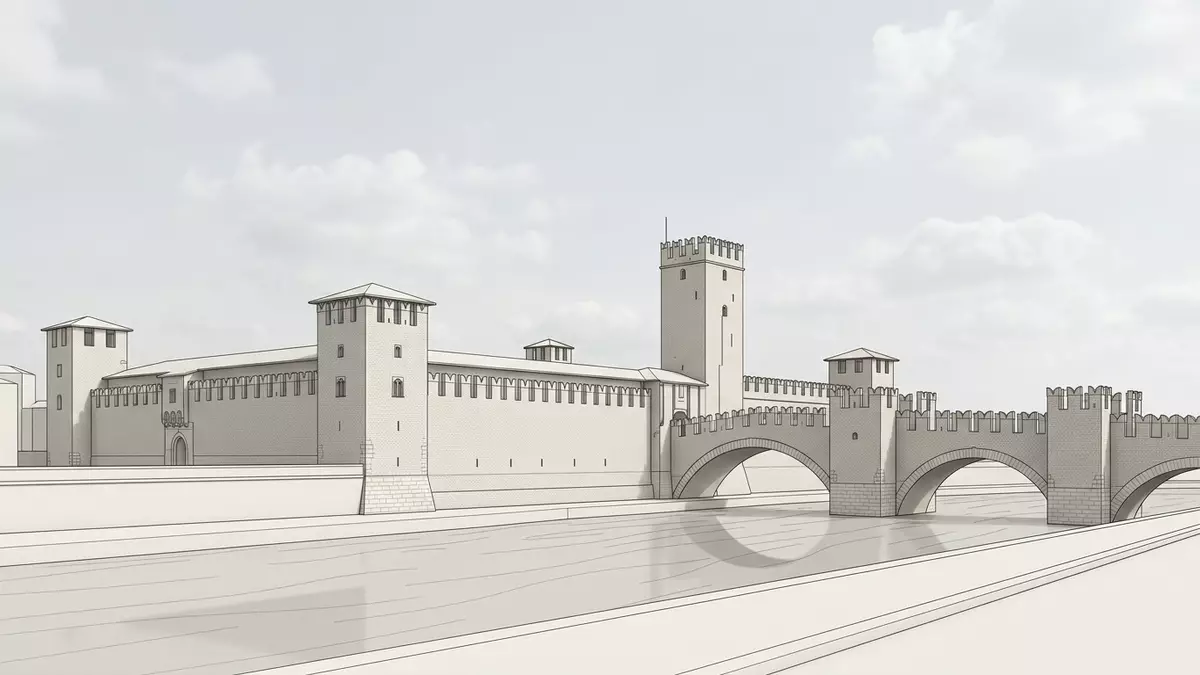
Castelvecchio is a medieval fortress in Verona whose rough defensive walls contain a carefully composed museum. The building joins the military architecture of Cangrande II della Scala with Carlo Scarpa’s twentieth-century arrangement of galleries, courtyards and objects.
Castelvecchio’s fortress form beside the Adige
Construction began in 1354 under Cangrande II della Scala, a ruler of the Scaliger dynasty. The complex took shape beside the Adige, with fortified buildings, towers and a bridge connecting the castle to the opposite bank.
The castle’s military character remains legible in its masonry, battlements, enclosed spaces and tall mastio. The complex was completed in 1376, when the highest tower was finished. Its fabric belongs to the fourteenth-century city of Verona, when the Scaliger court controlled the city.
The fortified bridge, known as Ponte di Castelvecchio or Ponte Scaligero, extends from the castle across the Adige. Its brick structure, stone details and crenellated parapets continue the visual language of the fortress. The bridge is part of Castelvecchio’s identity, not a separate ornamental addition.
From military complex to civic museum
Castelvecchio became a civic museum in the twentieth century. Antonio Avena directed the transformation into an art museum, completed in 1926, and the interiors received a Neo-medieval character.
The collections cover medieval and Renaissance art from Verona and northern Italy. Paintings, sculpture, weapons, ceramics, archaeological material, miniatures, goldsmiths’ work and historic bells appear within the castle’s rooms.
The arrangement places works of art against the surviving architecture. Brick, stone, timber, plaster and metal frames form a visual setting for painted panels, carved figures and devotional objects. The castle functions as both an exhibition building and a historical artefact.
Carlo Scarpa’s detailed museum intervention
In 1958, museum director Licisco Magagnato brought Carlo Scarpa into the project. Scarpa’s restoration and installation work continued through several phases between 1958 and 1974.
Scarpa treated the galleries, stairs, bridges, thresholds and display supports as connected architectural elements. His work uses carefully placed materials, controlled views and sharply defined junctions between old masonry and newer surfaces.
A celebrated example is the presentation of the equestrian statue of Cangrande I della Scala. The sculpture appears at a high point within the castle, separated from the surrounding fabric by Scarpa’s precise framing and circulation route.
The museum also preserves the Carlo Scarpa Archive, containing drawings connected with the intervention. Castelvecchio therefore presents two historical layers together: the Scaliger fortress of the fourteenth century and Scarpa’s post-war museum architecture.
Visiting Castelvecchio: what travellers from Western Europe should know
- Castelvecchio stands at Corso Castelvecchio 2 in central Verona, beside the Adige and the Ponte di Castelvecchio.
- The complex contains uneven historic surfaces, masonry thresholds, stairs and changes between courtyards, towers and galleries.
- The museum’s collections occupy rooms within the former fortress, while the bridge provides a direct architectural connection across the river.
- The official language is Italian and the currency is the euro.
Searching for Castelvecchio on social platforms
These links open searches for Castelvecchio on each platform.Frequently asked questions about Castelvecchio
Where is Castelvecchio?
Castelvecchio is in central Verona, beside the Adige in northern Italy. Its address is Corso Castelvecchio 2.
What can visitors expect inside?
The museum presents medieval and Renaissance paintings, sculpture, weapons, ceramics, archaeological objects and decorative arts within the former fortress.
What makes Castelvecchio distinctive?
The castle combines Scaliger military architecture with Carlo Scarpa’s carefully detailed museum intervention. The Ponte di Castelvecchio extends the complex across the Adige.


