
Catedral de Leon and its white rooftop over León
Published on 08/15/2026 at 14:38 | Editorial responsibility: Rafael Müller, Editor-in-Chief AD HOC NEWS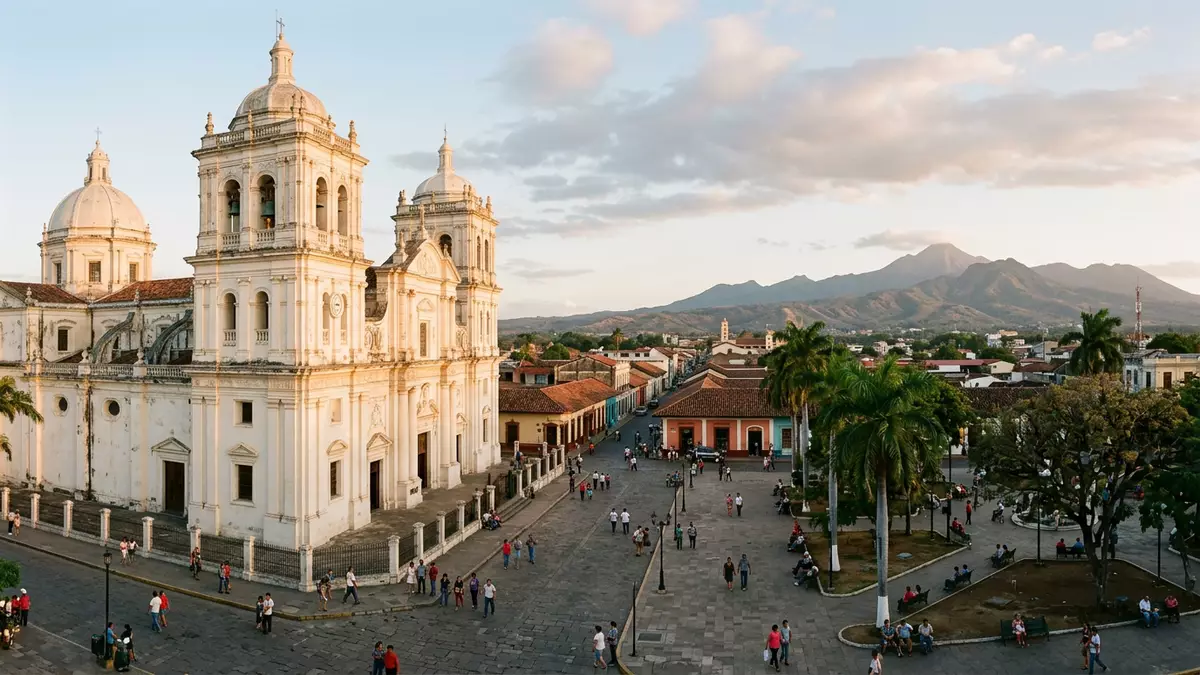
Catedral de Leon in León, Nicaragua, rises above the city with a pale, fortress-like mass and a rooftop that opens wide views across the urban grid and distant volcanoes. Officially named the Cathedral of the Assumption of Mary, it anchors the main square and summarises centuries of Central American religious architecture in one building.
A cathedral between Baroque and Neoclassical worlds
The full Spanish title of Catedral de Leon, “Real e Insigne Basílica Catedral de la Asunción de la Bienaventurada Virgen María”, underlines its status as the principal Roman Catholic church of León and the seat of the local diocese.Cathedral of the Assumption of Mary Construction of the present cathedral began in 1747 and continued into the early nineteenth century, reflecting the long reach of Spanish colonial rule in Nicaragua.Constructed between 1747 and the early 19th century Its design is attributed to the Guatemalan architect Diego José de Porres Esquivel, whose plan brought ideas from Antigua Guatemala to this trading city on the Nicaraguan plains.Diego José de Porres Esquivel
From outside, Catedral de Leon reads as a transitional structure between late Baroque exuberance and the cleaner lines of Neoclassicism, with a relatively plain façade, stout towers and restrained ornament picked out in pale plaster and stone.Transition from Baroque to Neoclassical architecture The building’s ground plan follows a basilica-style rectangle that echoes Spanish models yet is adjusted to Central American proportions, giving it a broad, horizontal emphasis rather than a steep vertical thrust.Basilica rectangular layout with regional proportions Thick masonry walls and substantial corner towers provide a sense of mass and permanence against the low surrounding cityscape.
Interior light, artworks and crypts
Stepping inside Catedral de Leon brings a shift from the heavy exterior to a spacious hall of pale vaults and controlled daylight. The nave and aisles form a long interior, over 100 m (about 330 ft) in length, broken by arcades and supported by solid piers.It is 105,83 m long by 57,13 m wide The decoration is relatively sober for a cathedral of this scale, with white or lightly coloured surfaces that set off the altars, paintings and sculptural details.
The most notable piece within the cathedral is a wooden Flemish altarpiece, an intricate carved work that links León with transatlantic trade and artistic exchange between Europe and Central America.Wooden Flemish altarpiece Along the walls are paintings depicting the fourteen Stations of the Cross, created by Nicaraguan artist Antonio Sarria around the turn of the twentieth century, which add a local voice to the building’s devotional art.Paintings of the 14 stations of the Way of the Cross by Antonio Sarria Below the main floor, crypts hold the graves of local bishops and prominent Nicaraguan figures, tying national history into the cathedral’s fabric.
A UNESCO-listed landmark above a Nicaraguan square
Catedral de Leon stands on the edge of the central square of León, framed by arcaded civic buildings and the regular pattern of streets that radiate from the plaza.Located in the heart of the Nicaraguan city of León In 2011 the cathedral was inscribed on the UNESCO World Heritage List as a cultural property, recognised for its architectural synthesis and its role in the development of a distinct Central American ecclesiastical style.León Cathedral World Heritage listing This status underlines both its artistic value and its importance in the history of Nicaragua’s colonial and republican periods.
For visitors, one of the defining experiences of Catedral de Leon is access to its rooftop, reached via interior stairways that emerge onto a bright expanse of domes and walkways. From there, the view takes in the gridded streets of León and a chain of volcanic cones on the horizon, placing the white masses of the cathedral in a wider volcanic landscape. The contrast between the quiet upper platforms and the busy square below emphasises the building’s dual role as both a working parish church and a landmark for the city as a whole.
Visiting Catedral de Leon: what travellers from Western Europe should know
- Catedral de Leon stands on the main square of León in western Nicaragua, directly facing the central park that forms the heart of the city.
- The cathedral’s interior includes long aisles and a series of chapels, and reaching the rooftop involves climbing stairways that include narrow flights and enclosed sections.
- León lies on the Pacific side of Nicaragua, and Catedral de Leon forms part of a compact historic centre that also includes churches, markets and museums within walking distance.
- The official language is Spanish and the currency is the Nicaraguan córdoba.
- Entry requirements depend on your nationality; UK travellers can check the FCDO travel advice at gov.uk/foreign-travel-advice, Irish travellers the Department of Foreign Affairs at ireland.ie.
Searching for Catedral de Leon on social platforms
These links open searches for Catedral de Leon on each platform.
Frequently asked questions about Catedral de Leon
Where is Catedral de Leon located?
Catedral de Leon stands beside the main square of León in western Nicaragua, in the country’s Pacific lowlands.
What can visitors expect inside Catedral de Leon?
The interior offers a long nave and aisles with restrained decoration, a Flemish wooden altarpiece and paintings of the fourteen Stations of the Cross by Antonio Sarria.
What makes Catedral de Leon distinctive among Central American churches?
Catedral de Leon combines late Baroque and Neoclassical architecture in a single large structure, holds UNESCO World Heritage status and provides extensive rooftop views over León and nearby volcanoes.


