
Catedral de Puebla and its dark stone silhouette over the zócalo
Published on 09/21/2026 at 08:11 | Editorial responsibility: Rafael Müller, Editor-in-Chief AD HOC NEWS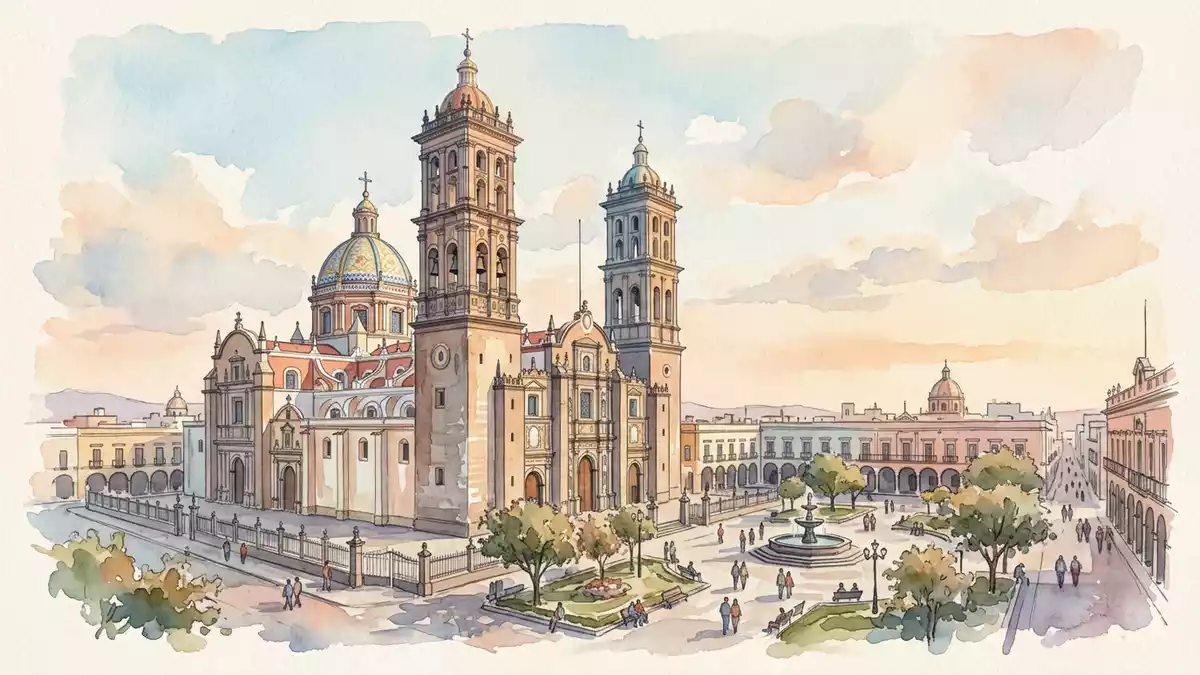
Catedral de Puebla in central Mexico rises in dark volcanic stone along the southern edge of Puebla’s main square, combining Renaissance order with Baroque height in one dominant urban silhouette. Built as the episcopal seat of the Archdiocese of Puebla de los Ángeles and dedicated to Our Lady of the Immaculate Conception, it grew between the sixteenth and eighteenth centuries into one of the main colonial churches of New Spain.
A cathedral that occupies an entire city block
Catedral de Puebla stands in the historic centre of Puebla, capital of the state of Puebla, occupying the full block immediately south of the city’s zócalo, the principal plaza laid out in the colonial period.Occupies the entire block south of the zócalo Its long north elevation faces the square across a paved frontage, while the principal doorway opens towards Avenida 16 de Septiembre, the east–west street that runs along the cathedral’s southern side.Av. 16 de Septiembre in the Centro Histórico
The building’s plan forms a vast basilica occupying an entire manzana, bounded by city streets on all sides and forming a clear rectangular mass in the urban fabric.The cathedral occupies the full block between surrounding streets This setting places the cathedral at the centre of Puebla’s UNESCO-listed historic core, surrounded by arcaded commercial buildings, civic structures and smaller churches that reflect the city’s long role as a colonial and later republican hub.
From sixteenth-century foundations to a seventeenth-century consecration
The present Catedral de Puebla stands on foundations first laid in the second half of the sixteenth century, when plans for a larger episcopal church were drawn up for the growing city.Work on a more imposing cathedral began in 1575 Architectural records name Francisco Becerra, an emigrant architect from Trujillo in Spain, as maestro mayor of the project in 1575, giving the building a link to Iberian design practice of the late Renaissance.Francisco Becerra as maestro mayor from 1575
The main body of the cathedral rose through the later sixteenth century and into the seventeenth, with consecration recorded in 1649 under Bishop Juan de Palafox y Mendoza, by which time the core structure was in place.Consecrated in 1649 under Bishop Juan de Palafox y Mendoza Work on towers and interior fittings continued into the eighteenth century, reflecting a long construction history that followed changes in taste from late Renaissance sobriety towards fuller Baroque expression.
Dark stone, Renaissance order and Baroque towers
The exterior of Catedral de Puebla is characterised by dark, dense stone walls that give the building a pronounced horizontal emphasis, anchoring it in the surrounding urban grid. Architectural historians describe its main façades as a blend of Herreresque Renaissance forms, with clear classical orders and rectilinear organisation, combined with Baroque height and ornament concentrated in towers and portal surrounds.Blend of Herreresque Renaissance and early Baroque styles
The cathedral is also known formally as the Basilica Cathedral of Puebla and the Cathedral of Our Lady of the Immaculate Conception, reflecting its Marian dedication and its status as episcopal seat.Episcopal seat dedicated to Our Lady of the Immaculate Conception Its mass and floor area place it among the largest cathedrals in Mexico, with sources noting it as second only to Mexico City’s cathedral in scale.Described as the second largest cathedral in Mexico Within, the high nave, side aisles, choir and chapels are framed by stone piers and vaults that follow the longitudinal plan typical of major Iberian and colonial cathedrals.
Visiting Catedral de Puebla: what travellers from Western Europe should know
- Catedral de Puebla stands along Avenida 16 de Septiembre beside Puebla’s zócalo in the historic centre of Puebla, in the Mexican state of Puebla in central Mexico.
- The approach from the zócalo crosses a broad paved frontage, and the interior is reached through substantial stone portals followed by aisles and chapels laid out along the nave.
- The cathedral forms part of the wider historic centre of Puebla, a UNESCO World Heritage city where streets of colonial houses and arcaded plazas extend around the church.
- The official language is Spanish and the currency is the Mexican peso.
- Entry requirements depend on your nationality; UK travellers can check the FCDO travel advice at gov.uk/foreign-travel-advice, Irish travellers the Department of Foreign Affairs at ireland.ie.
Searching for Catedral de Puebla on social platforms
These links open searches for Catedral de Puebla on each platform.
Frequently asked questions about Catedral de Puebla
Where is Catedral de Puebla located within the city?
Catedral de Puebla stands beside the zócalo in the historic centre of Puebla, along Avenida 16 de Septiembre in the Mexican state of Puebla.
What can visitors expect inside Catedral de Puebla?
Visitors encounter a large basilica interior with a high nave, aisles, choir and chapels framed by dark stone piers and vaults in a blend of Renaissance and Baroque styles.
What makes Catedral de Puebla distinctive among Mexican cathedrals?
Its dark volcanic stone, Renaissance ordering of façades, Baroque towers, long construction history from the sixteenth to eighteenth centuries and status as one of Mexico’s largest cathedrals make it distinctive.


