
Catedral de Puebla and its towering stone silhouette
Published on 08/14/2026 at 15:00 | Editorial responsibility: Rafael Müller, Editor-in-Chief AD HOC NEWS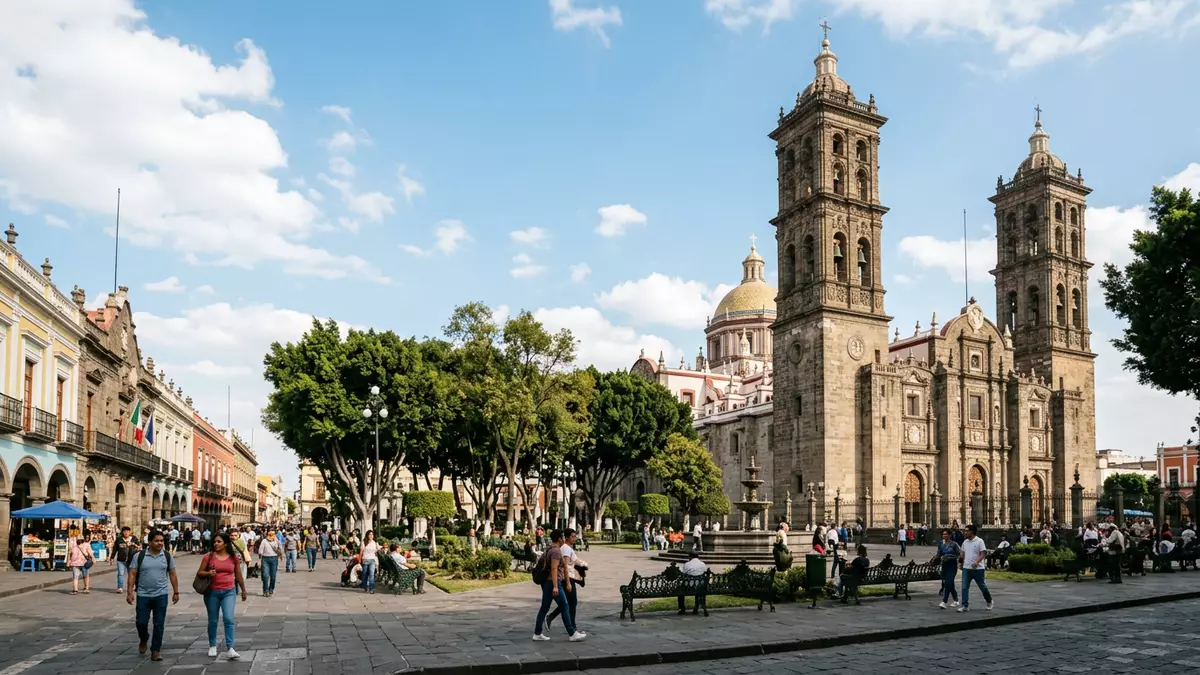
Catedral de Puebla dominates the historic centre of Puebla as a vast stone basilica whose towers and interior chapels embody centuries of Mexican Baroque craftsmanship and devotion. Built between the late sixteenth and seventeenth centuries and consecrated in 1649, it serves as the episcopal seat of the Archdiocese of Puebla de los Ángeles and anchors the main square of this colonial city.
A cathedral wrapped around Puebla’s main square
Catedral de Puebla stands on the southern edge of Puebla’s zócalo, occupying an entire city block beside the central plaza that forms the heart of the historic centre.occupies the entire block south of the zócalo The basilica faces important city streets such as Avenida 16 de Septiembre, with side doors opening towards the square so that the cathedral’s stone mass and towers are a constant presence in everyday life.Catedral de Puebla, Calle 16 de Septiembre
The cathedral’s footprint follows a basilican plan, with a long central nave and flanking side aisles forming a rectangle of substantial length and width.dimensions are 50 x 98 metres Inside, thick masonry walls and a sequence of vaults mark out the main nave and processional aisles, while lateral chapels and sacristy spaces extend the building’s volume beyond what is visible from the square.
From sixteenth-century foundation to seventeenth-century consecration
The origins of Catedral de Puebla lie in a more modest church built between 1536 and 1539 under Bishop Julián Garcés of Tlaxcala, reflecting the early years of Spanish settlement in the region.between 1536 and 1539 As the city grew, authorities ordered a larger temple and in 1575 commissioned architect Francisco Becerra to design and oversee a new cathedral structure, beginning a long building phase that extended through the early seventeenth century.constructed intermittently from 1575
In 1634, the design was reworked by Juan Gómez de Trasmonte, master architect of Mexico City’s metropolitan cathedral, giving Puebla’s cathedral a more classical appearance and a clear basilican layout aligned with contemporary church design.made an adjustment to the project, giving it a more classic appearance The building was completed under Bishop Juan de Palafox y Mendoza, with consecration taking place on 18 April 1649, a date now firmly tied to the cathedral’s finished form and its dedication to the Immaculate Conception.Year consecrated 18 April 1649
Stone towers, Baroque chapels and a basilica interior
Catedral de Puebla is constructed in masonry with a dark stone exterior that gives the building a severe, monumental presence against the lighter façades of the surrounding colonial streets.Baroque style cathedral Its architecture combines Herreresque Renaissance elements with early Baroque detailing, a blend visible in the spare lines of the main façade and the richer ornamentation that frames doors, windows and sculptural niches along its elevations.blend of severe Herreresque-Renaissance and early baroque styles
The cathedral’s two stone towers rise above the corners of the west front, housing bells and forming vertical markers that are among the tallest ecclesiastical structures in Mexico.second largest cathedral in size in the country Inside, the nave and aisles are covered by a series of vaults and domes, including two principal cupolas, creating a high, rhythmically articulated ceiling above an interior rich in gilded retablos, frescoes and side chapels that display an extensive collection of sacred art.
Visiting Catedral de Puebla: what travellers from Western Europe should know
- Catedral de Puebla stands beside Puebla’s main square, the zócalo, with entrances on streets such as Avenida 16 de Septiembre; it is reached on foot from the surrounding historic centre.
- The interior is organised around a long central nave with side aisles and chapels, so a visit involves walking along stone floors and through narrower passageways between the chapels and altars.
- Puebla lies in central Mexico at altitude, and the cathedral’s towers rise above the surrounding urban fabric, so views of the building from the square and nearby streets include substantial height and flights of steps.
- The official language is Spanish and the currency is the Mexican peso.
- Entry requirements depend on your nationality; UK travellers can check the FCDO travel advice at gov.uk/foreign-travel-advice, Irish travellers the Department of Foreign Affairs at ireland.ie.
Searching for Catedral de Puebla on social platforms
These links open searches for Catedral de Puebla on each platform.
Frequently asked questions about Catedral de Puebla
Where is Catedral de Puebla located in the city?
Catedral de Puebla is situated beside the zócalo in Puebla’s historic centre, occupying the block along streets such as Avenida 16 de Septiembre.
What can visitors expect inside the cathedral?
Visitors encounter a basilica interior with a long central nave, flanking aisles, multiple chapels, vaults and domes, alongside retablos, frescoes and other sacred artworks.
What makes Catedral de Puebla distinctive among Mexican cathedrals?
Catedral de Puebla is notable for its blend of Renaissance and early Baroque architecture, its tall twin towers and its seventeenth-century basilica plan consecrated in 1649.


