
Catedral de Puebla and its towers above the historic zócalo
Published on 09/19/2026 at 17:20 | Editorial responsibility: Rafael Müller, Editor-in-Chief AD HOC NEWS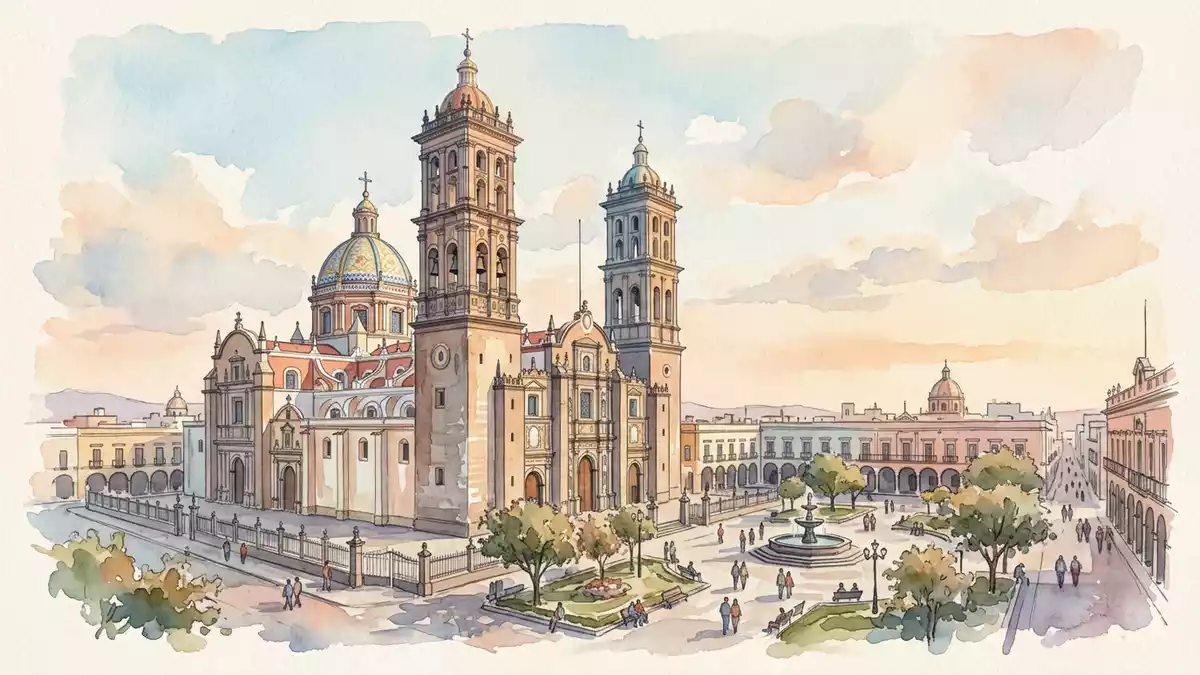
Catedral de Puebla dominates the historic centre of Puebla in central Mexico, its dark stone mass and tall twin towers lining the southern edge of the city’s main square, the zócalo. Built as the episcopal seat of the Archdiocese of Puebla de los Ángeles and dedicated to Our Lady of the Immaculate Conception, it grew from the late sixteenth century into a vast cathedral that combines Renaissance order with Baroque height and ornament.
A colonial cathedral shaped over centuries
The present Catedral de Puebla belongs to the generation of major colonial churches begun in the second half of the sixteenth century, when Puebla emerged as an important city between Mexico City and Veracruz. Construction of the cathedral is documented from 1575, with the Spanish architect Francisco Becerra responsible for the initial design and layout of the new building after an earlier cathedral proved insufficient for the growing diocese.constructed intermittently from 1575 Research on its construction history traces successive phases, beginning with work directed by Becerra and continuing under other master builders as the fabric rose over the later sixteenth and early seventeenth centuries.the construction history from 1575
The cathedral reached a major milestone in 1649, when Bishop Juan de Palafox y Mendoza consecrated the church as the Cathedral of Our Lady of the Immaculate Conception, marking its full status as the seat of the archdiocese.consecrated in 1649 under Bishop Palafox Work, however, continued long after that ceremony. Architectural studies describe later phases through the seventeenth and eighteenth centuries, including the completion of the southern tower in 1768 and subsequent interior remodelling in the nineteenth century under the architect José Manzo, who reworked the high altar area in a style distinct from the earlier Baroque decoration.completion of the south tower in 1768
Renaissance order and Baroque height
Catedral de Puebla is described as a cathedral whose architecture blends Herreresque Renaissance forms with early Baroque elements, reflecting the long span of its construction. The main body follows a clear, ordered plan, with a broad nave, side aisles and chapels arranged in a rectilinear layout typical of Spanish Renaissance church design.blend of Herreresque-Renaissance and early baroque Above this ordered base rise the cathedral’s towers, whose height and detailing belong more to the Baroque era, adding vertical emphasis to the skyline around the zócalo.
The cathedral’s formal name, Basilica Cathedral of Puebla, reflects its double status as diocesan seat and minor basilica, under the Marian dedication of the Immaculate Conception.Cathedral of Our Lady of the Immaculate Conception The towers rise to a height recorded at about 69 m (226 ft), placing them among the tallest church towers in Mexico and giving the building a pronounced vertical profile above the historic centre.towers are Mexico’s tallest Inside, visitors encounter a sequence of side chapels with elaborate altarpieces, frescoes and sculptural details, many of which belong to the seventeenth century, when pictorial ornamentation enriched the earlier structural framework.pictorial ornamentation corresponds to the XVII century
Anchoring Puebla’s UNESCO-listed historic centre
Catedral de Puebla stands on Avenida 16 de Septiembre along the southern edge of Puebla’s zócalo, the main square at the heart of the city’s historic centre. The cathedral occupies an entire block, with its long side facing the square and its principal doorway opening towards the street, while additional entrances give access from the plaza.occupies the entire block south of the zócalo This urban setting has remained central to Puebla’s identity, and the historic centre, including the cathedral, is recognised as a World Heritage Site for its colonial townscape and ensemble of churches.historic center of Puebla declared a World Heritage Site
From the zócalo, the cathedral’s exterior is characterised by dark stone walls, the rhythmic progression of pilasters and windows along its flank, and the rise of the towers above the roofline. The building fronts a broad paved space that separates it from the square’s gardens and arcades, making its mass and detailing visible from many angles around the central district.dark stone towers lining the southern edge of the zócalo Within a short walk lie other colonial churches and civic buildings, but Catedral de Puebla remains a primary reference point, both as a religious centre and as a landmark in the city’s street pattern.
Visiting Catedral de Puebla: what travellers from Western Europe should know
- Catedral de Puebla stands on Avenida 16 de Septiembre beside the zócalo in the historic centre of Puebla, in the state of Puebla in central Mexico. It is reached on foot from the surrounding streets and squares of the colonial centre.
- The terrain around the cathedral is paved and largely level, with broad promenades and steps at some entrances. Inside, movement between the nave and side chapels involves short transitions and occasional steps.
- The official language is Spanish and the currency is the Mexican peso.
- Entry requirements depend on your nationality; UK travellers can check the FCDO travel advice at gov.uk/foreign-travel-advice, Irish travellers the Department of Foreign Affairs at ireland.ie.
Searching for Catedral de Puebla on social platforms
These links open searches for Catedral de Puebla on each platform.
Frequently asked questions about Catedral de Puebla
Where is Catedral de Puebla located?
Catedral de Puebla is in the historic centre of Puebla, in central Mexico, occupying the block south of the zócalo along Avenida 16 de Septiembre.
What can visitors expect inside the cathedral?
Inside, visitors encounter a broad nave, side chapels with elaborate altarpieces and frescoes, and a high altar area reworked in the nineteenth century.
What makes Catedral de Puebla distinctive among Mexican churches?
Its combination of Renaissance layout, Baroque towers, long construction history from 1575 to the eighteenth century and position beside the zócalo gives it a distinctive profile.


