
Catedral de Sal de Zipaquira carved beneath the Andes
Published on 09/23/2026 at 10:47 | Editorial responsibility: Rafael Müller, Editor-in-Chief AD HOC NEWS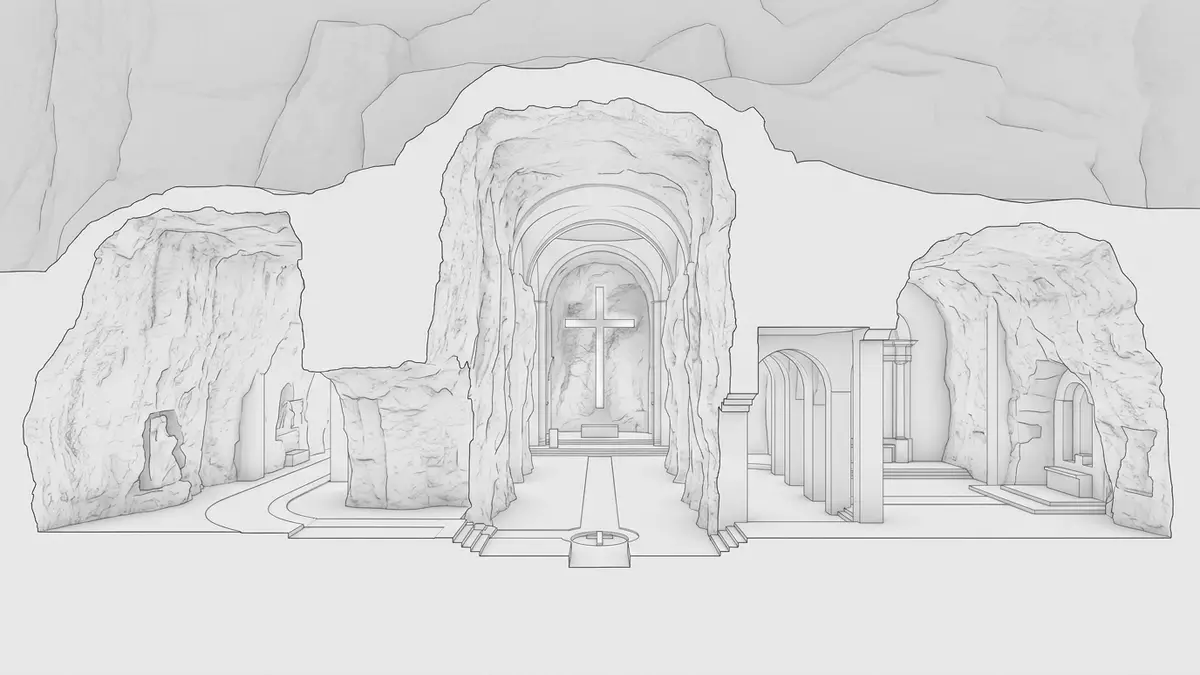
Catedral de Sal de Zipaquira is an underground Roman Catholic sanctuary carved inside a salt mine beneath Zipaquira, Colombia. Its passages, chapels and sculptures occupy chambers about 180 metres (591 ft) below the surface, turning halite into architecture, religious art and geological landscape.
Salt becomes architecture beneath Zipaquira
The cathedral is located in the Cundinamarca department, north of Bogotá, inside the Zipaquira Salt Park. The mine lies in the Eastern Andes, where a prehistoric inland sea left extensive salt deposits beneath layers of earth and rock.
The walls and ceilings retain the pale, irregular character of rock salt. Mine tunnels lead towards devotional spaces containing the Stations of the Cross, carved reliefs and sculptures. A large cross cut into the rock forms the visual focus of the principal chamber, while illuminated surfaces reveal the texture of the halite.
The complex combines an active religious function with the physical vocabulary of mining. There is no conventional exterior church façade underground; the architecture is defined by excavated passageways, broad chambers, carved walls and the material surrounding them.
From miners’ chapel to a 1995 sanctuary
The history of worship inside the mine reaches back to the 1930s, when miners created a small underground sanctuary dedicated to the Virgin of the Rosary of Guasá. A larger church opened in the 1950s, but structural concerns led to its closure in the early 1990s.
The present Catedral de Sal de Zipaquira opened in 1995. Bogotá architect Roswell Garavito Pearl developed the design, with engineering direction from Jorge Enrique Castelblanco Reyes. Their work occupies deeper chambers and includes a sequence of spaces associated with the life of Christ.
The central route includes the Stations of the Cross, followed by three principal naves. These spaces represent the birth, life and death of Christ, with altars and religious sculpture distributed through the underground complex.
The site’s history also reaches beyond the twentieth-century church. The Muisca people extracted and traded salt in the region before Spanish colonisation, and Zipaquira’s deposits remained economically important during the colonial and republican periods.
Three naves, carved figures and mineral light
The interior is a progression from narrow mine passages into larger chambers. Sculptures made from salt and marble appear beside exposed rock, while coloured lighting changes the appearance of the carved surfaces without concealing their mineral origin.
Religious imagery includes the Virgin of Guasá, the Stations of the Cross and a representation of La Piedad. The Guardian Angel, carved by Italian sculptor Ludovico Consorte in 1950, belongs to the artistic history associated with the mine’s earlier sanctuary.
Water appears in reflective installations within the complex. Their surfaces mirror the illuminated walls and ceilings, creating a second visual layer within the excavated chambers. The contrast between dark passages, pale salt and coloured light gives each section a distinct character.
The main sanctuary is a place of Catholic worship, while the surrounding route presents mining history and geological interpretation. Religious symbols and industrial traces remain together throughout the visit, with the rock itself forming the continuous material background.
The cathedral’s formal recognition in Colombia followed its completion. On 4 February 2007, it was declared the First Wonder of Colombia, a national designation connected with its engineering, religious importance and architectural form. The title appears alongside the site’s established identity as an underground church.
Catedral de Sal de Zipaquira also belongs to the cultural landscape of Zipaquira, a historic Andean town with colonial architecture around its central plaza. The mine and the town present different periods of Colombian history, from Muisca salt production to twentieth-century engineering and contemporary religious use.
Visiting Catedral de Sal de Zipaquira: what travellers from Western Europe should know
- Zipaquira lies in Cundinamarca, north of Bogotá. The cathedral is within Zipaquira Salt Park and can be reached from Bogotá by road or rail connections serving Zipaquira.
- The visit descends through underground mine passages and chambers. The route includes uneven rock surfaces, stairs and extended walking beneath the mountain.
- The site stands at high Andean altitude, with Zipaquira positioned about 2,652 metres (8,701 ft) above sea level.
- The official language is Spanish and the currency is the Colombian peso.
- Entry requirements depend on your nationality; UK travellers can check the FCDO travel advice at gov.uk/foreign-travel-advice, Irish travellers the Department of Foreign Affairs at ireland.ie.
Searching for Catedral de Sal de Zipaquira on social platforms
These links open searches for Catedral de Sal de Zipaquira on each platform.
Frequently asked questions about Catedral de Sal de Zipaquira
Where is Catedral de Sal de Zipaquira?
It is beneath Zipaquira in Colombia’s Cundinamarca department, north of Bogotá. The sanctuary occupies chambers inside a salt mine within Zipaquira Salt Park.
What can visitors expect inside?
The route passes through mine tunnels, Stations of the Cross, carved figures, reflective water installations and three principal naves. Walking takes place underground among salt walls and excavated chambers.
What makes the cathedral distinctive?
Its architecture is carved into halite rather than assembled as a freestanding building. The 1995 sanctuary combines Catholic worship, mining history and Andean geology beneath the surface.


