
Catedral de Sal de Zipaquira: Colombia’s underground salt cathedral
Published on 09/17/2026 at 06:05 | Editorial responsibility: Rafael Müller, Editor-in-Chief AD HOC NEWS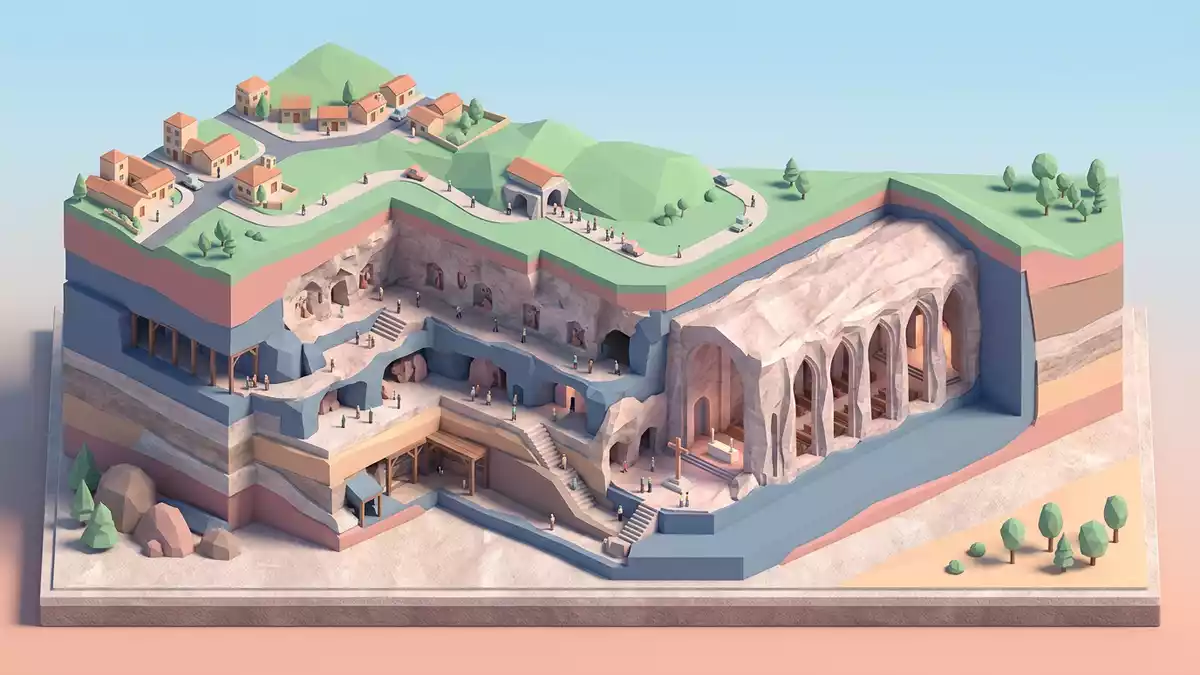
Far below the streets of Zipaquira in Colombia, the Catedral de Sal de Zipaquira turns a working salt mountain into an underground cathedral carved directly into halite rock. Completed in its present form in 1995, this Roman Catholic complex lies within the tunnels of a former mine and combines engineering, devotional spaces and geology in a single subterranean landscape.underground Roman Catholic church
An underground church in a salt mountain
The Catedral de Sal de Zipaquira occupies a halite ridge on the outskirts of Zipaquira, where salt has been extracted since long before Spanish rule, and the current cathedral lies roughly 180 to 200 m (590 to 660 ft) below the surface.salt deposit in the eastern Andean range The complex extends through broad galleries and chambers cut from the rock, using former extraction tunnels as access routes and reshaping parts of the mine into places of worship and gathering.
The first miners’ sanctuary inside the Zipaquira salt workings dates to 1932, and a larger underground church opened in the 1950s before safety concerns led to its closure in the early 1990s.first informal chapel was built by miners in 1932 The present cathedral, inaugurated in 1995, was excavated in new chambers deeper in the mountain, with a dedicated architectural and engineering project replacing the older sanctuary while keeping the tradition of an underground place of worship.new chamber opened for visitors in December 1995
Architecture, layout and salt-carved symbolism
The design of the current Catedral de Sal de Zipaquira was developed in the early 1990s by the Bogotá architect Roswell Garavito Pearl, working with engineer Jorge Enrique Castelblanco Reyes, after a competition organised by the Colombian Society of Architects.architect Roswell Garavito Pearl Their project carved broad naves and a principal altar hall out of the halite, reinforcing the rock where necessary while leaving many surfaces as exposed salt strata, so that the walls, ceilings and sculptures share the same pale, crystalline material.
Visitors descend through a sequence of chapels aligned with the Stations of the Cross, each chapel carved from salt rock and many incorporating reliefs or crosses formed from the same material.14 chapels carved from salt rock The main sanctuary occupies a chamber around 75 m long and about 18 m high, large enough to host large congregations, with an illuminated cross at the altar carved out of the wall and lit from behind to stand out against the darker rock.chamber 75 m long and 18 m high
Salt, Muisca history and national symbolism
The salt deposit at Zipaquira formed tens of millions of years ago when an inland sea covering part of the eastern Andes dried out and left thick layers of salt buried under sediments.inland sea covered the region Long before European arrival, the Muisca people exploited this halite mountain, using salt as a trading commodity that supported one of the most prosperous pre-Hispanic societies on the Bogotá savanna.
During the colonial and republican periods, salt extraction from Zipaquira helped finance wider political and military campaigns, including independence efforts by figures such as Antonio Nariño and Simón Bolívar.salt used to finance campaigns of the liberators Recognition of the site’s cultural and engineering significance led to its designation as the “First Wonder of Colombia”, a title conferred by national institutions and repeated in official tourism material, which underlines its role as both a sacred space and a symbol of Colombian modern architecture.proclaimed the Salt Cathedral the first wonder of Colombia
Visiting Catedral de Sal de Zipaquira: what travellers from Western Europe should know
- Catedral de Sal de Zipaquira stands just outside the town of Zipaquira in Cundinamarca, north of Bogotá, and is reached along roads that climb into the halite ridge where the mine entrances lie.located at Carrera 6 Calle 1, Zipaquirá
- The approach from the park involves descending into the mountain along galleries and stairways, including a series of sloping tunnels and steps as the route leads deeper to the chapels and main sanctuary.inside Colombia’s Catedral de Sal de Zipaquirá, 180 meters underground
- Zipaquira lies in the Eastern Cordillera of the Andes, and weather in the surrounding uplands can be cool; inside the mine, the air remains at a roughly stable temperature, with solid rock floors and occasional damp patches.
- Nearby, Zipaquira’s colonial centre with its surface cathedral and plaza provides a contrast to the underground sanctuary and reflects the town’s long history as a salt-mining settlement.
- The official language is Spanish and the currency is the Colombian peso.
Searching for Catedral de Sal de Zipaquira on social platforms
These links open searches for Catedral de Sal de Zipaquira on each platform.
Frequently asked questions about Catedral de Sal de Zipaquira
Where is Catedral de Sal de Zipaquira located?
Catedral de Sal de Zipaquira lies beneath a halite mountain on the northern side of Zipaquira in Cundinamarca, Colombia, within a former salt mine complex.
What can visitors expect inside the cathedral?
Visitors walk through underground galleries lined with salt rock into chapels marking the Stations of the Cross and a large main sanctuary with an illuminated cross and exposed halite walls.
What makes Catedral de Sal de Zipaquira distinctive among churches?
It is a consecrated Catholic worship space carved entirely into a salt deposit, combining mining heritage, large underground chambers and modern Colombian architectural design within a single mountain.


