
Cenotes de Valladolid and the limestone pools of Yucatán
Published on 09/21/2026 at 08:44 | Editorial responsibility: Rafael Müller, Editor-in-Chief AD HOC NEWS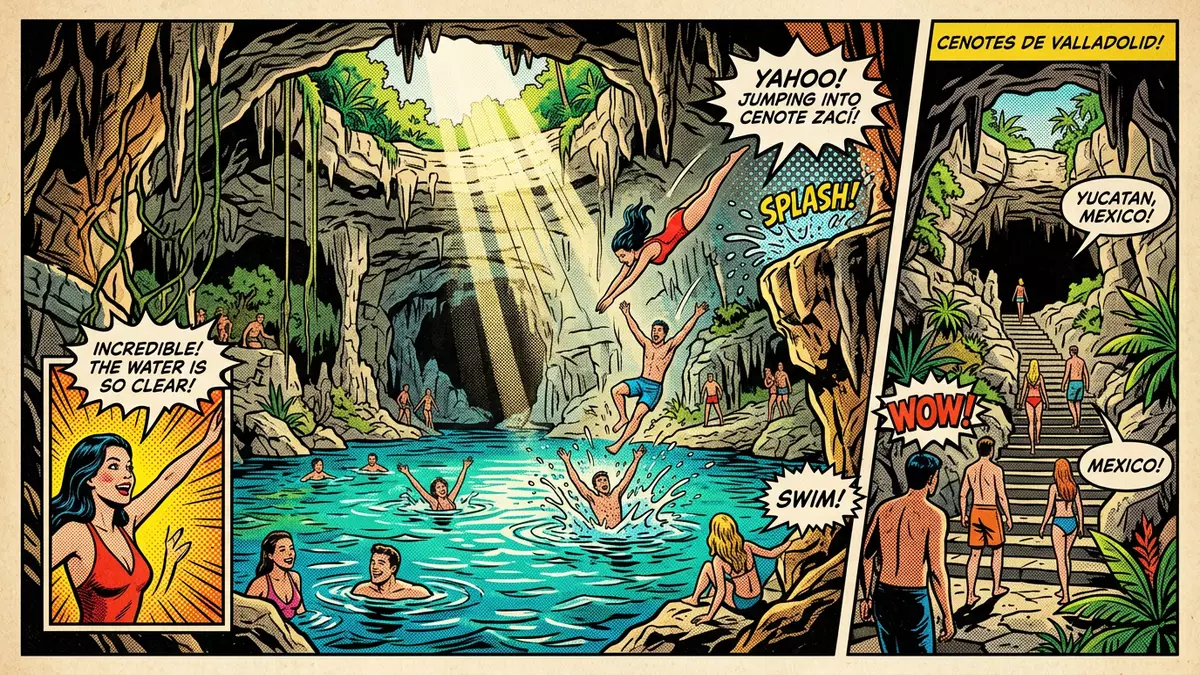
Cenotes de Valladolid are a cluster of freshwater sinkholes in and around the colonial city of Valladolid in eastern Mexico, where the limestone plateau of the Yucatán Peninsula opens into clear pools of groundwater.
Limestone, groundwater and a ring of cenotes around Valladolid
Cenotes de Valladolid form part of a broader belt of sinkholes across the Yucatán Peninsula, created where soluble limestone has collapsed or opened to reveal permanent groundwater beneath the surface.Cenotes are sinkholes and natural wells Around Valladolid, this geology expresses itself in pools that sit inside caves, in partially covered chambers and in more open basins, giving the area a mixture of enclosed grottoes and outward-facing water landscapes.There are over 300 cenotes within the wider Valladolid area
The city of Valladolid lies in the state of Yucatán in eastern Mexico, on a low-lying limestone plateau that carries underground rivers rather than surface streams.Cenotes de Valladolid are in and around the city of Valladolid in the state of Yucatán Cenotes tap into these subterranean flows, forming deep freshwater basins that are structurally connected to the peninsula’s aquifer. Around Valladolid, many cenotes sit within short travelling distance of the urban grid, so the transition from streets and plazas to sinkholes and water is abrupt rather than gradual.
Cenote Zací and the cenotes that orbit the colonial city
A defining feature of cenotes de Valladolid is the way at least one of these pools lies inside the fabric of the city itself. Cenote Zací occupies a large depression within central Valladolid and is reached from ordinary streets leading out of a colonial plaza, so the descent from townscape to water happens almost immediately.Cenote Zaci is a massive semi-open cenote right in the middle of Valladolid Pathways and staircases lead down from the rim to the swimming level, with sheer rock faces shaping the outline of the basin and vegetation clinging to ledges and overhangs.
Beyond Cenote Zací, Valladolid acts as a base for reaching a wider ring of cenotes distributed through the surrounding countryside. Guides and local descriptions consistently name places such as Cenote Suytun, Cenote Xkekén, Cenote Samulá, Cenote Oxman, Cenote Ik Kil and Cenote Xcanahaltun among the pools accessible on day outings from the city.Guides list Cenote Suytun, Cenote Xkekén, Cenote Samulá, Cenote Oxman, Cenote Ik Kil and Cenote Xcanahaltun Some lie beside archaeological sites such as Chichén Itzá and Ek? Balam, while others sit beside small rural settlements or former haciendas, so the experience of visiting them varies from cave-like interiors to more open water edged by gardens or agricultural land.
Cave chambers, semi-open basins and light on the water
The individual cenotes around Valladolid differ mainly in how much of their limestone roof remains and how light reaches the water. Pools such as the Dzitnup cenotes Xkekén and Samulá sit inside enclosed chambers with rock overhead and walls decorated by stalactites and stalagmites, with shafts of daylight entering through openings and catching particles in the air.Cenote X’Kekén is located near Valladolid in a town called Dzitnup Semi-open cenotes such as Zací have broader apertures at the top, so rock overhangs share space with exposed sections where tree roots descend towards the surface of the water and ledges form informal viewing platforms.
Elsewhere, pools such as Cenote Suytun and Sac Aua have gained attention for more geometric interventions in their basins. Suytun is known for a circular platform that extends into the water from the edge, set beneath an opening in the roof so that daylight falls directly onto stone and water.Cenote Suytun is noted for its platform and light Sac Aua, in contrast, presents a pool with an island-like area rising from the centre, with the basin ringed by rock walls and surrounding vegetation, giving it a distinct plan compared with more straightforward circular depressions.Cenote Sac Aua is described as an island cenote
Visiting Cenotes de Valladolid: what travellers from Western Europe should know
- Cenotes de Valladolid surround the city of Valladolid in the state of Yucatán, eastern Mexico, and can be reached from the urban centre by road into the surrounding countryside.
- Cenotes are sinkholes in limestone, and approaches commonly involve descending staircases or paths along rock faces to reach water level, with uneven surfaces in cave sections.
- Cenotes lie in a tropical lowland setting; enclosed cave cenotes can be dark away from openings, while semi-open basins expose visitors directly to the Yucatán sun.
- The official language is Spanish and the currency is the Mexican peso. Entry requirements depend on your nationality; UK travellers can check the FCDO travel advice at gov.uk/foreign-travel-advice, Irish travellers the Department of Foreign Affairs at ireland.ie.
Searching for Cenotes de Valladolid on social platforms
These links open searches for Cenotes de Valladolid on each platform.
Frequently asked questions about Cenotes de Valladolid
Where are Cenotes de Valladolid located?
Cenotes de Valladolid are in and around the city of Valladolid in the state of Yucatán in eastern Mexico, on the limestone plateau of the Yucatán Peninsula.
What should visitors expect when entering these cenotes?
Visitors encounter descents along staircases or paths into limestone depressions where freshwater basins sit below street level, with cave-like chambers in enclosed cenotes and exposed rock walls around semi-open pools.
What makes Cenotes de Valladolid distinctive compared with other water landscapes?
The distinctive character lies in the concentration of cenotes within reach of a single colonial city, including Cenote Zací inside Valladolid itself and a surrounding ring of cave and semi-open pools set in limestone, rural settlements and archaeological sites.


