
Centro Historico de Arequipa and its volcanic white stone cityscape
Published on 08/18/2026 at 13:07 | Editorial responsibility: Rafael Müller, Editor-in-Chief AD HOC NEWS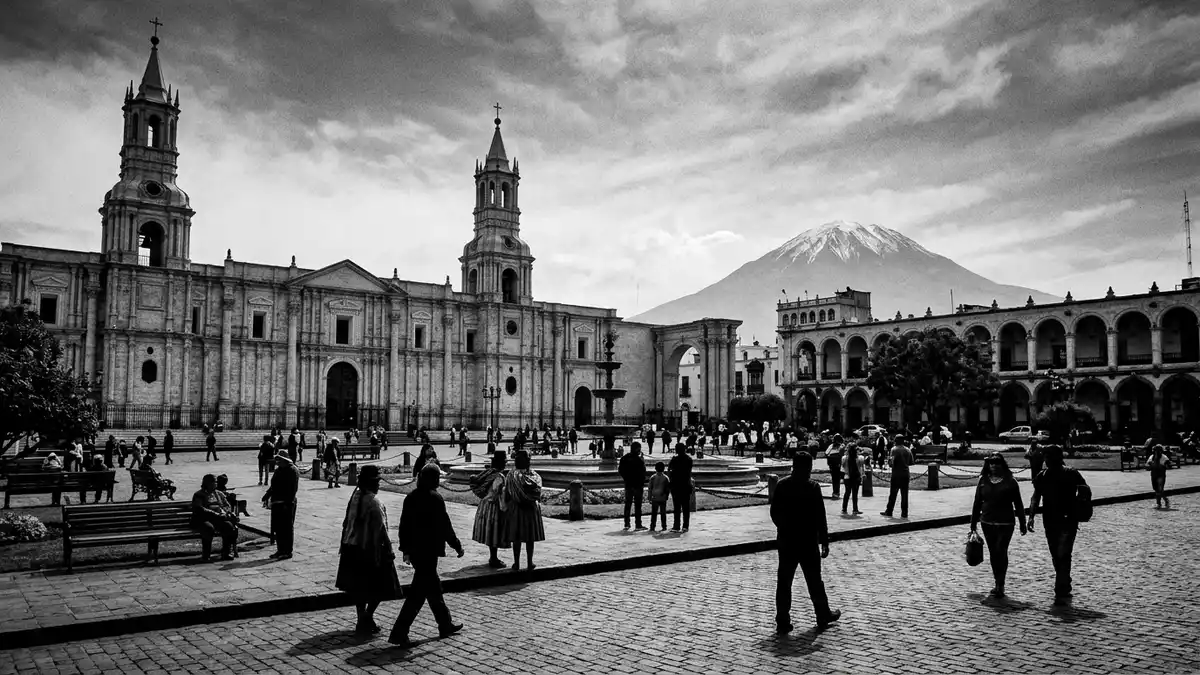
Centro Historico de Arequipa is the colonial core of Arequipa in southern Peru, a historic grid of streets, churches and courtyards built largely from pale volcanic stone and recognised as a UNESCO World Heritage Site since 2000. Within this area, Spanish colonial town-planning meets Andean craftsmanship in a cityscape that has earned Arequipa the nickname “White City”.
Volcanic stone and the White City character
The defining material of Centro Historico de Arequipa is sillar, a white and sometimes pink volcanic rock quarried from the flanks of nearby volcanoes such as Chachani and Misti, then cut into blocks for walls, arcades and vaults.Sillar, a white volcanic stone This stone gives facades, churches and casonas a luminous tone under the strong Andean light, and many buildings in the historic centre carry thick masonry walls that express the material’s strength.
UNESCO’s description of the Historical Centre of the City of Arequipa emphasises this volcanic rock and the way it underpins the whole ensemble of streets and squares.The Historic Centre of Arequipa built in sillar The protected core covers a substantial urban area with blocks laid out on a Spanish colonial grid, and inside it houses religious complexes, government buildings and residences whose robust walls, archways and vaulted interiors are all shaped by the properties of this stone.
Spanish grid, Andean courtyards and mestizo Baroque
Centro Historico de Arequipa follows the kind of rectilinear town plan introduced by Spanish officials in the sixteenth century, organised around Plaza de Armas, the main square where the city was founded on 15 August 1540 by Garci Manuel de Carbajal.Founding of Arequipa in 1540 The original layout comprises a set of city blocks radiating from this plaza, with arcaded fronts and civic buildings framing the central space.
Architecture in the historic centre blends Spanish Baroque and later neoclassical forms with motifs and techniques from the Andes, an approach often described as mestizo Baroque in the region.Mestizo Baroque architecture in Arequipa Facades of churches and casonas show carved columns, elaborate reliefs and decorative bands in sillar, while behind them lie courtyards edged by semi-circular arches and rooms covered by vaulted roofs that create an interplay between enclosed interiors and open-air patios.
Plaza de Armas and landmark buildings
At the heart of Centro Historico de Arequipa stands Plaza de Armas, laid out as the main civic square when the town was established in the sixteenth century and later surrounded by portals, administrative buildings and arcades. Along its northern edge runs the Cathedral of Arequipa, a long church constructed mainly in sillar with brick vaults and reconstructed in the nineteenth century after earlier damage, occupying the entire side facing the plaza.Cathedral of Arequipa in sillar
Beyond the main square, the historic centre contains convents such as Santa Catalina, government edifices and urban houses that share a consistent language of stone arcades, carved portals and interior courtyards.Religious and civil buildings in the historic centre Together, this ensemble illustrates the fusion of European town-planning principles with local construction methods and decorative traditions that led UNESCO to inscribe the area on the World Heritage List in 2000.
Visiting Centro Historico de Arequipa: what travellers from Western Europe should know
- Centro Historico de Arequipa lies in the central part of Arequipa, south of the Río Chili, and is reached along city streets that converge on Plaza de Armas.
- Historic houses and churches often have interior courtyards reached through stone-built passageways, and some routes within older buildings include staircases and vaulted corridors.
- The city stands at high elevation in the Andes, so the historic streets and squares sit well above sea level, with views to surrounding volcanoes from parts of the centre.
- Spanish is the official language and the currency is the Peruvian sol.
- Entry requirements depend on your nationality; UK travellers can check the FCDO travel advice at gov.uk/foreign-travel-advice, Irish travellers the Department of Foreign Affairs at ireland.ie.
Searching for Centro Historico de Arequipa on social platforms
These links open searches for Centro Historico de Arequipa on each platform.
Frequently asked questions about Centro Historico de Arequipa
Where is Centro Historico de Arequipa located?
Centro Historico de Arequipa occupies the colonial core of Arequipa in southern Peru, laid out around Plaza de Armas on a Spanish-designed grid of streets.
What can visitors expect when walking through the historic centre?
Visitors encounter pale sillar-stone facades, arcaded fronts around the main square, churches, convents and casonas with courtyards linked by passageways and vaulted interiors.
What makes Centro Historico de Arequipa distinctive among historic cities?
The combination of volcanic sillar architecture, a sixteenth-century Spanish urban plan and mestizo Baroque decoration led UNESCO to recognise the area as a World Heritage Site.


