
Centro Historico de Lima and its colonial street grid
Published on 09/24/2026 at 02:32 | Editorial responsibility: Rafael Müller, Editor-in-Chief AD HOC NEWS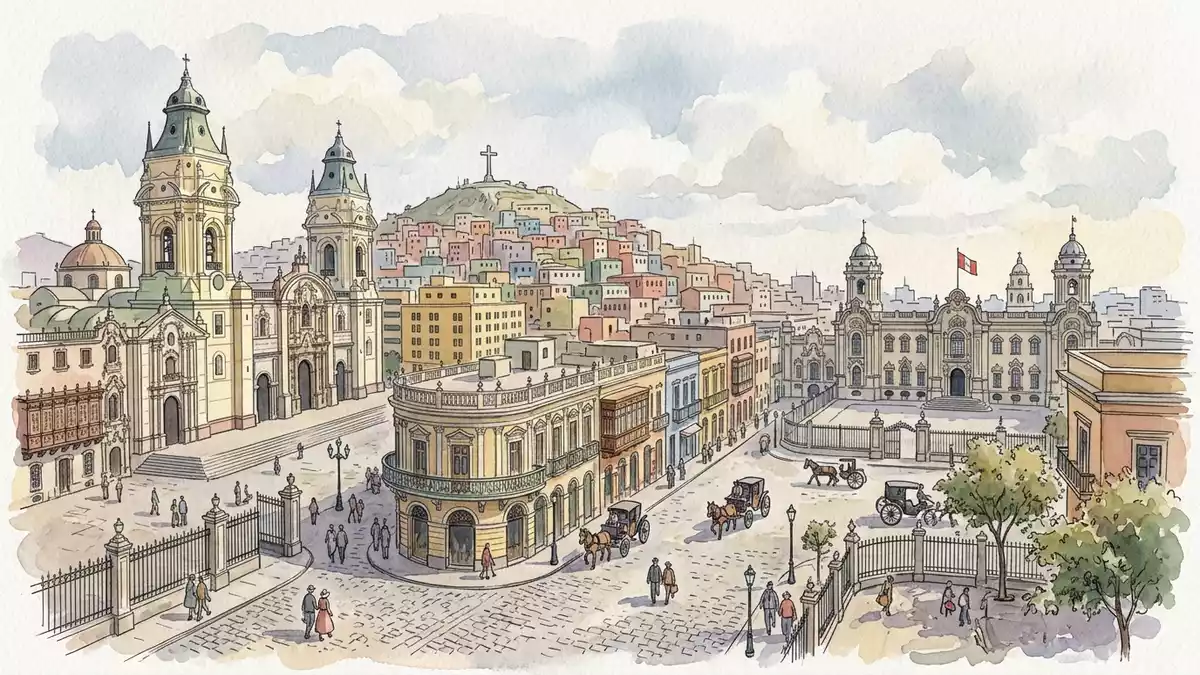
Centro Historico de Lima is a city centre laid out as a visible grid around Plaza Mayor. Founded by Francisco Pizarro in January 1535, it preserves churches, convents, civic buildings and timber balconies across Lima and Rímac.
Centro Historico de Lima begins with a colonial grid
The historic centre occupies the Rímac valley, beside the river that gives the area its name. Its streets retain the regular urban pattern associated with the Spanish foundation of Lima, with Plaza Mayor forming the principal civic space.
Lima was the political, administrative, religious and economic capital of the Viceroyalty of Peru. The city was known as Ciudad de los Reyes, or City of Kings, and its historic fabric reflects that former role through squares, churches, public buildings and houses.
Plaza Mayor and the architecture of Lima
Plaza Mayor brings together the Basilica Cathedral of Lima, the Government Palace and the Municipal Palace. The Archbishop’s Palace and nearby religious buildings add carved timber balconies, arcades and richly decorated façades to the surrounding streets.
The architecture combines adobe, brick and quincha, a lightweight construction material used in Lima. Earthquakes shaped the surviving building tradition, while colonial and republican balconies remain a recognisable feature of the urban landscape.
The religious buildings include the Church and Convent of San Francisco, whose monumental complex contains decorated interiors and catacombs. San Francisco convent complex forms a major part of the historic centre’s architectural identity.
From viceregal capital to protected historic centre
Religious orders established churches, convents, hospitals, schools and universities during the Spanish colonial period. San Marcos University was founded in 1551, adding an educational institution to the city’s religious and administrative network.
The centre also contains monuments connected with public life, including the stone bridge over the Rímac, the Paseo de Aguas, the Alameda de los Descalzos and the Plaza de Toros de Acho. These places extend the historic landscape beyond Plaza Mayor and into the Rímac district.
The World Heritage designation began with the Convent Ensemble of San Francisco in 1988. The protected area was extended in 1991 as the Historic Centre of Lima.
The designation recognises the centre as evidence of Spanish colonial urban development in Latin America. Its buildings also record collaboration between local craftspeople and artists from Europe, visible in construction, decoration and architectural forms.
Visiting Centro Historico de Lima: what travellers from Western Europe should know
- Centro Historico de Lima lies in Lima’s central districts and extends across parts of Lima and Rímac. The Rímac River forms a major geographic reference.
- Plaza Mayor is the principal starting point for the cathedral, Government Palace, Archbishop’s Palace and surrounding colonial streets.
- The centre is explored through streets, squares, churches, convents and civic buildings. Walking routes include Jirón de la Unión and the streets around Plaza San Martín.
- The official language is Spanish and the currency is the Peruvian sol.
- Entry requirements depend on your nationality; UK travellers can check the FCDO travel advice at gov.uk/foreign-travel-advice, Irish travellers the Department of Foreign Affairs at ireland.ie.
Searching for Centro Historico de Lima on social platforms
These links open searches for Centro Historico de Lima on each platform.Frequently asked questions about Centro Historico de Lima
Where is Centro Historico de Lima?
It lies in central Lima, across parts of the Lima and Rímac districts. The historic area sits in the Rímac valley and includes places on both sides of the Rímac River.
What can visitors expect to see?
The centre contains Plaza Mayor, churches, convents, civic buildings, historic mansions and streets lined with colonial and republican balconies.
What makes the centre distinctive?
Its regular colonial street grid remains visible around Plaza Mayor. The World Heritage site also brings together architecture from the viceregal and republican periods.


