
Centro Historico de Puebla and its tiled colonial streets
Published on 09/24/2026 at 06:14 | Editorial responsibility: Rafael Müller, Editor-in-Chief AD HOC NEWS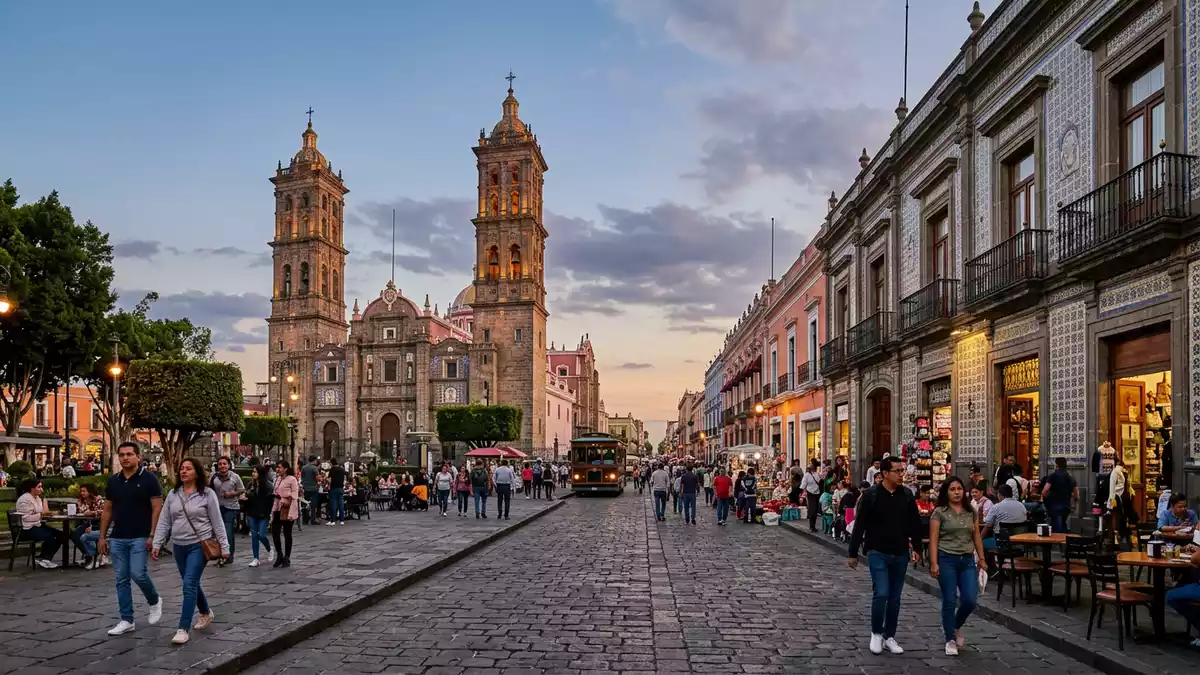
Centro Historico de Puebla is a historic district where a sixteenth-century street plan meets churches, civic buildings and houses covered with coloured tiles. Founded in 1531, Puebla preserves this urban ensemble beneath the volcano Popocatépetl, with the Zócalo and cathedral forming its architectural centre.
Puebla’s sixteenth-century grid and tiled façades
The district grew from the foundation of Puebla de los Ángeles in the Spanish colonial period. Its streets retain a regular layout, while the buildings along them represent several centuries of construction and decoration. The result is not a single monument but a connected cityscape of streets, squares, religious buildings, palaces and private houses.
Tiles give many façades a strong visual identity. Blue, green, yellow and white azulejos appear on walls, entrances and architectural details, alongside brick, stone and painted plaster. These surfaces belong to houses as well as monumental buildings, so decoration continues from the major squares into the surrounding streets.
Renaissance, Baroque and later Neoclassical elements appear within the historic centre. European forms were combined with American materials, craftsmanship and artistic traditions, producing an architectural language associated with Puebla. The district received UNESCO World Heritage status in 1987, with its urban form and buildings forming part of the designation. UNESCO’s Puebla listing records the cathedral, churches, palaces and tiled houses as elements of this historic ensemble.
Cathedral, Zócalo and the Baroque interior
Puebla Cathedral faces the city’s main square, the Zócalo. Its construction spans the sixteenth and seventeenth centuries, giving the building a layered appearance that joins Renaissance and Baroque traditions. The broad stone façade, towers and formal interior make it a central reference point within the street network.
The cathedral is one part of a larger religious landscape. Santo Domingo contains the Capilla del Rosario, whose gilded stucco, sculpted figures and dense ornament represent the richness of New Spanish Baroque. San Francisco and the Jesuit Church add further historic churches to the district, while the old archbishop’s palace and the Palafox Library extend the sequence of civic and ecclesiastical architecture.
The streets around the Zócalo connect these buildings with arcaded façades, courtyards and residential fronts. Their scale changes from large institutional structures to narrower houses, but the materials and decorative details keep the district visually connected. The architecture is therefore read across several blocks, not only inside individual monuments. Puebla’s historic buildings include the cathedral, the former archbishop’s palace and houses with azulejo-covered walls.
A living historic centre in Puebla
Centro Historico de Puebla remains part of the city rather than an isolated archaeological site. Shops, homes, religious buildings, public institutions and restaurants occupy streets that preserve the colonial plan. Historic façades stand beside later additions, creating a district whose architecture includes the sixteenth, seventeenth, eighteenth, nineteenth and twentieth centuries.
The formally protected area contains more than churches. The Zócalo provides a civic focus, while the surrounding blocks hold palaces, courtyards, educational buildings and houses. The Palafox Library occupies the former archbishop’s palace, linking a historic building with a continuing cultural function.
Puebla’s visual character also comes from repetition. A single tiled doorway is decorative; a succession of tiled façades creates a streetscape. Brick, volcanic stone, painted surfaces and Talavera ceramics recur across different building types, making the material palette as important as the individual landmarks.
The district’s historical importance rests on this combination of intact planning and architectural variety. Puebla was founded as a colonial city in 1531, and the preserved grid allows the relationship between streets, squares and buildings to remain legible. Its 1987 World Heritage inscription recognises the historic centre as a cultural ensemble rather than a collection of unrelated monuments. The protected historic centre includes Plateresque, Mannerist, Baroque, Neoclassical and later architectural elements.
Visiting Centro Historico de Puebla: what travellers from Western Europe should know
- Centro Historico de Puebla occupies the historic core of Puebla in central Mexico. The Zócalo, Puebla Cathedral and City Hall provide clear reference points within the district.
- The area is explored through urban streets, squares, arcades and building interiors. Cobbled or uneven surfaces, steps and changing pavement levels occur around historic buildings.
- The official language is Spanish and the currency is the Mexican peso.
- Entry requirements depend on your nationality; UK travellers can check the FCDO travel advice at gov.uk/foreign-travel-advice, Irish travellers the Department of Foreign Affairs at ireland.ie.
Searching for Centro Historico de Puebla on social platforms
These links open searches for Centro Historico de Puebla on each platform.Frequently asked questions about Centro Historico de Puebla
Where is Centro Historico de Puebla?
It is the historic centre of Puebla, a city in central Mexico. The district is organised around the Zócalo, Puebla Cathedral and adjoining historic streets.
What can visitors expect to see?
Visitors find churches, palaces, libraries, arcades, courtyards and houses with coloured tile façades. The district is experienced through its connected streets as well as its individual monuments.
What makes the district distinctive?
Its sixteenth-century urban grid remains linked to a dense collection of religious and civic buildings. Talavera tiles, brick, stone and Baroque ornament give the streets a recognisable material character.


