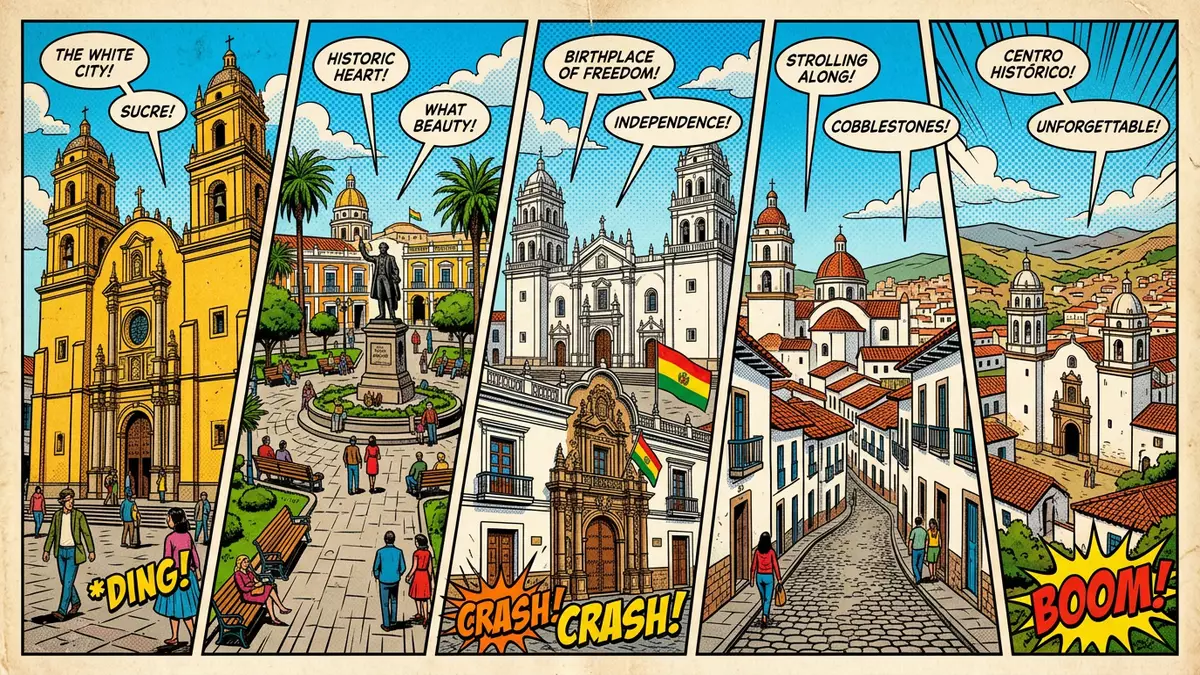
Centro Historico de Sucre and its white colonial streets
Published on 08/09/2026 at 15:18 | Editorial responsibility: Rafael Müller, Editor-in-Chief AD HOC NEWS
Centro Historico de Sucre is the historic core of Bolivia’s constitutional capital, Sucre, and its streets are marked by whitewashed façades, churches and colonial courtyards. The city’s centre preserves a clear urban pattern from the Spanish colonial era, with many buildings from the eighteenth and nineteenth centuries.
White façades and colonial streets in Sucre
The district is known for its bright lime-washed buildings, tiled roofs and narrow streets laid out around plazas. This gives Centro Historico de Sucre a coherent appearance that survives across civic, religious and domestic architecture.
Among the best-known landmarks are the Cathedral of Sucre, the Casa de la Libertad and the convents and churches that line the old centre. The architecture reflects a long period of colonial and republican history, with baroque and neoclassical elements appearing in different buildings.
A city centre shaped by independence history
Sucre holds a special place in Bolivian history because the country’s declaration of independence was signed there in 1825. The Casa de la Libertad, a central building in the old town, is closely linked with that event and with the political life of the early republic.
The historic centre also reflects the period when Sucre developed as a major administrative and ecclesiastical city in the Andes. Its churches, patios and public squares preserve the scale of a city built for civic ceremony as much as for everyday life.
Churches, courtyards and civic buildings
Walking through Centro Historico de Sucre brings together religious architecture, shaded interiors and formal street fronts. Many buildings open on to courtyards, while their outer walls present a restrained street face of plaster, stone and carved wood.
The district includes museums, legal buildings and religious houses that still define the city’s historic identity. Their concentration in a relatively compact area makes the centre legible on foot, with each block adding another layer of Sucre’s colonial fabric.
Visiting Centro Historico de Sucre: what travellers from Western Europe should know
- Sucre is reached by road and by air through the city’s airport.
- Admission arrangements and opening hours are set by the site's operator and change with the season; the official website is the only binding source.
- The dry season from May to October is a comfortable period for walking the centre, while early morning and late afternoon suit the brightest façades.
- The historic centre sits at high altitude, so steady walking and time for adjustment are sensible on arrival.
- Spanish is the main language in daily use, and cash is useful for small purchases in the centre.
- Entry requirements depend on your nationality. UK travellers should check the FCDO travel advice at gov.uk/foreign-travel-advice; Irish travellers the Department of Foreign Affairs at ireland.ie; EU and EEA citizens their own national foreign ministry.
Searching for Centro Historico de Sucre on social platforms
These links open searches for Centro Historico de Sucre on each platform.
Frequently asked questions about Centro Historico de Sucre
Where is Centro Historico de Sucre?
It is in Sucre, Bolivia, in the city’s colonial core. The area centres on plazas, churches and civic buildings.
What should visitors expect?
Expect a walkable historic centre with white façades, religious architecture and a strong street pattern from the colonial period. The altitude is noticeable, so an unhurried pace is useful.
What makes it distinctive?
Its unity of white architecture and preserved historic fabric sets it apart within Bolivia’s urban heritage. The link with the 1825 independence declaration gives the centre added historical weight.