
Centro Historico del Cusco and its layered stone cityscape
Published on 08/20/2026 at 21:45 | Editorial responsibility: Rafael Müller, Editor-in-Chief AD HOC NEWS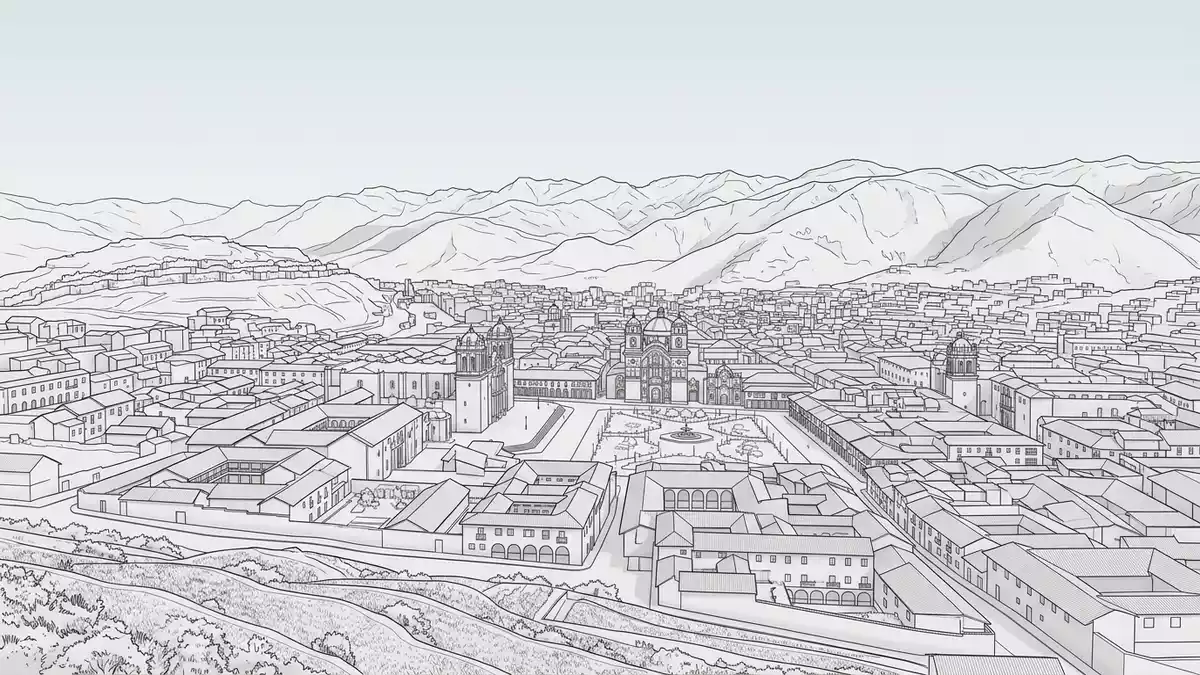
Centro Historico del Cusco is the historic centre of Cusco in Peru, where finely worked Inca stone and Spanish colonial façades share the same streets and plazas in the high Andes. Within this compact district the former Inca capital and its colonial successor sit quite literally on top of one another, a relationship recognised as cultural heritage of the nation and as part of the UNESCO World Heritage “City of Cusco” inscription from 1983.
Stone on stone: Inca foundations and colonial façades
The most striking feature of Centro Historico del Cusco is the way Inca and Spanish building traditions occupy the same walls. In many streets colonial houses and churches rise directly from bases assembled by Inca stonecutters, their precisely fitted blocks forming the lower courses beneath plastered upper storeys and arcaded balconies.Historic Centre of Cusco This layered construction is visible along corridors such as Hatunrumiyoc, where long runs of dressed stone form continuous street edges supporting later additions.
Religious complexes make the overlap particularly clear. The Convent of Santo Domingo incorporates foundations and walls belonging to the Inca temple complex known as Qorikancha, using earlier masonry as a structural base for cloisters and church volumes.Convent of Santo Domingo walls Nearby, the Cathedral on the Plaza de Armas stands on ground associated with palatial Inca structures, its stone mass and towers aligned with an open square that once formed part of a major ceremonial space.
Plazas, streets and the monumental designation
Centro Historico del Cusco centres on the Plaza de Armas, a broad square ringed by arcaded colonial buildings and major churches that mark the heart of the city. This plaza, linked to the earlier Inca ceremonial space of Huacaypata, anchors a network of streets that retain both pre-Columbian alignments and colonial interventions, creating a varied urban fabric of cobbled lanes, smaller squares and stepped passages.Plaza de Armas description
The Peruvian government declared the central part of Cusco, including the historic centre, a Monumental Area in 1972 under Supreme Resolution 2900-72-ED, recognising its concentration of historic streets, churches and civic buildings.Monumental Area designation In 1983 UNESCO added the “City of Cusco” to the World Heritage List as a cultural property, defining a central zone with a buffer area that together cover key parts of Centro Historico del Cusco and its surroundings.City of Cuzco World Heritage listing
A walkable Andean basin of stone and altitude
Cusco lies in a basin in the southern highlands of Peru, and Centro Historico del Cusco occupies its core, with streets that climb gently away from the main squares and views that open towards surrounding slopes.stone streets of Cusco The altitude gives the historic centre a distinct setting: churches and civic buildings rise above pavements laid in stone, and staircases link different street levels where the basin’s contours meet constructed terraces.
Within this terrain the historic centre retains many colonial buildings, plazas and churches as well as stretches of pre-Columbian wall, a continuity that underpinned its World Heritage recognition in the twentieth century.Cusco World Heritage context Walking through Centro Historico del Cusco means moving repeatedly between these layers: from arcaded fronts on the Plaza de Armas to narrow corridors flanked by Inca stone, and from monastic complexes to small chapels tucked into the grid of streets.
Visiting Centro Historico del Cusco: what travellers from Western Europe should know
- Centro Historico del Cusco sits in the centre of Cusco in the southern highlands of Peru and is reached by road from the wider city and via Cusco’s airport.
- The historic centre is largely walkable, with cobbled streets, uneven stone surfaces and staircases that link different levels between plazas and higher lanes.
- The official language is Spanish and the currency is the Peruvian sol.
- Entry requirements depend on your nationality; UK travellers can check the FCDO travel advice at gov.uk/foreign-travel-advice, Irish travellers the Department of Foreign Affairs at ireland.ie.
Searching for Centro Historico del Cusco on social platforms
These links open searches for Centro Historico del Cusco on each platform.
Frequently asked questions about Centro Historico del Cusco
Where is Centro Historico del Cusco located?
Centro Historico del Cusco lies in the central part of Cusco, a city in the southern highlands of Peru, occupying the core of its old urban basin.
What can visitors expect in the historic centre?
Visitors encounter cobbled streets, plazas such as the Plaza de Armas, colonial churches, convents and long stretches of Inca stonework integrated into later buildings.
What makes Centro Historico del Cusco distinctive?
It is distinctive for the direct overlap of Inca and Spanish colonial construction, recognised by national Monumental Area protection and inclusion in UNESCO’s City of Cusco World Heritage listing.


