
Changdeokgung, a palace shaped around its wooded hills
Published on 09/05/2026 at 16:28 | Editorial responsibility: Rafael Müller, Editor-in-Chief AD HOC NEWS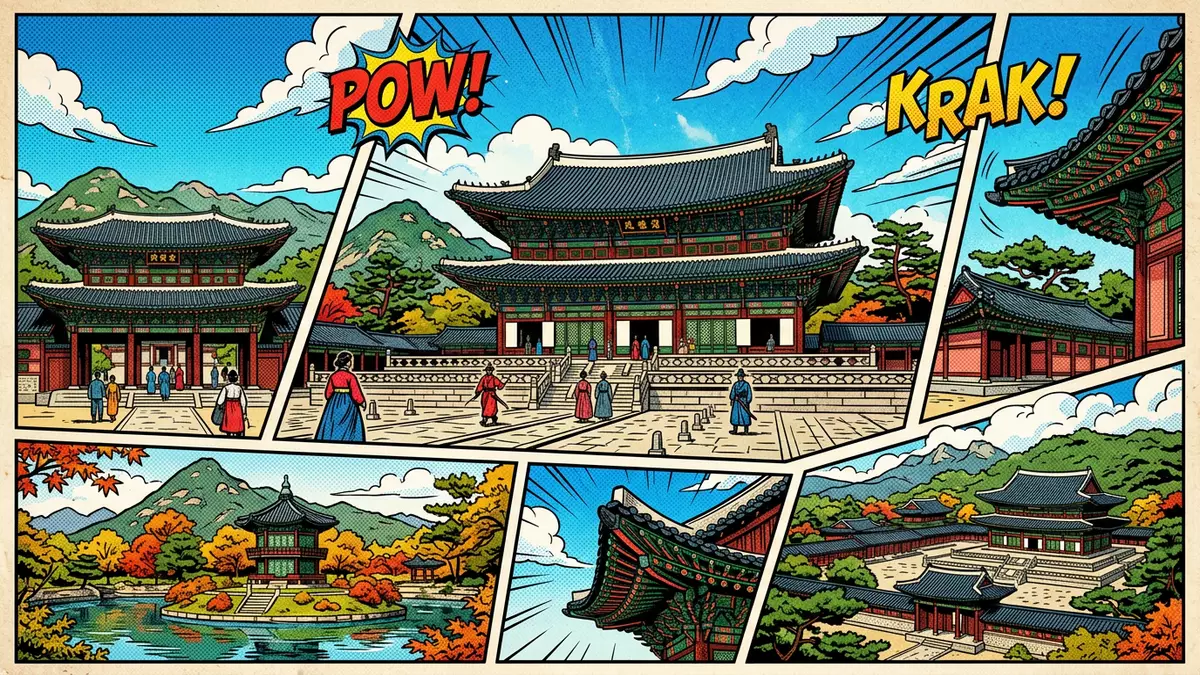
Changdeokgung in Seoul is a Joseon dynasty royal palace laid out around wooded hills, with its courts, halls and garden following the natural lie of the land rather than a rigid grid. Established as a royal residence in the early fifteenth century, it later gained formal recognition as a UNESCO World Heritage Site for the way its architecture and landscaping are integrated with the surrounding topography.
A Joseon royal palace on the slopes of Baegaksan
Changdeokgung stands in Jongno-gu in northern Seoul, at the foot of Ungbong Peak on the slopes of Mount Baegaksan, one of the traditional guardian mountains for the city. The palace complex was founded in 1405 during the reign of King Taejong as a secondary residence to Gyeongbokgung, the main palace of the Joseon dynasty.Founded in 1405 during Taejong’s reign The Joseon dynasty itself ruled Korea from the late fourteenth century until the early twentieth century, and Changdeokgung formed part of a network of royal palaces in and around Seoul.
Although it began as an auxiliary palace, Changdeokgung became the principal royal residence after a fire in 1592 destroyed Gyeongbokgung during the Japanese invasions of Korea.It served as the main royal residence from 1610 For around two and a half centuries the daily life of the court, from audiences with ministers to private family routines, took place within its timber halls and tiled courtyards. Only in 1867, when Gyeongbokgung was rebuilt, did Changdeokgung lose its status as the primary seat of power.
Architecture that bends to the terrain
The palace complex covers a wide, irregular area on a hillside, and its layout follows the undulating terrain rather than forcing it into a strict axial plan.The complex occupies roughly 58 hectares on sloping ground Timber audience halls, residential quarters and service buildings stand on stone platforms and are linked by courtyards and pathways that rise and fall with the ground. Roofs with upturned eaves, painted structural members and stone staircases form a sequence of spaces that opens and narrows as the route climbs.
Changdeokgung is one of several surviving Joseon palaces in Seoul, yet its relationship with the existing hills and woodland gives it a recognisably different character. Buildings are dispersed rather than packed into a single formal rectangle, and groups of pavilions sit partway up the slope between stands of mature trees. This arrangement reflects a broader East Asian tradition of harmonising built structures with their setting, and it helped secure inscription of the palace complex on the UNESCO World Heritage List in 1997.Inscribed as a World Heritage Site in 1997
The Secret Garden behind the palace
Behind the main palace buildings lies Huwon, the rear garden historically known as the Secret Garden, which extends up the slope as a sequence of wooded clearings, ponds and pavilions. The garden covers more than 400,000 m², occupying most of the hillside behind the palace complex and forming a broad band of trees within central Seoul.The rear garden covers around 446,943 square metres Paths wind between clusters of buildings, and the ground rises in stages, so that views open over ponds and pavilions framed by woodland.
The Secret Garden was reserved for the royal family and court and was once accessible directly from both Changdeokgung and the neighbouring palace of Changgyeonggung.Historically linked to Changgyeonggung Within it, small timber pavilions sit beside water or on terraces, and planting mixes ornamental trees with areas of open grass. Even viewed from within modern Seoul, the garden’s scale and dense foliage make it read as an extensive piece of woodland rising behind the palace roofs, reinforcing the sense that Changdeokgung is organised around its hillside rather than treating it as background.
Visiting Changdeokgung: what travellers from Western Europe should know
- Changdeokgung lies in Jongno-gu in central Seoul, north of the Cheonggyecheon stream, with the main entrance facing Yulgok-ro and Anguk Station on Metro Line 3 a short walk away.
- Within the palace, movement between halls and the Secret Garden involves staircases and gently sloping paths, and routes through the garden climb over uneven terrain and woodland tracks.
- The palace complex stands at low urban altitude but rises up the hillside behind the gate, so a visit combines level paved courtyards with longer walks on gradients through the rear garden.
- The official language is Korean and the currency is the South Korean won.
- Entry requirements depend on your nationality; UK travellers can check the FCDO travel advice at gov.uk/foreign-travel-advice, Irish travellers the Department of Foreign Affairs at ireland.ie.
Searching for Changdeokgung on social platforms
These links open searches for Changdeokgung on each platform.
Frequently asked questions about Changdeokgung
Where is Changdeokgung and what surrounds it?
Changdeokgung stands in Jongno-gu in central Seoul, on the lower slopes of Mount Baegaksan, close to Anguk Station and the neighbouring palace of Changgyeonggung.
What should visitors expect from a walk through Changdeokgung?
A visit combines paved palace courtyards, timber halls and gates with longer walks on gently rising paths through the extensive Secret Garden woodland behind the buildings.
What makes Changdeokgung distinctive among Seoul’s palaces?
Its layout bends to the hillside and tree cover, with halls, pavilions and the Secret Garden arranged around existing slopes and woodland rather than a strictly rectilinear plan.


