
Chateau de Chambord and its extraordinary rooftop skyline
Published on 08/16/2026 at 14:10 | Editorial responsibility: Rafael Müller, Editor-in-Chief AD HOC NEWS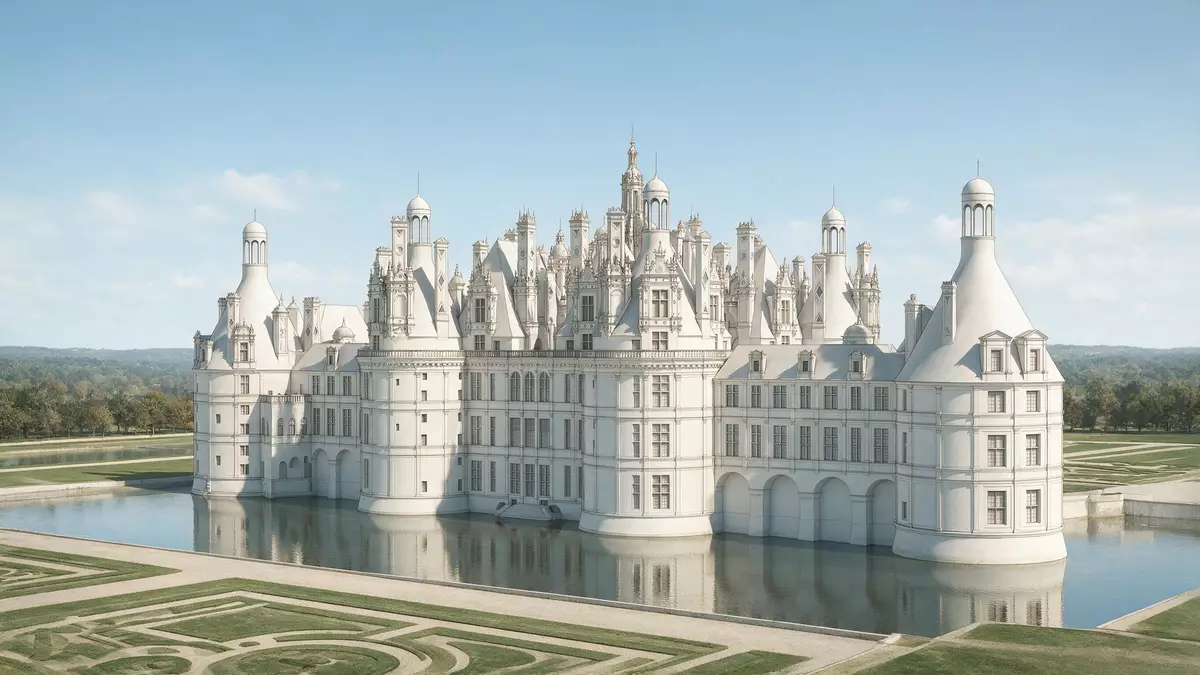
Chateau de Chambord in Chambord, in the Centre-Val de Loire region of France, is a French Renaissance royal residence framed by an immense former hunting domain that still shapes its setting. Built for King Francis I in the first half of the sixteenth century, it combines the mass of a medieval fortress with the ornament and symmetry of Renaissance classicism.
A French Renaissance palace with a fortified silhouette
Chateau de Chambord stands in the eastern part of the Loire Valley, on low ground near the River Cosson within a broad expanse of forest that once served as a royal hunting reserve.eastern Loire Valley setting Francis I ordered construction to begin in 1519, creating a residence that could serve his court while he pursued game in the surrounding woodland.construction starting in 1519 The main block follows the model of a medieval fortified castle, with a central square keep and substantial corner towers, yet its details belong unmistakeably to the Renaissance.medieval keep with corner towers
The château’s overall layout reflects French medieval traditions, with an enclosing wall and a moat defining the core composition, but the facades carry classical string courses and regular window bays associated with the new architectural language Francis I embraced after his Italian campaigns.blend of medieval plan and classical detail French and Italian influences meet throughout the structure, from the symmetry of the wings flanking the central courtyard to decorative motifs on chimney stacks and stair turrets that recall patterns found in Italian palaces.French and Italian influences The building became an emblem of the French Renaissance, standing as a large royal residence rather than a defensive stronghold.
The double-helix staircase and interior plan
At the heart of the château’s keep, a striking double-helix staircase rises through several levels, forming one of the most discussed features of Chambord.double-helix staircase This central staircase consists of two intertwined flights that wind around a shared vertical space, enabling two people to ascend and descend on separate flights while still seeing each other through openings between the flights. The design has long been associated with the influence of Leonardo da Vinci, whose interest in complex stair forms and geometrical layouts was known to the French court in the early sixteenth century, even though the exact architectural authorship of Chambord remains debated.influence of Leonardo da Vinci
Around this core, the interior plan organises rooms in a pattern that mixes ceremonial spaces and private apartments. The keep opens on to an internal courtyard, framed by relatively low wings that house suites and service spaces and connect the main block to later additions. Over the course of the sixteenth and seventeenth centuries, successive rulers added wings, including a chapel wing and a royal apartment wing, extending the residence and refining circulation routes without disturbing the central staircase that had become its organising feature.chapel and royal wings The result is a large stone complex that visitors can experience as a sequence of halls, chambers and staircases opening towards the courtyard and surrounding landscape.
An extraordinary rooftop skyline above the hunting domain
Seen from a distance across the former hunting park, Chateau de Chambord is distinguished by an elaborate rooftop skyline that rises above its terraces in a dense forest of chimneys, lanterns and stair turrets.chimneys and rooftop turrets Above the main terrace level, dozens of sculpted chimney stacks punctuate the sky at varying heights, interspersed with small towers and ornamental gables that give the roofline its distinctive silhouette. Near the centre, a taller lantern tower rises above the core staircase, acting as a visual focal point for the whole composition and marking the point where the interior circulation meets the open air.central lantern tower
The château stands within a vast enclosed estate, historically laid out as a hunting reserve that allowed the king and his entourage to pursue deer and other game in the surrounding woodland.royal hunting estate The park and forest remain fundamental to the identity of Chambord, framing views of the building from long straight avenues and creating a landscape in which the stone mass appears as an isolated architectural object emerging from trees and meadows. The relationship between the château and its estate is reinforced by the straight canalised course of the River Cosson near the building, a feature of the broader water management around the site.location by the River Cosson
Visiting Chateau de Chambord: what travellers from Western Europe should know
- Chateau de Chambord lies near the River Cosson in Chambord, east of the main Loire River corridor in the Centre-Val de Loire region of France; it is reached by road from nearby Loire Valley towns and by regional rail connections to Blois-Chambord station.
- The château interior includes broad stone staircases and upper terraces reached by long flights of steps, and the rooftop level involves walking across open terraces exposed to wind and weather.
- The surrounding estate is an extensive enclosed park with long straight avenues and woodland paths, so visiting the grounds can involve significant distances on foot over level but sometimes uneven surfaces.
- The official language is French and the currency is the euro.
Searching for Chateau de Chambord on social platforms
These links open searches for Chateau de Chambord on each platform.
Frequently asked questions about Chateau de Chambord
Where is Chateau de Chambord located?
Chateau de Chambord is in Chambord, in the Centre-Val de Loire region of France, in the eastern part of the Loire Valley near the River Cosson.
What should visitors expect on a visit to Chateau de Chambord?
Visitors encounter a vast stone château with a central double-helix staircase, an internal courtyard, extensive rooms and terraces, and views across a broad former hunting park.
What makes Chateau de Chambord distinctive among Loire Valley châteaux?
Chambord is distinctive for its combination of medieval fortress-like massing with French Renaissance ornament, its central double-helix staircase, and its exceptionally dense rooftop skyline of chimneys and towers.


