
Chateau de Chillon on the rock above Lake Geneva
Published on 09/08/2026 at 09:53 | Editorial responsibility: Rafael Müller, Editor-in-Chief AD HOC NEWS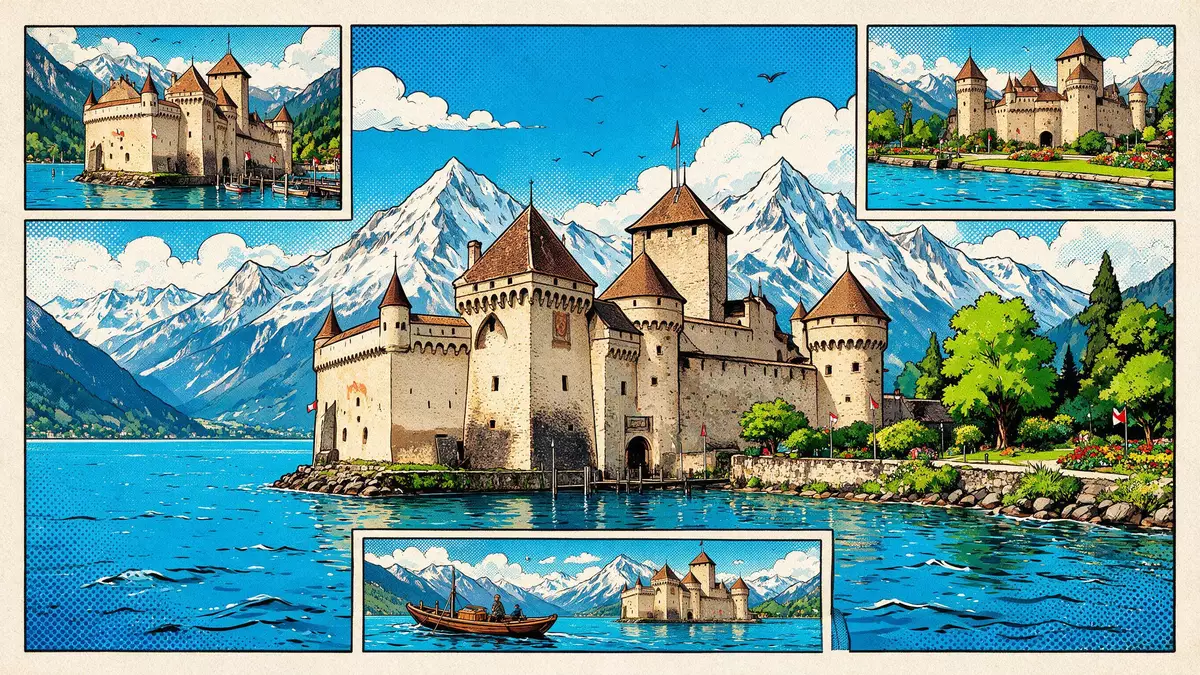
Chateau de Chillon is a medieval fortress on a rocky islet at the edge of Lake Geneva near Montreux in western Switzerland, its stone walls rising directly from the water and forming a compact ensemble of towers and courtyards pressed against the lakeshore. The site has been fortified since the Middle Ages, and the castle’s documented history reaches back to the twelfth century, when the House of Savoy established it as one of their strongholds in the region.
A lakeside stronghold shaped by Savoy and Bern
The strategic position of Chateau de Chillon is immediately visible: the fortress occupies a narrow rock outcrop between the lake and the steep slopes that climb towards the Alps, controlling the passage along the shore and the route between northern Europe and Italy. Excavations carried out from the end of the nineteenth century suggest that the site has been occupied since the Bronze Age, underscoring how long this rocky spur has served as a lookout and defensive point in the Lake Geneva corridor.occupied since the Bronze Age The oldest written mention of the castle dates back to 1150, when the Savoy family already controlled the fortress and its tolls along the lakeside path.
From the twelfth century into the sixteenth century Chateau de Chillon served as a residence and power centre for the Counts of Savoy, who expanded the complex and gave the fortress much of its current outline.Counts of Savoy during the 12th-16th centuries In 1536 Bernese forces seized the castle during the Reformation-era conflicts, and for more than two centuries it functioned as an administrative seat, arsenal and prison under Bernese authority.Bernese era from 1536 to 1798 After the Vaud revolution in 1798, the fortress passed into the hands of the new Vaudois authorities; since 1803 it has been owned by the Canton of Vaud and is now protected as a Swiss Cultural Property of National Significance.Swiss Cultural Property of National Significance
Architecture clustered along rock and water
Seen from the lakeside boats or the shore road, Chateau de Chillon appears as a single compact mass of masonry, yet the fortress is in fact a cluster of buildings accumulated over several centuries, linked along the length of the rock and enclosed by curtain walls. The castle rises from a base of medieval masonry laid directly on the irregular rock, with towers, halls and service ranges arranged to follow the outline of the islet and the defensive needs of a water-bound stronghold.mittelalterliche Wasserburg im Kanton Waadt Inside, Gothic vaulted chambers, stone staircases and timber roofs reflect the layers of construction from the Savoy period through the Bernese and Vaudois eras.
The oldest visible parts of the castle include the keep and chapel, which date from around the late eleventh century and anchor the complex at its landward end.castle keep and chapel date from the late 11th century Later additions by Savoy builders extended the halls and towers along the rock, while Bernese administrators adapted existing rooms for storage and imprisonment; traces of fourteenth-century frescoes and inscriptions remain on some walls, combining decorative schemes with the robust defensive architecture. The ensemble of courtyards, towers and lakeside ramparts gives visitors a compact tour through several architectural periods, all contained within the length of a single rocky platform above the water.
From fortress and prison to romantic landmark
Through its Savoy and Bernese phases Chateau de Chillon was not only a residence and stronghold but also a place of confinement, and its underground vaults are closely associated with the sixteenth-century imprisonment of François Bonivard, a Genevan monk and politician held there by the dukes of Savoy. His story later inspired Lord Byron, who visited in 1816 and wrote the narrative poem “The Prisoner of Chillon”, bringing the castle to the attention of a wide European readership and making its lakeside dungeon a symbol in Romantic literature.Lord Byron and “The Prisoner of Chillon” Other writers such as Jean-Jacques Rousseau, Victor Hugo and Alexandre Dumas also drew inspiration from the fortress and its setting.
By the end of the nineteenth century interest in conserving medieval monuments led to a programme of restoration at Chateau de Chillon, with architects and archaeologists working to stabilise the fabric and to present the castle as a historical site.restoration at the end of the 19th century The fortress has since become a museum, with rooms furnished to evoke different periods of its history and interpretation panels explaining the Savoy, Bernese and Vaudois eras. Its position on Lake Geneva, its concentration of medieval architecture and its literary associations together make Chateau de Chillon a distinctive landmark for travellers exploring the Riviera-Pays-d’Enhaut district around Montreux.
Visiting Chateau de Chillon: what travellers from Western Europe should know
- Chateau de Chillon stands on the shore of Lake Geneva in the commune of Veytaux, a short distance south-east of Montreux in the Canton of Vaud; it is reached by lakeside road, local bus services and by boats crossing the lake.
- Movement through the castle involves stone staircases, uneven floors and multiple levels linked by corridors and passages within the fortified shell, so exploring the site means spending time on steps and in enclosed interior spaces.
- The fortress lies directly beside Lake Geneva, and from its outer walkways and some rooms there are uninterrupted views across the water towards the Alps, combining an enclosed medieval structure with wide panoramas.
- The official language in this part of Switzerland is French and the currency is the Swiss franc.
Searching for Chateau de Chillon on social platforms
These links open searches for Chateau de Chillon on each platform.
Frequently asked questions about Chateau de Chillon
Where is Chateau de Chillon located?
Chateau de Chillon stands on a rocky islet at the edge of Lake Geneva in the commune of Veytaux, a short distance from Montreux in the Canton of Vaud.
What can visitors expect when exploring the castle?
Visitors move through medieval halls, courtyards and underground vaults connected by staircases and corridors, with views over Lake Geneva from the ramparts and some rooms.
What makes Chateau de Chillon distinctive among Swiss castles?
Its position directly on the lake, its well-preserved medieval architecture shaped by Savoy, Bernese and Vaudois rule, and its strong literary associations give Chateau de Chillon a particular place in Swiss cultural history.


