
Chateau de Versailles and its long axis of royal power
Published on 09/17/2026 at 06:44 | Editorial responsibility: Rafael Müller, Editor-in-Chief AD HOC NEWS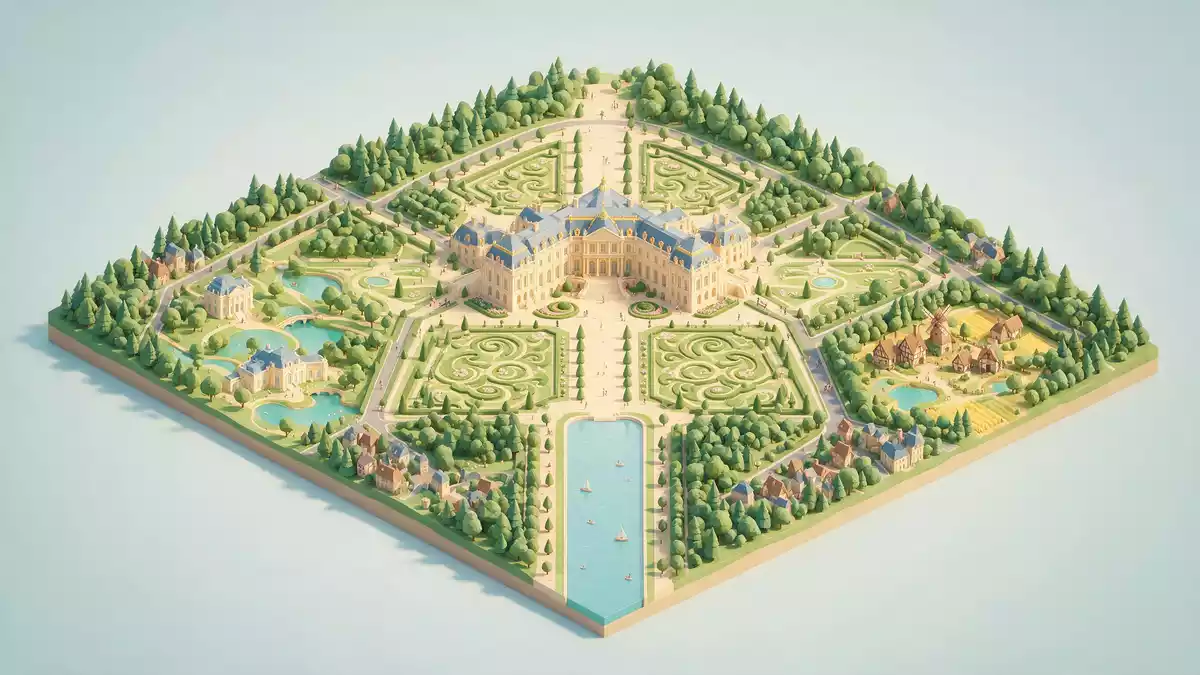
Chateau de Versailles in Versailles, west of Paris, is a former royal residence where Louis XIV, Louis XV and Louis XVI turned a hunting retreat into a vast palace aligned with formal gardens along a single grand east–west axis.Louis XIII's old hunting pavilion was transformed and extended by his son, Louis XIV in the seventeenth century, giving the estate the scale and geometry that visitors encounter.The palace and park were designated a World Heritage Site by UNESCO in 1979, recognising their role at the centre of French power and art in the seventeenth and eighteenth centuries.
The royal residence that reshaped Versailles
The story of Chateau de Versailles begins with Louis XIII, who established a hunting lodge at Versailles in the early seventeenth century.The original residence served as a retreat for the king and his family, standing in countryside south-west of Paris.In 1661 Louis XIV began transforming Versailles into an opulent palace, commissioning major extensions and formal gardens as part of a long project that continued into the early eighteenth century.
From 6 May 1682 Versailles became the principal seat of French royal power, when Louis XIV installed the court and government at the palace.The court of Versailles was the centre of political power in France from 1682 until October 1789, when the royal family returned to Paris at the outset of the French Revolution.Louis XIV, Louis XV and Louis XVI all reigned from Versailles, and successive works under their architects and decorators left the palace with a layered architectural history spanning the 1630s to the 1780s.French Classicism and Baroque ornament combine in its façades and interiors, making the estate a reference point for European palace architecture.
The Hall of Mirrors and the palace facing its gardens
At the centre of Chateau de Versailles, the main palace block presents long façades towards the town on one side and the formal gardens on the other.The composition is organised along a strong east–west line that runs through the building and into the park, making the relationship between architecture and landscape a defining feature.The palace is one of the greatest achievements in French seventeenth-century art, with stone façades articulated by regular windows, pilasters and sculpted decoration above courtyards.
Inside, the Hall of Mirrors is the most recognised room, stretching as a gallery along the garden side of the central block.The gallery replaced an earlier open terrace designed by Louis Le Vau, enclosing the view of the gardens behind large windows and mirrored wall panels.From the central windows of the Hall of Mirrors the Grande Perspective runs out into the gardens, giving visitors a framed view of lawns, water and avenues that align with the palace’s axis.Architecturally the interiors combine classical order with rich Baroque decoration, including stucco, gilding and painted ceilings that celebrate the monarchy.
The Grand Canal and the geometry of the gardens
Beyond the palace walls the gardens of Chateau de Versailles extend over a large area shaped by terraces, pools, parterres and woodland.In 1661 Louis XIV entrusted André Le Nôtre with the creation and renovation of the gardens, treating their design as a project equal in importance to the palace itself.Le Nôtre laid out the grounds in the French formal style, with geometric precision, symmetrical compositions and long vistas anchored on the main east–west axis.
The Grande Perspective begins at the Water Parterre directly outside the palace and stretches away into the landscape, lined with statues, clipped hedges and ornamental basins.The Grand Canal was cut into the park as part of this composition, forming a long cross-shaped sheet of water that receives reflections of sky and tree lines.The palace and formal landscape developed over generations into a model royal residence, and the gardens remain one of the clearest examples of seventeenth-century French landscape design centred on axial geometry.
Visiting Chateau de Versailles: what travellers from Western Europe should know
- Chateau de Versailles stands in the city of Versailles in northern France, west-south-west of Paris, and is reached by rail services from the capital to Versailles stations.
- The palace interior includes broad staircases and long corridors, while the gardens extend over a wide area; visiting the estate involves significant walking over level and gently sloping paths.
- The formal park surrounds the palace on several sides, with the Grand Canal and woodland lying at some distance from the main courtyards, so exploring its outer parts requires time and comfort on foot.
- The official language is French and the currency is the euro.
Searching for Chateau de Versailles on social platforms
These links open searches for Chateau de Versailles on each platform.Frequently asked questions about Chateau de Versailles
Where is Chateau de Versailles and what kind of place is it?
Chateau de Versailles stands in the city of Versailles in northern France, west of Paris, and is a former royal palace surrounded by extensive formal gardens.
What can visitors expect when exploring the estate?
Visitors encounter grand stone façades, ceremonial halls such as the Hall of Mirrors, and a formal park with terraces, water features, statues and tree-lined avenues laid out along a long axis.
What makes Chateau de Versailles distinctive among European palaces?
The combination of French Classical and Baroque architecture with André Le Nôtre’s axial gardens and the role of Versailles as the political centre of France between 1682 and 1789 give the estate a distinctive character.


