
Chefchaouen Medina and its blue-washed maze in the Rif
Published on 09/17/2026 at 21:06 | Editorial responsibility: Rafael Müller, Editor-in-Chief AD HOC NEWS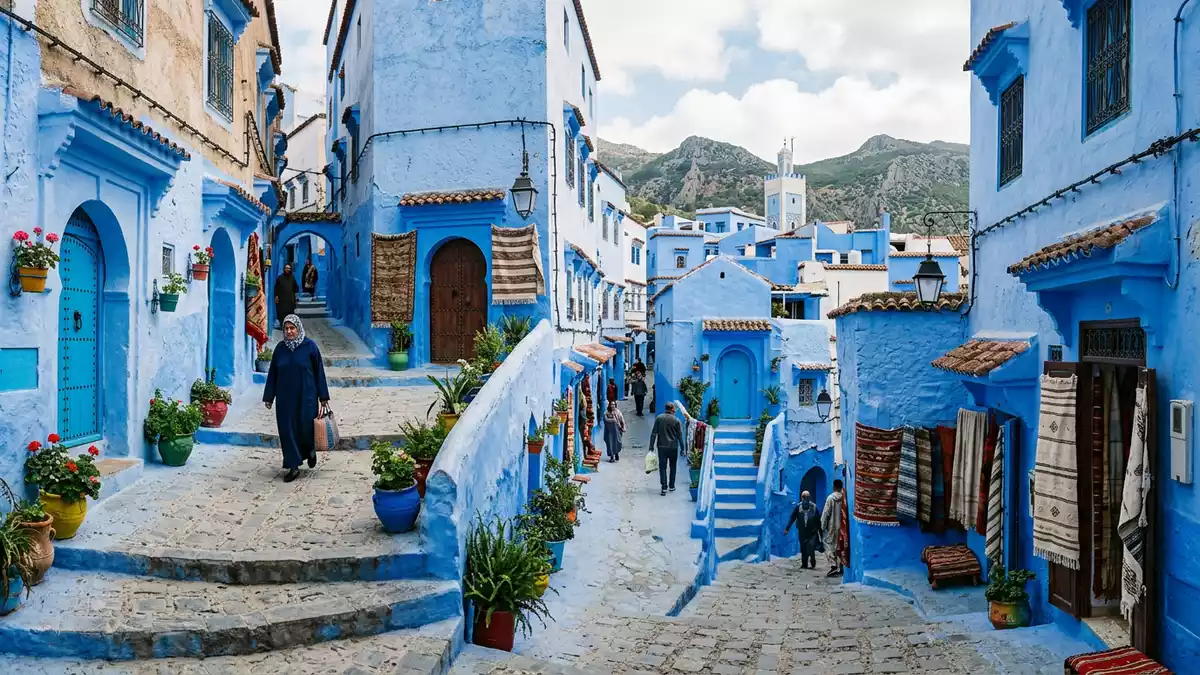
Chefchaouen Medina, the historic old town of Chefchaouen in northern Morocco, spreads across the lower slopes of the Rif Mountains in a dense patchwork of blue and white houses. Founded in the fifteenth century under the leadership of Moulay Ali ben Rashid, this walled quarter has grown into a compact urban landscape where painted façades, tiled roofs and narrow lanes are all pressed into the same steep terrain.
Blue limewash on a mountainside townscape
The most striking feature of Chefchaouen Medina is the extensive blue limewash that covers so many of its walls, steps and doorways. The city is known for buildings in shades of blue, a characteristic that has earned Chefchaouen nicknames such as the “Blue City” and “Blue Pearl” of Morocco.buildings in shades of blue In earlier periods the townscape was described as much whiter, but during the twentieth century blue pigment was increasingly mixed into limewash, so that entire neighbourhoods in the medina came to be painted in different tones of blue.neighbourhoods covered in different shades of blue
Walking through Chefchaouen Medina reveals how varied that colour can be. Some alley walls are pale and powdery, others shaded towards indigo where repeated coats have darkened over time.pale and powdery, others shaded towards indigo Staircases climb past blue-painted niches and recessed entrances, with contrasting white edges that catch the light. Wooden doors, window grilles and small archways are often picked out in stronger pigments than the surrounding limewash, so that a single façade can carry several tones of blue at once. Where walls meet the stone of the mountain or unpainted masonry, the colour line is sharp, emphasising how much of the visible surface has been deliberately transformed by pigment.
Andalusian-influenced architecture in a fifteenth-century medina
Chefchaouen as a settlement dates back to the late fifteenth century, when a fortified outpost was established beneath twin peaks in the Rif to control movement through the surrounding valleys.founded at the end of the 15th century During that period, Muslim and Jewish refugees from Granada and other parts of al-Andalus settled here, bringing architectural habits and decorative traditions that helped shape the medina. Many houses in Chefchaouen Medina are built in a Berber-Andalusian style, with compact volumes, tiled roofs and elevations organised around internal courtyards.Berber-Andalusian style
In the streets, that architectural pattern reads as a series of terraces and projecting elements that break up the steep hillside. External staircases link different levels of the same house, small balconies lean over lanes, and brick or masonry arches brace upper storeys across narrow passages.houses rise in compact terraces Many façades carry simple geometric panels in the same limewash as the surrounding wall, so that a continuous surface stretches from one plot to the next instead of a row of sharply separated fronts. Fountains, covered passages and small public squares punctuate the lanes, giving short horizontal pauses in a town mostly composed of slopes and steps.fountains, covered passages and small public squares
Kasbah, square and steep alleys at the heart of the medina
At the centre of Chefchaouen Medina lies Outa el-Hammam, the main historical square of the town.Outa el-Hammam, the main historical square This open space is framed by façades with arcades, small terraces and a mix of blue and neutral colours. Directly on the square stands the kasbah of Chefchaouen, a fifteenth-century fortified residence whose high walls, towers and internal garden recall the defensive role the town played when it was founded.Kasbah of Chefchaouen The kasbah’s ochre-coloured surfaces and robust masonry form a strong visual contrast with the blue and white façades that now characterise much of the surrounding medina.ochre-coloured walls create a striking contrast
From Outa el-Hammam, narrow streets radiate into residential quarters and towards the edges of the old town. Some lanes head uphill, closely following the slope of the mountain and turning into staircases where the gradient becomes too steep for a continuous path.streets rise and fall, staircases follow one another Others descend towards gates such as Bab el-Ain and towards the more modern fabric of Chefchaouen outside the old walls.towards Bab el-Ain and the modern town Within the medina, small mosques, religious schools and neighbourhood squares are tucked into corners between houses, their minarets and courtyards rising above or opening onto the interlocking maze of blue-painted routes.
Visiting Chefchaouen Medina: what travellers from Western Europe should know
- Chefchaouen Medina lies in northern Morocco, in the Rif Mountains south of the Mediterranean coast. It forms the historic centre of Chefchaouen, reached over mountain roads from larger cities such as Tangier and Fes.
Within the old town, movement is on foot along lanes and staircases. - The terrain inside the medina is steep, with streets that rise and fall and many staircases linking different levels. Narrow passages, stepped alleys and uneven surfaces are characteristic features of the historic quarters.
- Outa el-Hammam, the main square of the medina, is a practical point of orientation. From here, paths lead uphill towards residential areas above the kasbah and downhill towards Bab el-Ain and the newer parts of Chefchaouen.
- The official language is Arabic and the currency is the Moroccan dirham.
- Entry requirements depend on your nationality; UK travellers can check the FCDO travel advice at gov.uk/foreign-travel-advice, Irish travellers the Department of Foreign Affairs at ireland.ie.
Searching for Chefchaouen Medina on social platforms
These links open searches for Chefchaouen Medina on each platform.
Frequently asked questions about Chefchaouen Medina
Where is Chefchaouen Medina located?
Chefchaouen Medina forms the historic centre of Chefchaouen, a mountain town in northern Morocco set on the slopes of the Rif range south of the Mediterranean coast.
What should visitors expect on a first walk through the medina?
Visitors encounter steep, narrow lanes, staircases and small squares lined with houses in blue and white, centred on the ochre kasbah and the main square of Outa el-Hammam.
What makes Chefchaouen Medina distinctive among Moroccan old towns?
The combination of fifteenth-century origins, Andalusian-influenced architecture, the kasbah and the extensive blue limewash on walls and steps gives Chefchaouen Medina a particularly recognisable appearance within Morocco.


