
Chichen Itza and its stone core in Yucatán
Published on 09/18/2026 at 14:14 | Editorial responsibility: Rafael Müller, Editor-in-Chief AD HOC NEWS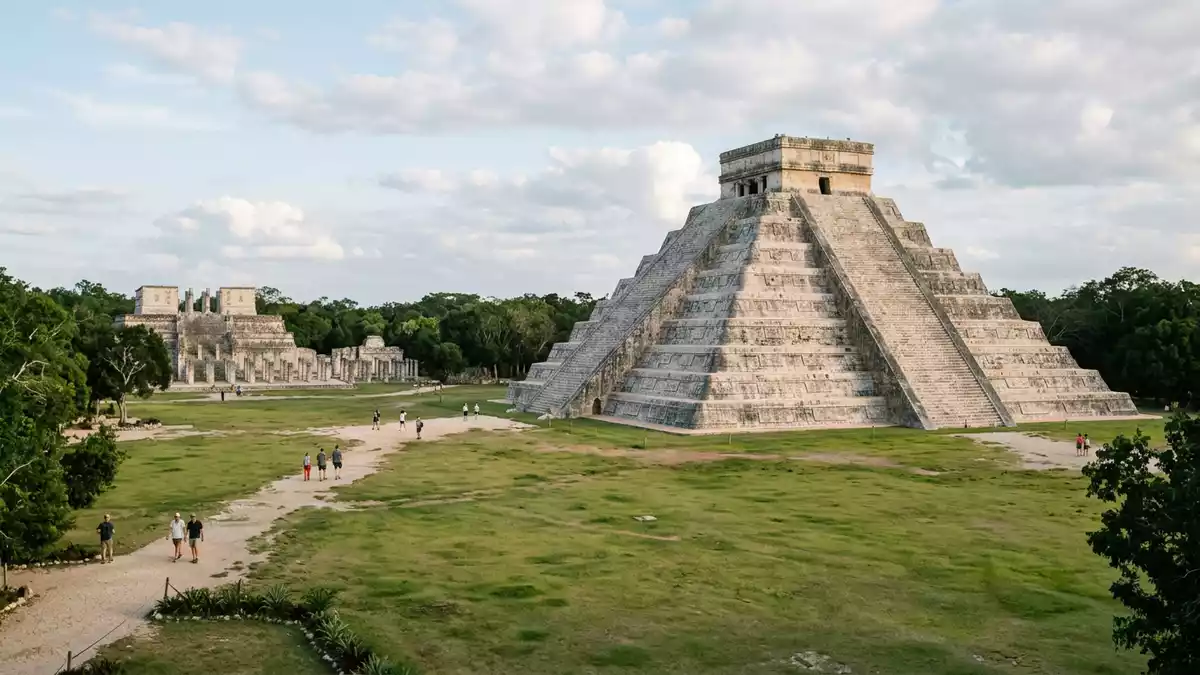
Chichen Itza is a pre-Hispanic Maya city in Yucatán, near Valladolid in Mexico, and a UNESCO World Heritage site. Its best-known buildings stand in stone, with El Castillo and the Great Ball Court giving the place its strongest outline.
Maya stonework and Toltec layers
The site is linked with the Maya-Toltec civilisation and UNESCO’s listing of the Pre-Hispanic City places it among the major archaeological ensembles of the Yucatán Peninsula. The surviving buildings show a mix of Maya planning and later architectural elements associated with central Mexico, especially in the carved stone facades and stepped masses.
Archaeological descriptions place the city’s main florescence between the tenth and twelfth centuries, with earlier occupation before that period and monumental building continuing across several phases. That broad span matters because the site is not a single-time snapshot; it is a layered urban landscape with temples, platforms, courtyards and processional spaces.
El Castillo and the great ball court
The stepped pyramid of Kukulkán, known in English as El Castillo, dominates the site with its square terraces and broad stairways. Nearby, the Great Ball Court stretches across an open ceremonial space, its long walls giving a sense of scale without relying on elaborate ornament.
Other named structures, including the Temple of the Warriors and the Observatory, broaden the impression of a city organised around stone architecture rather than isolated monuments. The UNESCO record also notes the site’s importance as a vestige of the Maya-Toltec civilisation, which helps explain why the buildings are read together rather than one by one.
A city of platforms, halls and carved facades
Chichen Itza is not defined by a single pyramid alone. It includes platforms, colonnaded ranges, temple groups and smaller buildings with dense carved detail, all of them arranged across an archaeological zone that once formed a major urban centre.
The material language is consistent: limestone blocks, stepped profiles, and relief work that makes the walls read as surfaces for carving as much as for enclosure. That visual unity gives the site a strong identity even when individual monuments differ in scale and purpose.
Visiting Chichen Itza: what travellers from Western Europe should know
- Chichen Itza lies in Yucatán, east of Valladolid, and visitors typically reach it by road from the town or by bus service on the Valladolid corridor.
- The archaeological zone is spread over open ground with broad walking surfaces, stone steps and exposed sun across much of the site.
- The official language is Spanish and the currency is the Mexican peso.
- Entry requirements depend on your nationality; UK travellers can check the FCDO travel advice at gov.uk/foreign-travel-advice, Irish travellers the Department of Foreign Affairs at ireland.ie.
Searching for Chichen Itza on social platforms
These links open searches for Chichen Itza on each platform.
Frequently asked questions about Chichen Itza
Where is Chichen Itza?
It lies in Yucatán, close to Valladolid and within Mexico’s northern Yucatán Peninsula. The site forms part of a larger archaeological zone rather than a single isolated monument.
What does a visit involve?
The setting is open and expansive, with stone structures spread across level ground and broad ceremonial spaces. El Castillo and the Great Ball Court provide the clearest first impressions, but the smaller buildings add depth.
What makes Chichen Itza distinctive?
Its combination of Maya and Toltec elements gives it a layered architectural character. The UNESCO-listed city combines pyramid forms, ball courts, platforms and carved facades in one historic landscape.


