
Chichen Itza and the stone geometry of a Maya city
Published on 09/24/2026 at 10:03 | Editorial responsibility: Rafael Müller, Editor-in-Chief AD HOC NEWS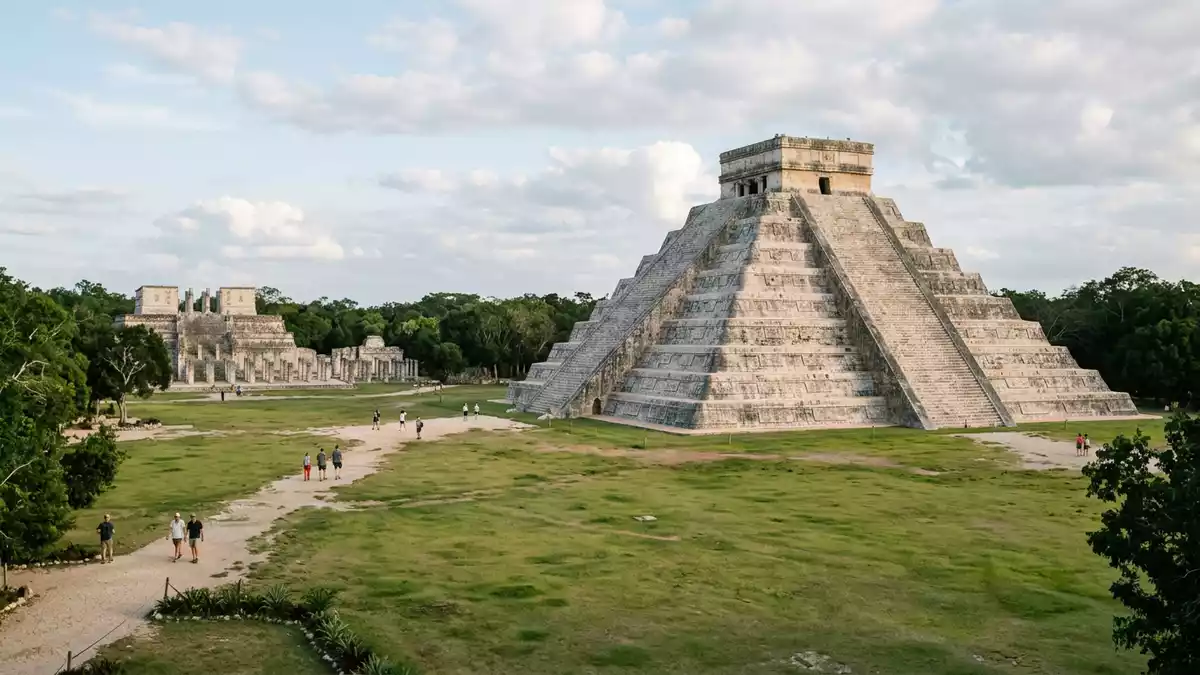
Chichen Itza spreads across the Yucatan Peninsula as a Maya city of pyramids, temples, courts and broad ceremonial spaces. Its most recognisable structure, El Castillo, rises at the centre of the archaeological zone, while the surrounding buildings reveal several centuries of architecture, sculpture and ritual life.
El Castillo and the geometry of the ceremonial centre
El Castillo, also called the Temple of Kukulkan, is a stepped pyramid with stairways climbing its four sides. The building’s terraces form a strict sequence of horizontal bands, and carved serpent imagery connects the pyramid with Kukulkan, the feathered serpent known in Maya tradition.
The pyramid belongs to the monumental core of Chichen Itza, where open plazas are bordered by stone structures. The stepped pyramid El Castillo stands beside other major buildings, including the Great Ball Court and temples associated with warfare, ceremony and astronomy.
A Maya city shaped by several architectural periods
Chichen Itza was established during the Classic period, with settlement dates recorded in local traditions reaching back to the fifth century AD. The visible city developed across the sixth to tenth centuries, and its architecture includes Maya forms from the northern Yucatan alongside strong Toltec influence.
The site’s stonework carries carved figures, bands of geometric ornament and images of animals, warriors and feathered serpents. The Maya and Toltec layers are visible across the ceremonial buildings, although individual structures belong to different stages of the city’s history.
Cenotes, water and the northern Yucatan landscape
The name Chichen Itza is connected with wells or cenotes, natural cavities that formed part of the city’s landscape. These water-filled limestone features belong to the porous geology of the Yucatan Peninsula, where surface rivers are scarce.
The Sacred Cenote lies within the archaeological zone, while the monumental centre contains temples, colonnades and plazas on relatively level ground. Chichen Itza remained a significant sacred place after its political importance declined, and Maya communities continued to associate the ruins with religious memory.
The city’s history covers a long span rather than a single architectural moment. UNESCO places the main settlement within a sequence extending from the Classic period into the centuries after the thirteenth century, with no major monuments recorded after that point. The World Heritage inscription of 1988 recognises the pre-Hispanic city as a major Maya cultural site.
Visiting Chichen Itza: what travellers from Western Europe should know
- Chichen Itza lies in Yucatan state, east of Merida and close to Valladolid. Road transport from Valladolid and Merida is the principal approach, with the archaeological zone reached from the regional highway.
- The site covers a broad area of plazas, temples and pathways. A visit involves walking between separated monuments across open ground, with limited shade beside some structures.
- El Castillo is viewed from ground level. Access to the pyramid is restricted, while the Great Ball Court, the Temple of the Warriors and the Observatory form part of the monumental area.
- The official language is Spanish and the currency is the Mexican peso.
Searching for Chichen Itza on social platforms
These links open searches for Chichen Itza on each platform.
Frequently asked questions about Chichen Itza
Where is Chichen Itza?
Chichen Itza is in Yucatan state on Mexico’s Yucatan Peninsula, near Valladolid. The archaeological zone lies between Valladolid and Merida.
What can visitors see at Chichen Itza?
The monumental area includes El Castillo, the Great Ball Court, the Temple of the Warriors, the Observatory, colonnades and the Sacred Cenote.
What makes Chichen Itza distinctive?
Its buildings combine Maya architectural traditions with Toltec influence. El Castillo, carved serpent imagery and the connection with cenotes give the city a distinctive visual and cultural character.


