
Chichen Itza and the stone geometry of Maya Yucatan
Published on 09/23/2026 at 11:15 | Editorial responsibility: Rafael Müller, Editor-in-Chief AD HOC NEWS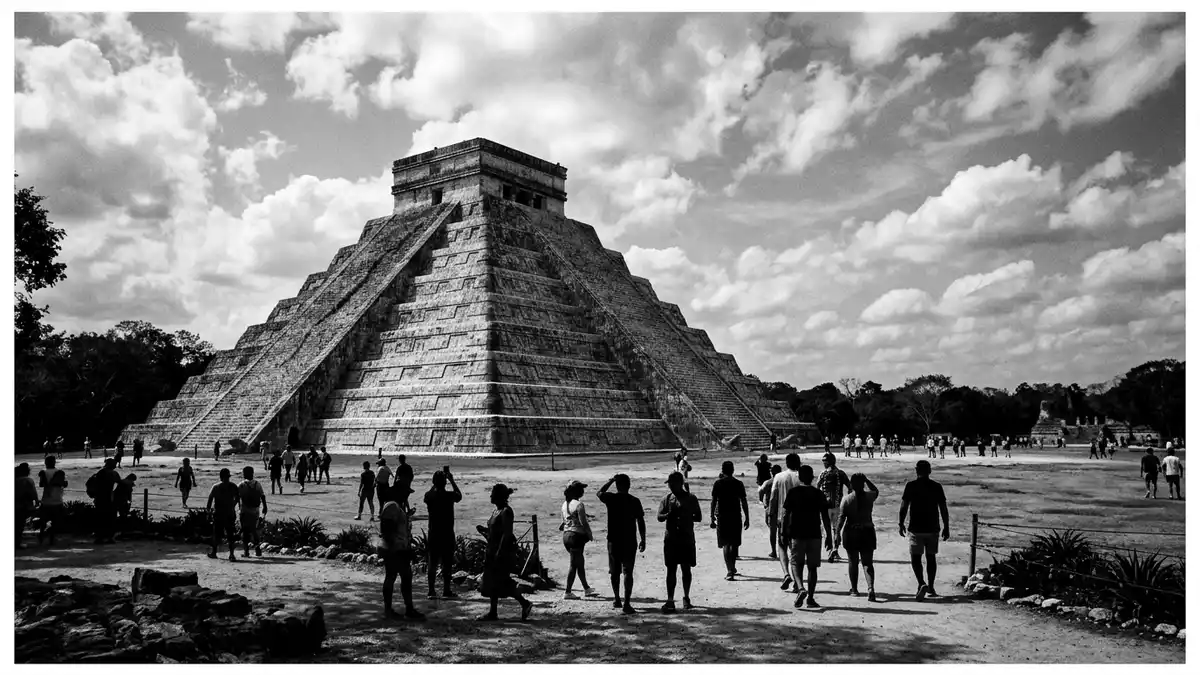
Chichen Itza is an ancient Maya city in Yucatan, near Valladolid, where broad ceremonial spaces meet stepped pyramids, carved columns and deep limestone wells. El Castillo rises at the centre of the northern group, while temples, courts and an observatory extend across the archaeological landscape.
El Castillo and the architecture of a Maya capital
El Castillo, also called the Temple of Kukulkan, is a stepped pyramid with stairways climbing its four sides. Its strong geometric form dominates the Great Plaza and gives Chichen Itza its clearest architectural focus.
The pyramid belongs to a city whose buildings combine Maya construction traditions with elements associated with central Mexico. This mixture is visible in the monuments of the northern group, including the Temple of Kukulkan and Warriors. Stone surfaces carry carved figures, feathered-serpent imagery and repeating patterns that connect architecture with Maya and Toltec visual traditions.
From Maya settlement to regional centre
Chichen Itza was founded by Maya communities around the sixth century CE and developed across the Late Classic, Terminal Classic and early Postclassic periods. Its history therefore belongs to several centuries of political and cultural change in the northern Maya lowlands.
The city reached a major phase between the tenth and fifteenth centuries. Different peoples left marks on its buildings, and the resulting architectural vocabulary includes Puuc features alongside forms linked with central Mexico. Chichen Itza was inscribed as a UNESCO World Heritage site in 1988, under the name Pre-Hispanic City of Chichen-Itza.
Courts, columns and the limestone landscape
The Great Ball Court is a long enclosed space with high side walls and carved stone panels. It forms part of a wider ceremonial area containing the Temple of the Jaguars, the Temple of the Warriors and groups of sculpted columns.
El Caracol, the circular observatory, adds a different silhouette to the complex. The name Chichen Itza refers to the mouth of the wells of the Itza, linking the city’s identity with cenotes, the natural limestone formations that hold water in the Yucatan Peninsula.
Beyond the principal plazas, the site includes platforms, temples, colonnades and carved monuments. The surviving buildings present Chichen Itza as an urban centre rather than a single pyramid, with routes between open courts and architectural groups revealing the scale of the former city.
Visiting Chichen Itza: what travellers from Western Europe should know
- Chichen Itza lies in Yucatan near Valladolid, between Merida and Cancun. Road transport is the principal way to reach the archaeological zone.
- The terrain consists of exposed limestone, broad plazas and stone buildings. El Castillo and several other monuments are viewed from ground level rather than climbed.
- The surrounding Yucatan landscape is low and largely level, while cenotes form part of the region’s natural geography and the site’s name.
- The official language is Spanish and the currency is the Mexican peso.
Searching for Chichen Itza on social platforms
These links open searches for Chichen Itza on each platform.
Frequently asked questions about Chichen Itza
Where is Chichen Itza?
Chichen Itza is in the northern part of the Yucatan Peninsula, in Mexico, near Valladolid. The archaeological zone lies between the regional centres of Merida and Cancun.
What can visitors expect to see?
The site contains El Castillo, the Great Ball Court, the Temple of the Warriors, carved columns and El Caracol. Wide plazas connect several groups of Maya architecture across the limestone terrain.
What makes Chichen Itza distinctive?
Its monuments combine Maya building traditions with elements linked to central Mexico. The city’s stepped pyramid, observatory, ball court and cenote-related name express several layers of Yucatan history.


