
Chua Tran Quoc, Hanoi’s lakeside Buddhist pagoda
Published on 09/17/2026 at 10:08 | Editorial responsibility: Rafael Müller, Editor-in-Chief AD HOC NEWS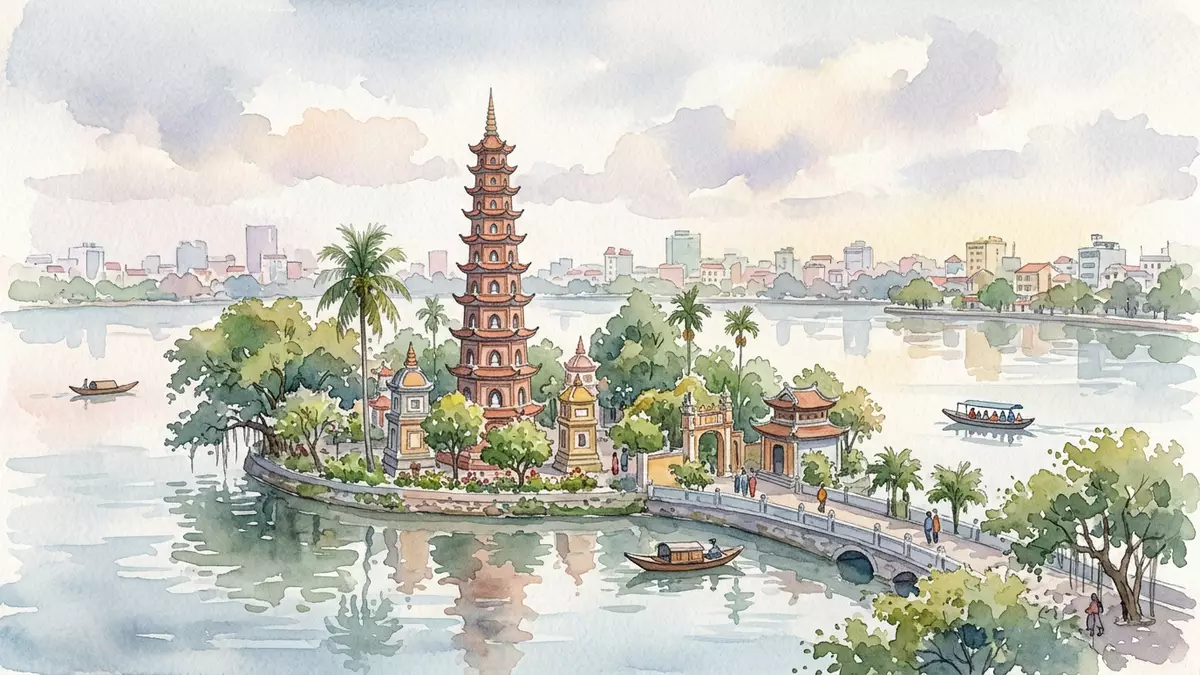
Chua Tran Quoc, known in English as Tran Quoc Pagoda, is a Buddhist temple on a small islet in Hanoi’s West Lake, widely recognised as the oldest Buddhist pagoda in the Vietnamese capital, with origins in the sixth century under Emperor Ly Nam De.
A sixth-century pagoda on West Lake
Chua Tran Quoc stands on a compact islet off the eastern shore of West Lake, linked to Thanh Nien Street in Yen Phu Ward by a short causeway that carries visitors across the water into its courtyards.Tran Quoc Pagoda is located on an islet east of West Lake The setting is unusual within Hanoi, with the pagoda complex surrounded on all sides by the broad surface of West Lake and separated from the dense city streets by the narrow strip of land of Thanh Nien Street.
The pagoda’s history reaches back to the reign of Emperor Ly Nam De in the sixth century, when the original foundation was established under the name Khai Quoc, meaning “Found the Nation”, during the pre-Ly dynastic period.The pagoda was built between 541 and 547 during the reign of King Ly Nam De Over the centuries its name changed several times, settling as Tran Quoc during the reign of King Le Hy Tong in the seventeenth century, and it has been known by that name since.
Layers of imperial and religious history
For centuries Chua Tran Quoc was closely associated with the Thang Long Imperial Citadel, serving as a significant Buddhist centre under the Ly and Tran dynasties and receiving royal visits on religious occasions.Tran Quoc Pagoda was established as the Buddhist centre of Thang Long under the Ly and Tran dynasties Historical texts record the presence of eminent monks at the pagoda, and the complex has been renovated repeatedly, reflecting architectural continuity across Vietnamese dynastic eras.Tran Quoc architecture shows harmonious continuity between historical eras
The pagoda was originally sited near the bank of the Red River under the name Khai Quoc Pagoda and was later relocated to its present lakeside position in the early seventeenth century, when its name settled as Tran Quoc.After a landslide, the pagoda was moved to the current location and its name settled as Tran Quoc in the early seventeenth century The site has been recognised as a National Historical and Cultural Heritage site since the early 1960s, underscoring its importance in the religious and cultural landscape of Hanoi.Tran Quoc Pagoda is listed as a National Historical and Cultural Heritage site
Courtyards, towers and lakeside views
Inside the precinct, Chua Tran Quoc follows a traditional Vietnamese Buddhist layout, with a sequence of halls and shrines arranged along a central axis from the main gate towards the inner sanctuaries.The main architectural units of Tran Quoc pagoda include the Front Hall, Incense Ward, Upper Edifice, Bell Tower, Ancestral Shrine and House of Steles The complex includes a front hall, incense space, upper hall, bell tower, ancestral shrine and a house of steles, forming a sequence of timber structures with tiled roofs that frame the inner courtyard.
One of the most distinctive features is the garden of towers, where multi-tiered brick stupas rise above the surrounding trees and walls, some dating to the eighteenth century and carrying statues and inscriptions in their niches.The highlight in the pagoda is its garden with many ancient towers dating back to the eighteenth century From the garden and the outer paths, views open across West Lake, with the pagoda’s towers and rooflines reflected in the water and the skyline of Tay Ho District forming a backdrop beyond the lake.
Visiting Chua Tran Quoc: what travellers from Western Europe should know
- Chua Tran Quoc stands on Kim Ngu islet off the eastern shore of West Lake in Hanoi’s Tay Ho District, linked to Thanh Nien Street by a short causeway that crosses between West Lake and Truc Bach Lake.
- The approach from Thanh Nien Street involves crossing the causeway on foot and entering through the main gate into a sequence of courtyards and halls, with stone paving and a modest number of steps within the complex.
- The pagoda lies in Yen Phu Ward in Hanoi, with the official language being Vietnamese and the currency the Vietnamese dong.
- Entry requirements depend on your nationality; UK travellers can check the FCDO travel advice at gov.uk/foreign-travel-advice, Irish travellers the Department of Foreign Affairs at ireland.ie.
Searching for Chua Tran Quoc on social platforms
These links open searches for Chua Tran Quoc on each platform.
Frequently asked questions about Chua Tran Quoc
Where is Chua Tran Quoc located in Hanoi?
Chua Tran Quoc stands on a small islet in West Lake in Hanoi’s Tay Ho District, linked to Thanh Nien Street in Yen Phu Ward by a short causeway.
What should visitors expect when entering the pagoda complex?
Visitors arrive via the lakeside causeway and pass through the main gate into courtyards, halls and tower gardens, with views across West Lake and traditional Buddhist architecture throughout the precinct.
What makes Chua Tran Quoc distinctive among Hanoi’s religious sites?
The pagoda combines a sixth-century foundation under Emperor Ly Nam De and long-standing status as Hanoi’s oldest Buddhist pagoda with a compact island setting on West Lake and a garden of historic towers.


