
Church of the Holy Sepulchre and the crowded heart of Jerusalem
Published on 09/05/2026 at 19:04 | Editorial responsibility: Rafael Müller, Editor-in-Chief AD HOC NEWS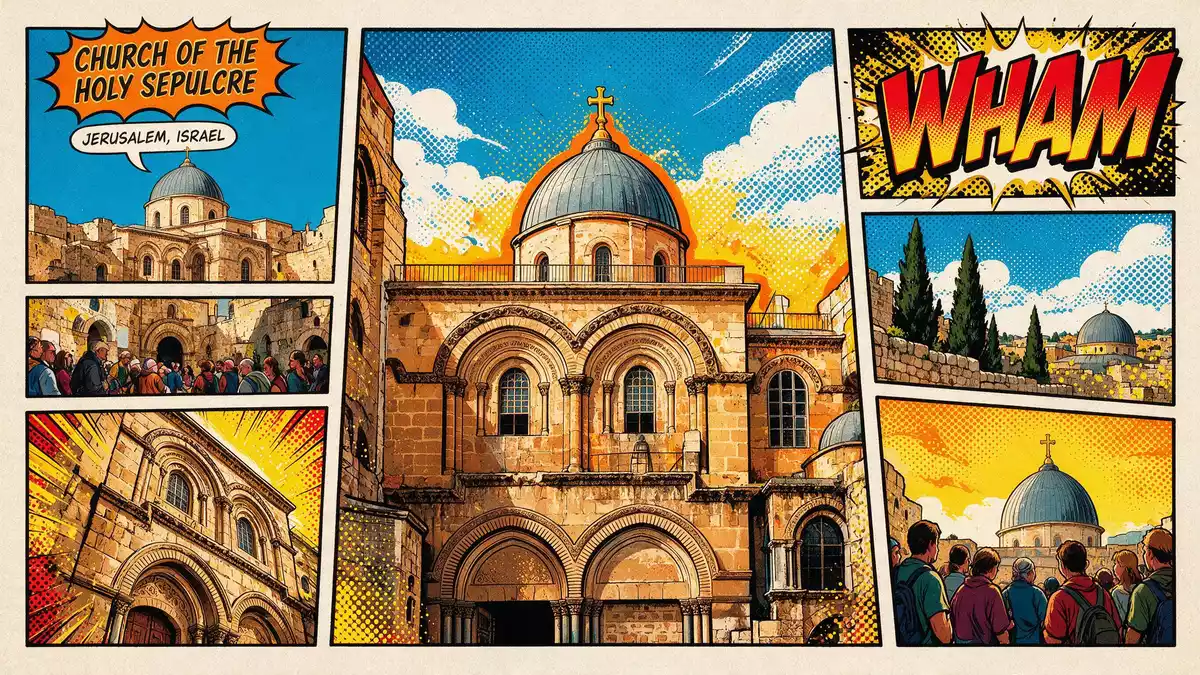
In Jerusalem’s Old City, the Church of the Holy Sepulchre brings the traditional sites of Jesus’s Crucifixion and burial into a single, densely layered church complex shaped by nearly 1,700 years of rebuilding. Founded in the fourth century under Emperor Constantine the Great and largely rebuilt in the twelfth century Crusader period, it stands as a compact world of chapels, domes and stone passages around Golgotha and the rock-cut tomb.
From Constantine’s complex to a Crusader church
The Church of the Holy Sepulchre traces its origins to the reign of Constantine I, when a Christian basilica was laid out between about 326 and 335 CE over a former quarry area of Jerusalem linked with the Crucifixion and burial narratives.Founded under Constantine the Great The early layout combined an entrance courtyard, a long basilica and the rotunda known as the Anastasis, which enclosed the rock-cut tomb in a shrine or edicule.A basilica, courtyard and rotunda
This Constantinian complex suffered major damage in 614 when Persian forces burned the church and again in 1009 when the Fatimid caliph al-Hakim ordered its destruction, leaving only fragments of the original structures.Burned in 614 and destroyed around 1009 In 1048 the Byzantine emperor Constantine IX Monomachos oversaw a reconstruction that preserved the rotunda and courtyard but did not fully restore the earlier basilica fronting the cardo, the main Roman street through Jerusalem.Rebuilt and rededicated around 1048
Golgotha, the tomb and the compact interior
Within the present church the traditional sites of Golgotha and the tomb sit only a short distance apart, both enclosed within stone architecture instead of standing in open rock.Two points of bare Jerusalem rock The rotunda of the Anastasis forms a circular hall under a high dome with the edicule at its centre, surrounding the space where the tomb is venerated, while chapels and stairways lead towards the upper level of Golgotha, marked within an ornate chapel above the main floor.
The Crusader rebuilding in the twelfth century gave much of the church its Romanesque character, enclosing Golgotha and the tomb under a single roof and adding a bell tower, barrel vaults and a reoriented main entrance on the south side.Twelfth-century Crusader Romanesque modifications The present church fabric dates largely from work completed in 1810 after a fire, when the edicule over the tomb was rebuilt in an Ottoman Baroque style by a Greek architect, adding a distinctive sculpted surface in contrast to the heavier masonry of the surrounding rotunda.Edicule rebuilt in 1810 in Ottoman Baroque style
Shared guardianship and living traditions
The Church of the Holy Sepulchre lies in the Christian Quarter in the northwest part of Jerusalem’s Old City and serves several Christian communities, whose liturgies and processions continue within the same stone spaces that have been altered across centuries.In the northwest quarter of the Old City A long-standing arrangement known as the Status Quo regulates the use and care of different chapels and altars, reflecting the shared guardianship among Eastern Orthodox, Oriental Orthodox and Roman Catholic communities.Status Quo agreement among denominations
Frequent repair and partial restoration have kept the compact church functioning despite damage from fire, instability in older masonry and the wear of heavy use, so that the visitor moves through layers of Byzantine, Crusader, Ottoman and later work rather than a single, uniform style.Present church dating mainly from 1810 The visible fabric therefore records a long architectural history focused on protecting and framing Golgotha and the tomb, the two points of rock around which the entire complex has been organised since Constantine’s time.Architecture focused on tomb and Calvary
Visiting Church of the Holy Sepulchre: what travellers from Western Europe should know
- The church stands in the Christian Quarter of Jerusalem’s Old City, west of the main market streets, and is reached on foot through narrow stone lanes.
- The interior includes stairways and uneven stone floors, with the ascent to the Golgotha chapel reached by a short but steep staircase inside the church.
- The official language in Israel is Hebrew and the currency is the Israeli new shekel.
- Entry requirements depend on your nationality; UK travellers can check the FCDO travel advice at gov.uk/foreign-travel-advice, Irish travellers the Department of Foreign Affairs at ireland.ie.
Searching for Church of the Holy Sepulchre on social platforms
These links open searches for Church of the Holy Sepulchre on each platform.
Frequently asked questions about Church of the Holy Sepulchre
Where is the Church of the Holy Sepulchre located?
The church stands in the Christian Quarter of the Old City of Jerusalem, in the northwest part of the walled historic area.
What should visitors expect inside the church?
Visitors encounter an intricate interior of chapels, domes and stone corridors, with the traditional sites of Golgotha and the tomb enclosed within the same compact building.
What makes the Church of the Holy Sepulchre distinctive?
Its compact plan brings Crucifixion and tomb traditions into a single, multi-level church, where Constantine-era foundations, Crusader work and an 1810 Ottoman Baroque edicule stand side by side.


