
Citadel of Qaitbay: Alexandria’s fortress by the Mediterranean
Published on 09/22/2026 at 07:11 | Editorial responsibility: Rafael Müller, Editor-in-Chief AD HOC NEWS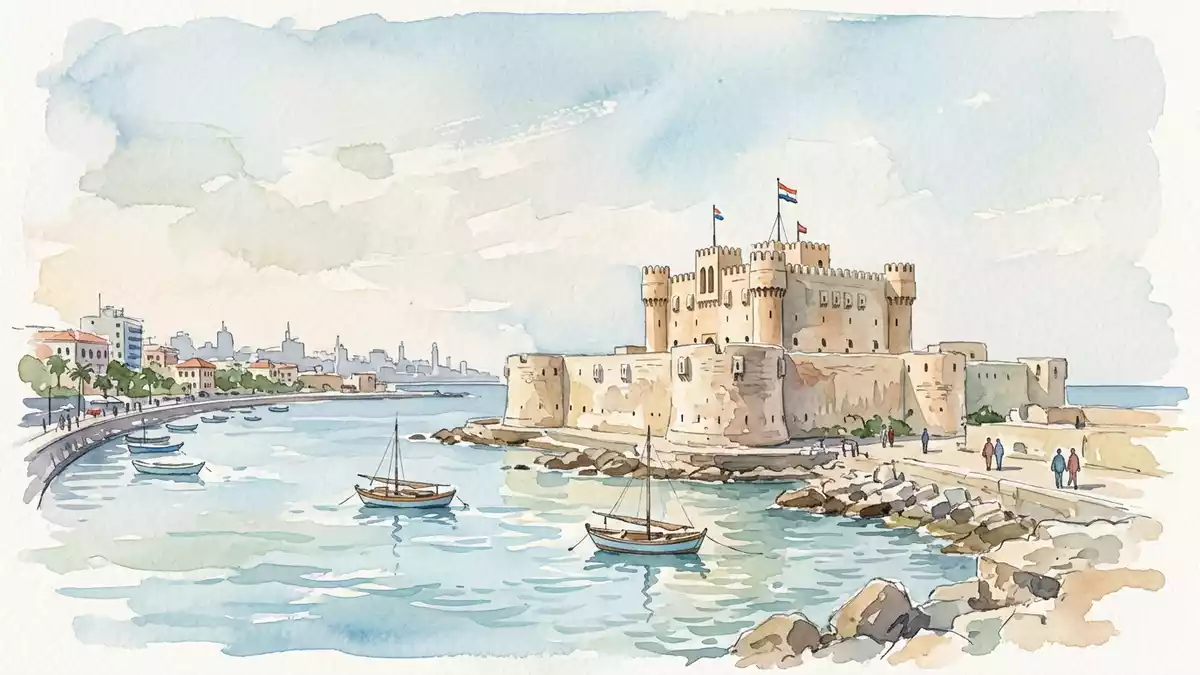
Citadel of Qaitbay occupies the eastern harbour of Alexandria, Egypt, where heavy stone walls meet the Mediterranean. Sultan Al-Ashraf Qaitbay built the fortress in the fifteenth century on the site associated with Alexandria’s ancient Pharos lighthouse.
Citadel of Qaitbay beside Alexandria’s harbour
The citadel forms a compact fortified complex at the end of the eastern harbour. Its pale stone walls, towers and battlements face the water, while Alexandria’s urban coastline extends behind it. The building is both a defensive monument and a prominent part of the city’s maritime setting.
Its name comes from Sultan Al-Ashraf Qaitbay, the Mamluk ruler who commissioned the fortress in the late fifteenth century. The surviving structure belongs to the Mamluk period, whose architecture appears in its solid masonry, crenellated parapets, arched openings and carefully controlled entrances. The Mamluk citadel structure remains closely connected with Alexandria’s harbour history.
Mamluk walls and the memory of the Pharos
Citadel of Qaitbay is traditionally dated to 1477–1479, when the fortress took shape under Qaitbay’s rule. Its position is associated with the ancient Pharos of Alexandria, the lighthouse that stood near this part of the coast in antiquity. The citadel is not the lighthouse itself, but its location carries the memory of one of the ancient Mediterranean world’s most celebrated structures.
The fortress includes a central defensive tower surrounded by enclosing walls. Stone staircases, vaulted rooms and narrow passages connect the different parts of the complex. The inner spaces retain the visual language of military architecture: thick walls, limited openings, elevated defensive positions and a strong distinction between exterior fortification and interior chambers.
The central tower contains rooms associated with the fortress administration and military life. Its upper levels include a mosque with Mamluk architectural features, including stone detailing, arches and a carefully organised interior. The Alexandria harbour setting places these historic rooms within a city shaped by navigation, trade and contact across the Mediterranean.
From coastal defence to a historic landmark
The citadel’s original function was military. Its walls protected the harbour approach, and its elevated position connected the fortress with Alexandria’s coastal defence system. The building’s form remains legible through its battlements, towers, defensive wall walks and restricted gateways.
Its history reflects Alexandria’s position between land and sea. Mamluk rule shaped the fortress, while the harbour connected the city with Egypt, the eastern Mediterranean and routes beyond. The site also preserves a link with earlier Alexandria through its association with the Pharos lighthouse.
Inside, the rooms present a sequence of stone chambers, arches and vaulted ceilings. The exterior provides views across the harbour and the Mediterranean, while the fortress walls frame the coastline in different directions. The contrast between enclosed military architecture and open sea is central to the character of Citadel of Qaitbay.
The monument is part of Alexandria’s historical landscape alongside the Corniche, the harbour and the city’s archaeological collections. Its identity rests on several layers: the Mamluk fortress, the coastal setting and the memory of the ancient lighthouse. The Pharos historical association gives the site a longer chronology than the fifteenth-century walls alone suggest.
Visiting Citadel of Qaitbay: what travellers from Western Europe should know
- Citadel of Qaitbay stands at the eastern harbour of Alexandria, beside the Mediterranean and at the end of the Corniche.
- The approach includes stone steps, vaulted passages and uneven surfaces within the fortified complex.
- The official language is Arabic and the currency is the Egyptian pound.
- Entry requirements depend on your nationality; UK travellers can check the FCDO travel advice at gov.uk/foreign-travel-advice, Irish travellers the Department of Foreign Affairs at ireland.ie.
Searching for Citadel of Qaitbay on social platforms
These links open searches for Citadel of Qaitbay on each platform.
Frequently asked questions about Citadel of Qaitbay
Where is Citadel of Qaitbay?
Citadel of Qaitbay stands at Alexandria’s eastern harbour on the Mediterranean coast of Egypt. It is positioned at the end of the Corniche.
What can visitors expect inside?
The complex contains fortified walls, stone staircases, vaulted chambers, defensive spaces and a mosque within the central tower. Exterior viewpoints face the harbour and the sea.
What makes the citadel distinctive?
Its distinctive character comes from the combination of a fifteenth-century Mamluk fortress, a harbour-side setting and an association with the ancient Pharos lighthouse.


