
Cite de Carcassonne and its double ring of medieval walls
Published on 08/25/2026 at 14:50 | Editorial responsibility: Rafael Müller, Editor-in-Chief AD HOC NEWS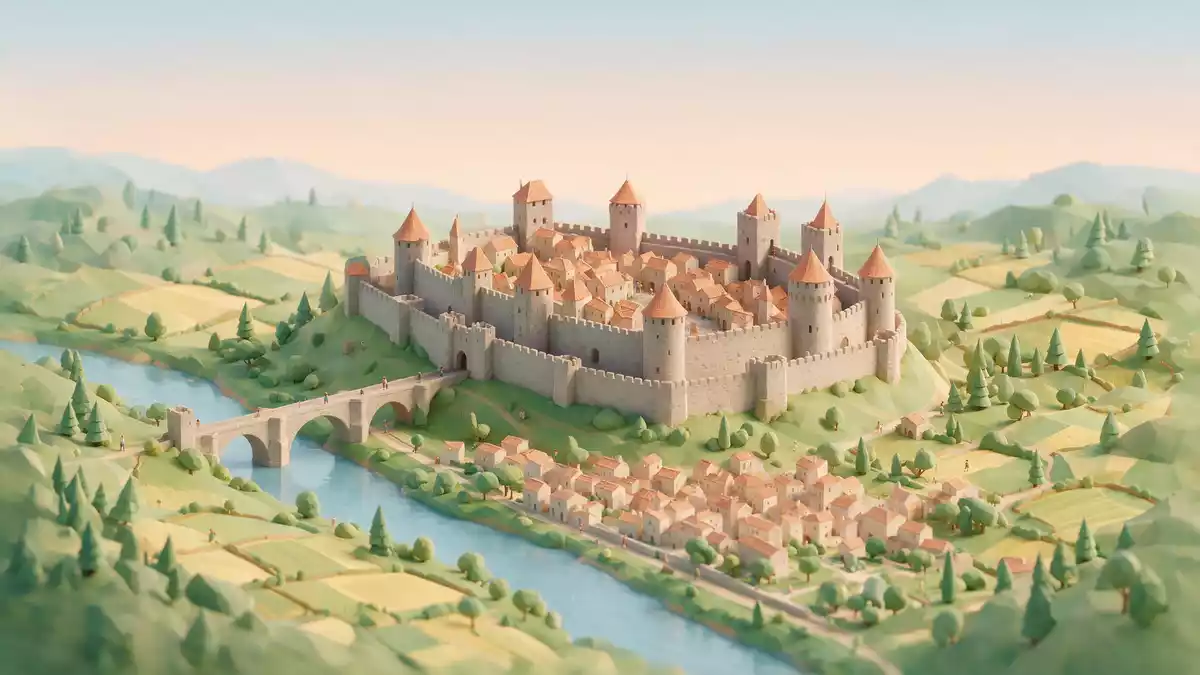
Cite de Carcassonne is a fortified medieval citadel rising above the modern city of Carcassonne in southern France, its double ring of walls enclosing a dense historic quarter. Recognised as the Historic Fortified City of Carcassonne on the UNESCO World Heritage List since 1997, it gathers two millennia of fortification into one compact hilltop. The fortified ensemble shows how Roman, medieval and nineteenth-century hands layered stone, towers and gates around a castle and a Gothic church.
From Gallo-Roman stronghold to medieval fortress town
The hilltop now known as Cite de Carcassonne carries traces of fortification reaching back to the Gallo-Roman period, when a walled enclosure first took shape on the right bank of the River Aude.founded in the Gallo-Roman period The early defences formed a compact circuit around the crest of the spur, tying the settlement to the river valley below. As centuries passed, the town saw Roman, Visigothic and later medieval occupants, all reworking the fortifications.
By the thirteenth century the citadel had taken on much of the silhouette visible today, with an inner enclosure reshaped from the earlier rampart and an outer line of walls added a short time later.inner enclosure reshaped around 1280 and outer enclosure around 1320 Together they created a fortified town with streets, houses and a castle framed between two belts of masonry. The citadel eventually became part of the kingdom of France in 1247, serving as a fortified frontier towards the Kingdom of Aragon.annexed to the kingdom of France in 1247
Walls, towers and the Château Comtal
The defining feature of Cite de Carcassonne is its double line of ramparts, a continuous defensive system wrapping around the hill for around 3 km and punctuated by 52 towers.double line of ramparts and fifty-two towers The two enclosures stand close together, separated by a narrow lane in places, and create a layered profile when seen from the plain of the Aude. From the outside, the walls rise in long sweeps of stone, interrupted by projecting towers with conical roofs added during nineteenth-century restoration work.
Inside the ramparts stands the Château Comtal, the medieval castle that formed the fortified heart of the site, surrounded by its own defences and linked directly to the city walls.inner castle, the Château Comtal Close by rises the Basilica of Saint-Nazaire, a church combining Romanesque masonry with Gothic additions and noted for its sculpted details and stained glass.fine Gothic cathedral within the fortified town Houses and small squares fill the remaining space, giving the interior the character of a compact medieval town enclosed entirely by fortifications.
Restoration, UNESCO status and the living citadel
By the nineteenth century the fortifications of Cite de Carcassonne had fallen into disrepair and faced proposals for demolition, a fate avoided through the efforts of figures including Prosper Mérimée and the architect Eugène Viollet-le-Duc.saved from demolition and restored by Viollet-le-Duc Viollet-le-Duc began work on the restoration in 1853, a programme continued by his collaborator Paul Boeswillwald and later by the architect Nodet.restored by Eugène Viollet-le-Duc between 1853 and 1879 Their interventions, although sometimes debated for their stylistic choices, stabilised the walls and towers and reinstated the fortified silhouette that defines the site.
In 1997 the Historic Fortified City of Carcassonne was inscribed on the UNESCO World Heritage List as an outstanding example of a medieval fortified town whose defences stand partly on walls from Late Antiquity.inscribed on the UNESCO World Heritage List in 1997 The inscription recognises both the layered history of the fortifications and the influence of Viollet-le-Duc’s restoration on the broader field of heritage conservation.restoration work influenced conservation practice Within the walls, a small resident population continues to live among the stone houses, while the streets connect the castle, basilica and gates in a walkable sequence of spaces framed by towers and battlements.
Visiting Cite de Carcassonne: what travellers from Western Europe should know
- Cite de Carcassonne stands on a hill on the right bank of the River Aude, on the south-eastern side of Carcassonne, and is reached from the lower town across the river.
- The terrain within the citadel includes cobbled streets and changes in level, with staircases and sloping passages connecting the interior streets, the castle and the ramparts.
- Carcassonne lies in southern France in the Aude department of the Occitanie region, and the official language is French with the currency being the euro.
- The fortified town forms part of a wider defensive landscape that includes outlying “sentinel castles” in the surrounding hills of Aude.Cité de Carcassonne and its mountain sentinel castles
- Entry requirements depend on your nationality; UK travellers can check the FCDO travel advice at gov.uk/foreign-travel-advice, Irish travellers the Department of Foreign Affairs at ireland.ie.
Searching for Cite de Carcassonne on social platforms
These links open searches for Cite de Carcassonne on each platform.
Frequently asked questions about Cite de Carcassonne
Where is Cite de Carcassonne located?
Cite de Carcassonne stands on a hill on the right bank of the River Aude, in the south-eastern part of Carcassonne in the Aude department of southern France.
What can visitors expect inside the walls?
Inside the double ring of walls, visitors find the Château Comtal, the Basilica of Saint-Nazaire and a network of narrow streets lined with stone houses and small squares.
What makes Cite de Carcassonne distinctive among fortified towns?
Cite de Carcassonne is distinguished by its double enclosure of around 3 km of ramparts with 52 towers and by the extensive restoration carried out in the nineteenth century by Eugène Viollet-le-Duc.


