
Ciudad Amurallada de Cartagena and its stone ring by the Caribbean
Published on 09/23/2026 at 22:43 | Editorial responsibility: Rafael Müller, Editor-in-Chief AD HOC NEWS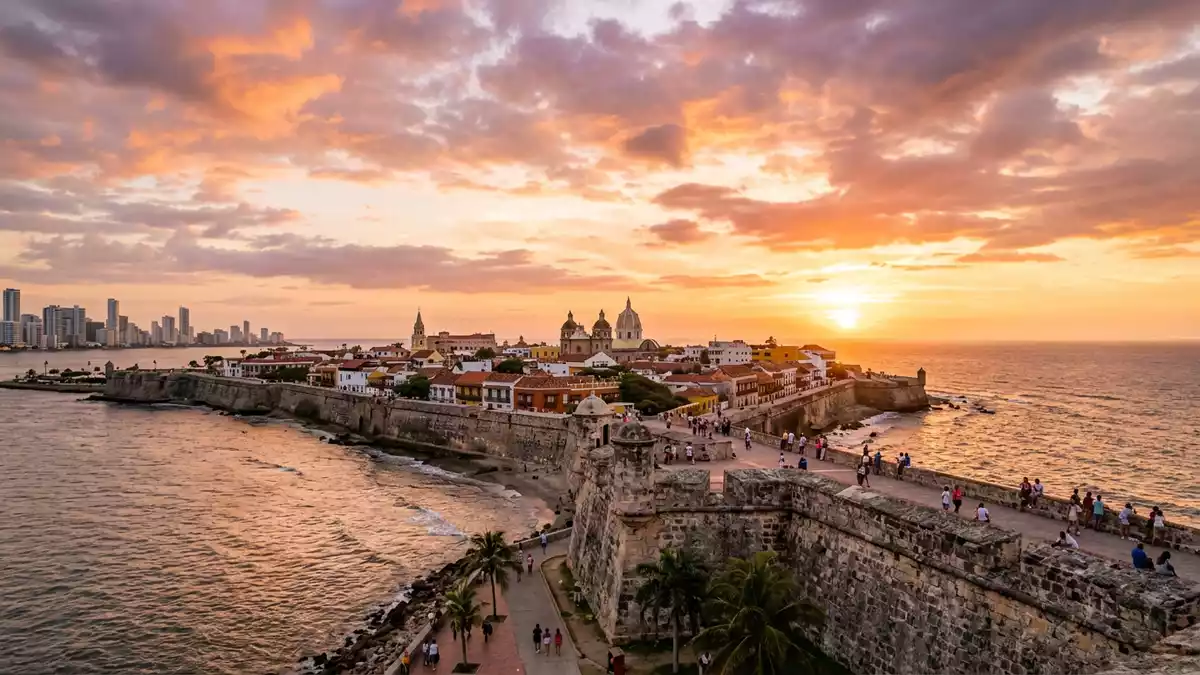
Ciudad Amurallada de Cartagena is a historic quarter enclosed by a long belt of masonry beside the Caribbean. Founded in 1533 by Pedro de Heredia, Cartagena de Indias grew into a Spanish colonial port whose walls, bastions, churches and houses remain closely joined.
The stone ring is the defining sight: a defensive perimeter, an elevated walkway and a boundary between the old quarters and the harbour landscape. Its construction belongs to the late sixteenth through eighteenth centuries, while the streets within preserve a layered urban fabric.
Ciudad Amurallada de Cartagena: a city enclosed by masonry
The fortifications developed in stages rather than as a single building campaign. Early defensive works appeared after Cartagena’s foundation, and the masonry system expanded through the colonial period. Construction of the preserved walls reached completion in 1796, according to the historical record of the city’s fortifications.
Large stretches use coral stone, giving the walls a pale, uneven surface. Bastions project from the perimeter, while the curtain walls join them into a continuous defensive line. The result is an architectural boundary that can be read from the sea, the harbour and the streets inside the enclosure.
Pedro de Heredia’s colonial port and its historic quarters
Pedro de Heredia founded Cartagena in 1533. Its position on Colombia’s Caribbean coast placed the settlement within the maritime networks of the Spanish empire, and the port became closely connected with transatlantic trade.
Inside the walls, narrow streets meet plazas, churches, civic buildings and houses with timber balconies. Painted façades and shaded arcades sit beside substantial masonry, producing a streetscape in which domestic, religious and military architecture occupy the same compact quarter.
The city’s history includes attacks, sieges and changing political authority. Francis Drake’s assault in 1586 is part of the fortification story, while the walls and forts also belong to the longer history of Spanish colonial power, Caribbean commerce and Colombian independence.
Walls, bastions and the World Heritage ensemble
Ciudad Amurallada de Cartagena forms part of the wider property called Port, Fortresses and Group of Monuments, Cartagena. UNESCO inscribed the cultural ensemble on the World Heritage List in 1984, recognising the relationship between the harbour, the historic quarters and the military architecture.
The listed ensemble extends beyond the urban wall. Castillo San Felipe de Barajas rises outside the old quarter, while additional fortifications occupy strategic positions around the bay. Within Ciudad Amurallada de Cartagena, the walls remain the clearest physical expression of the city’s colonial defensive system.
The ramparts also provide a changing view of the quarter’s materials and scales. From their upper paths, tiled roofs, church towers, balconies and modern buildings beyond the historic centre appear in the same field of vision. The stone ring remains the constant element, binding the streets and monuments into one recognisable place.
Visiting Ciudad Amurallada de Cartagena: what travellers from Western Europe should know
- Ciudad Amurallada de Cartagena lies beside Cartagena’s Caribbean harbour. Cartagena’s Rafael Núñez International Airport serves the city, and taxis connect the airport with the historic centre.
- The quarter is explored on foot across paved streets, plazas and rampart paths. The wall route includes stairs, uneven masonry and exposed sections without a continuous level surface.
- Cartagena’s official language is Spanish and its currency is the Colombian peso.
- Getsemaní lies beside the walled quarter, while Castillo San Felipe de Barajas stands outside the historic centre.
Searching for Ciudad Amurallada de Cartagena on social platforms
These links open searches for Ciudad Amurallada de Cartagena on each platform.
Frequently asked questions about Ciudad Amurallada de Cartagena
Where is Ciudad Amurallada de Cartagena?
It is the fortified historic quarter of Cartagena de Indias on Colombia’s Caribbean coast. The enclosure stands beside the city’s harbour and includes streets, plazas, churches and colonial houses.
What can travellers expect on a visit?
Visitors encounter a walkable historic quarter with masonry walls, bastions, balconies, churches and public squares. The ramparts include stairs, uneven surfaces and open sections above the surrounding streets.
What makes the place distinctive?
Its defining feature is the relationship between a continuous defensive wall and a dense colonial town. The quarter belongs to Cartagena’s World Heritage ensemble, inscribed in 1984.


