
Ciutat de les Arts i les Ciencies and Valencia’s white architectural landscape
Published on 09/23/2026 at 21:59 | Editorial responsibility: Rafael Müller, Editor-in-Chief AD HOC NEWS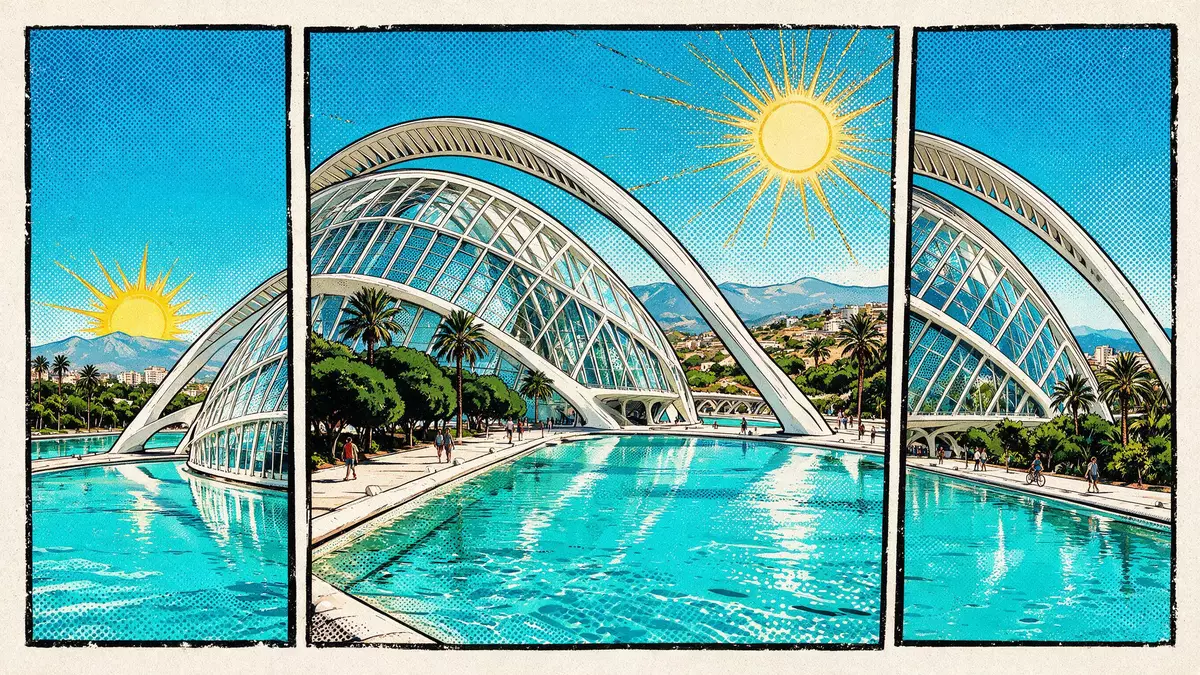
Ciutat de les Arts i les Ciencies stretches through Valencia as a long architectural landscape of white concrete, reflective water and open promenades. Designed chiefly by Santiago Calatrava, with Félix Candela contributing the Oceanogràfic, the complex brings science, culture, gardens and performance spaces together along the former Turia riverbed.
White forms along the former Turia riverbed
The complex occupies the southern part of Valencia’s former river course, which became a linear urban park after the Turia was diverted. Its buildings and bridges form a sequence beside water, planting and broad paved spaces.
White structural ribs, curved roofs and glazed surfaces recur across the site. The architecture is deliberately legible from outside, with large forms defining each building before visitors enter. The complex extends for almost 2 km and covers about 350,000 square metres. the complex’s architectural sequence includes exhibition buildings, gardens, an aquarium, bridges and performance spaces.
From L’Hemisfèric to the Oceanogràfic
L’Hemisfèric was the first major building to open, in 1998. Its programme combines planetarium presentations, IMAX films and digital projections within a low structure beside a shallow pool.
The Museu de les Ciències Príncipe Felipe opened in 2000 as an interactive science museum. L’Umbracle forms a raised garden and promenade, while the Oceanogràfic opened in 2002 with buildings dedicated to marine environments. Félix Candela designed its distinctive concrete roof structures. the six principal spaces include the aquarium, science museum, garden, cinema, opera house and Ágora.
Performance, gardens and civic space
Palau de les Arts Reina Sofía opened in 2005 and provides the complex’s opera and performance venue. Its sweeping roof and layered terraces form a separate architectural landmark within the larger sequence.
Ágora opened in 2009. The structure occupies the space between the Assut de l’Or bridge and the Oceanogràfic, and contains CaixaForum Valencia. Across the complex, the uses range from marine habitats and scientific displays to opera, cinema, exhibitions, lectures and concerts. the phased opening history runs from L’Hemisfèric in 1998 to Ágora in 2009.
Visiting Ciutat de les Arts i les Ciencies: what travellers from Western Europe should know
- Ciutat de les Arts i les Ciencies lies on the southern side of Valencia’s historic centre, along the former Turia riverbed. Valencia’s bus network and cycle routes connect the area with the city.
- The site is arranged across broad paved areas, planted promenades, bridges and water features. Individual buildings stand apart, so visiting several spaces involves walking between them.
- The complex includes L’Hemisfèric, Museu de les Ciències, L’Umbracle, Oceanogràfic, Palau de les Arts Reina Sofía and Ágora. The official language is Spanish and Valencian, and the currency is the euro.
- Valencia’s Mediterranean setting is visible in the planting around L’Umbracle and in the open water spaces between the buildings.
Searching for Ciutat de les Arts i les Ciencies on social platforms
These links open searches for Ciutat de les Arts i les Ciencies on each platform.Frequently asked questions about Ciutat de les Arts i les Ciencies
Where is Ciutat de les Arts i les Ciencies?
It lies in Valencia along the former bed of the Turia, south of the historic centre. The complex follows a long axis beside the city’s linear Turia Gardens.
What can visitors find there?
The site contains a science museum, planetarium and IMAX venue, aquarium, landscaped promenade, opera house and Ágora. Its spaces cover science, marine life, gardens, cinema, music and exhibitions.
What makes the complex distinctive?
Its identity comes from the visible relationship between white structural forms, water, bridges and open public spaces. Santiago Calatrava designed most buildings, while Félix Candela designed the Oceanogràfic roofs.


