
Colaiste na Trionoide and the Long Room’s literary landscape
Published on 09/23/2026 at 07:20 | Editorial responsibility: Rafael Müller, Editor-in-Chief AD HOC NEWS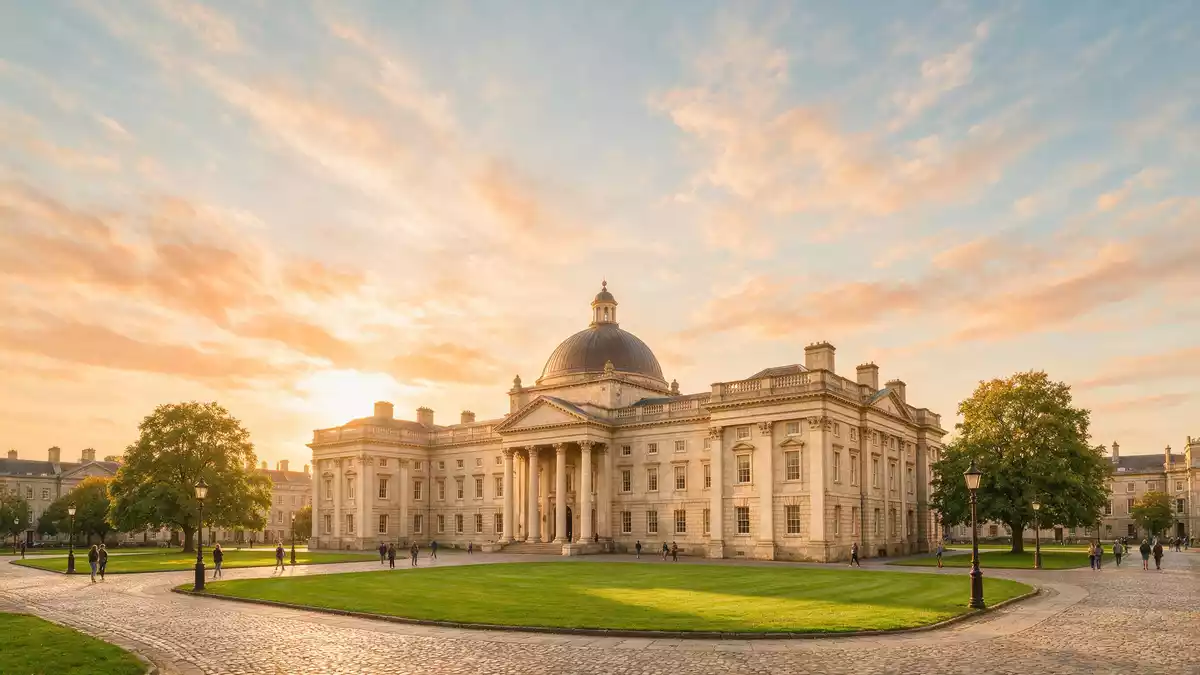
Colaiste na Trionoide occupies a historic campus beside College Green in Dublin. Its most recognisable interior, the Long Room, stretches through the Old Library with timber shelves, marble busts and a collection of historic books. The college was founded by Queen Elizabeth I in 1592, creating a place where architecture, scholarship and Irish cultural memory meet.
The Long Room: a library shaped by books
The Long Room is the main chamber of the Old Library and measures nearly 65 metres in length. Its present interior includes a barrel-vaulted ceiling, an upper gallery and long runs of oak shelving. The building was constructed between 1712 and 1732, during the period when the college expanded its central buildings. The Long Room’s history includes a substantial alteration in the nineteenth century, when the roof was raised and the upper bookcases were added.
Marble busts line the hall, presenting philosophers, writers and figures connected with the college. The collection includes Jonathan Swift, William Shakespeare, Isaac Newton, Aristotle and many other named subjects. A bust of Jonathan Swift was made by Louis François Roubiliac, while many classical figures were produced by Peter Scheemakers.
Colaiste na Trionoide from 1592 to the Georgian campus
Colaiste na Trionoide began with a royal charter granted by Queen Elizabeth I in 1592. The institution grew from a small foundation into a university whose buildings occupy a central position in Dublin. Its early history belongs to the Tudor period, while much of the visible historic campus took shape during the eighteenth century.
The Old Library was the first building of a major eighteenth-century expansion. Construction began in 1712, followed by other college buildings, including the Printing House and the Dining Hall. The campus contains architectural work from several periods, with Georgian and neoclassical buildings forming much of its historic character. The college’s recorded history also traces changes in teaching, governance and student life from the seventeenth century through the twentieth century.
The institution’s intellectual history includes figures such as Jonathan Swift, George Berkeley, Edmund Burke, Oliver Goldsmith and Wolfe Tone. Scientific work is associated with William Rowan Hamilton, Humphry Lloyd, George Salmon, George Francis Fitzgerald and John Joly. These names belong to different fields, yet they share the same Dublin campus and its long academic tradition.
The Book of Kells and the library’s cultural collections
The Old Library is associated with the Book of Kells, an illuminated manuscript containing the four Gospels. The manuscript reached Colaiste na Trionoide in 1661 and became part of the college’s cultural collections. Its decorated pages connect early Christian art, medieval bookmaking and Irish heritage.
The Long Room contains more than books. A medieval harp known as the Brian Boru harp is displayed there, although its association with the eleventh-century king is not historically established. The instrument is made from oak and willow and has 29 brass strings. It became the model for Ireland’s national emblem.
The library also holds a copy of the 1916 Proclamation of the Irish Republic, read by Patrick Pearse outside Dublin’s General Post Office on 24 April 1916. The document places the library within the political and cultural history of Ireland, while the Book of Kells connects it with medieval manuscript culture. The Book of Kells and Trinity are therefore linked through several layers of Irish history rather than a single period.
Visiting Colaiste na Trionoide: what travellers from Western Europe should know
- Colaiste na Trionoide stands on College Green in central Dublin, on the south side of the River Liffey. The Luas Green Line serves the College Green area.
- The principal historic buildings are arranged around courtyards and squares. The Long Room is reached within the Old Library, whose public route includes stairs.
- The official language is English and Irish, and the currency is the euro.
Searching for Colaiste na Trionoide on social platforms
These links open searches for Colaiste na Trionoide on each platform.Frequently asked questions about Colaiste na Trionoide
Where is Colaiste na Trionoide?
Colaiste na Trionoide is in central Dublin, beside College Green on the south side of the River Liffey.
What can visitors expect to see?
The historic campus includes courtyards, Georgian buildings, the Old Library and the Long Room, with its shelves, books and marble busts.
What makes the place distinctive?
Its distinctive character comes from the combination of a 1592 university foundation, an eighteenth-century library hall and collections such as the Book of Kells and the Brian Boru harp.


