
Colossi of Memnon, stone guardians on Luxor’s West Bank
Published on 09/17/2026 at 23:00 | Editorial responsibility: Rafael Müller, Editor-in-Chief AD HOC NEWS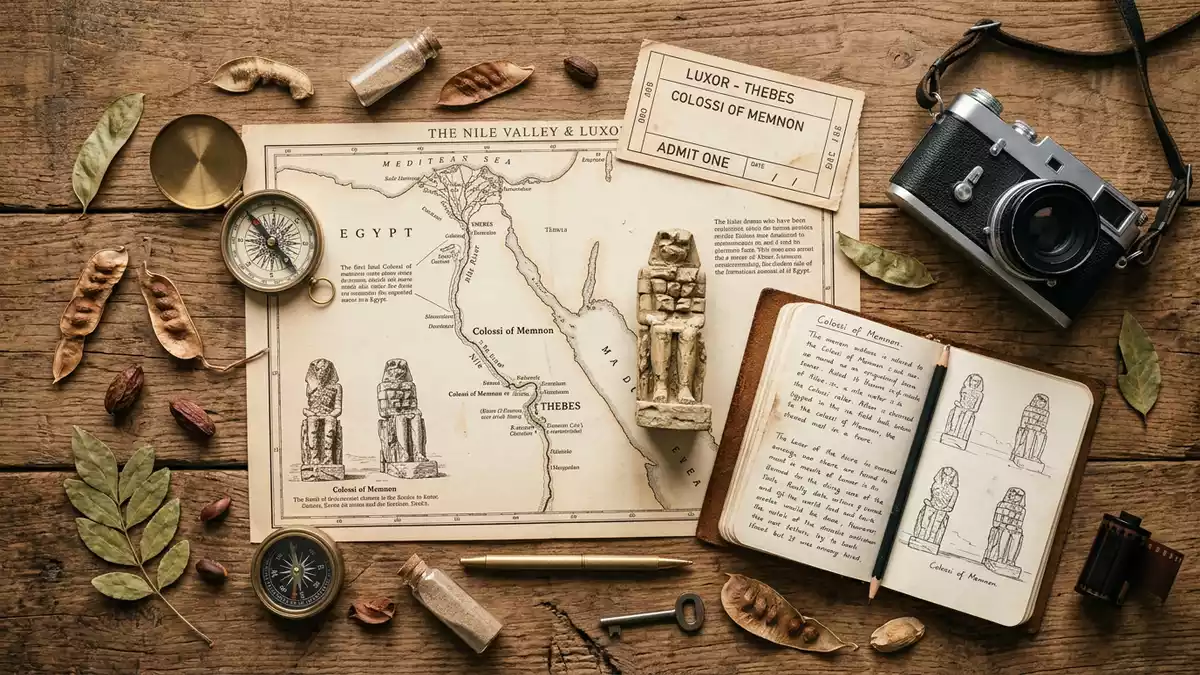
On the flat western bank of the Nile opposite Luxor, the Colossi of Memnon rise as two vast seated figures that have watched the Theban plain since the fourteenth century BC. Carved in quartzite sandstone and representing Pharaoh Amenhotep III of the eighteenth dynasty, they front the ruins of his mortuary temple and form one of the most striking encounters with ancient Egypt in the open landscape.
Amenhotep III’s giant portraits in stone
The Colossi of Memnon are a pair of monumental statues of Amenhotep III, an eighteenth?dynasty ruler whose reign is dated to the fourteenth century BC.Amenhotep III of the 18th Dynasty Each statue depicts the king seated on a throne, with his hands resting on his knees in a formal pose that is recognisable from many smaller royal images but magnified here to colossal scale.two large stone statues of the Pharaoh Amenhotep III The material is quartzite sandstone, quarried in Upper Egypt and transported to the site, then carved as single monumental blocks.
Measured with their bases, the statues stand around 18 m (59 ft) high, making them comparable in height to a multi?storey building and giving them a presence that dominates the surrounding fields.the statues are made of quartzite sandstone and stand 18 meters Each figure is seated facing east towards the Nile and the rising sun, their thrones carved with reliefs that include depictions of family members and symbolic motifs linked to kingship and the river god Hapy.seated king on a throne ornamented with imagery
Guardians of a vanished mortuary temple
The statues originally flanked the entrance to the mortuary temple of Amenhotep III, a complex that once stretched out behind them across the western plain.stand at the front of the ruined Mortuary Temple of Amenhotep III At its height, this temple is described in modern scholarship as one of the largest built in Thebes, a broad arrangement of courts and halls that has largely disappeared through ancient flooding, dismantling and reuse of stone. Today, the colossal statues are among the few prominent remains marking the former entrance.
The wider setting is the Theban Necropolis, the band of funerary temples and tomb fields that stretches along the West Bank opposite Luxor and includes sites such as Deir el?Bahari and the Valley of the Kings.near the Valley of the Kings in Theben-West in the modern city of Luxor Standing beside the road that leads towards these archaeological areas, the Colossi of Memnon occupy a low platform on the plain, with scattered blocks and fragments of temple architecture extending behind them and giving a sense of how much of Amenhotep III’s complex has vanished compared with these enduring gatekeepers.
From Egyptian royal statues to Memnon in classical tradition
Although the statues were carved to represent Amenhotep III, their name “Colossi of Memnon” belongs to a later layer of history. In Greek and Roman times, travellers associated one of the statues with Memnon, a semi?divine Ethiopian king from epic tradition, and the site became part of the classical travel lore attached to the Nile valley.named in Greco-Roman times after Memnon, a semi-divine king Ancient writers recorded stories about sounds heard from the stone at dawn, linking them to the mythic figure’s voice, and the name Memnon settled on the colossi as a cultural label.
The statues have undergone damage and repair over more than three millennia, including seismic events in antiquity and restoration work in the Roman period. Their present outlines show cracks, missing sections in the upper bodies and replacement blocks, yet the seated posture and sheer volume of stone remain clear from a distance.the Colossi were damaged and repaired and re-erected in the early Roman period This layered condition, combining ancient Egyptian craftsmanship with the marks of long history, contributes to their role as stone landmarks that link the New Kingdom to later periods of Nile?valley travel.
Visiting Colossi of Memnon: what travellers from Western Europe should know
- The Colossi of Memnon stand on Luxor’s West Bank in Egypt, beside the main road running from the riverside towards the Theban Necropolis and sites such as Deir el?Bahari and the Valley of the Kings.
- The statues rise from a low stone platform in the open plain, reached directly from the roadside; the ground around them is level but unshaded, with short walks over firm earth to view the reliefs and weathered surfaces.
- The site lies in Egypt, where the official language is Arabic and the currency is the Egyptian pound.
- Entry requirements depend on your nationality; UK travellers can check the FCDO travel advice at gov.uk/foreign-travel-advice, Irish travellers the Department of Foreign Affairs at ireland.ie.
Searching for Colossi of Memnon on social platforms
These links open searches for Colossi of Memnon on each platform.
Frequently asked questions about Colossi of Memnon
Where are the Colossi of Memnon located?
The Colossi of Memnon stand on the West Bank of the Nile opposite Luxor in Egypt, beside the road leading towards the Theban Necropolis.
What should a visitor expect on a visit?
Visitors encounter two very large seated statues of Amenhotep III in the open plain, with weathered stone surfaces, carved thrones and scattered remains of the former mortuary temple behind them.
What makes the Colossi of Memnon distinctive among ancient sites?
The site combines two quartzite sandstone statues on a monumental scale, their role as entrance guardians to Amenhotep III’s vast mortuary temple and a later association with the classical figure Memnon, all visible in the same West Bank landscape.


