
Constitution Hill brings prisons and a court together
Published on 09/23/2026 at 20:41 | Editorial responsibility: Rafael Müller, Editor-in-Chief AD HOC NEWS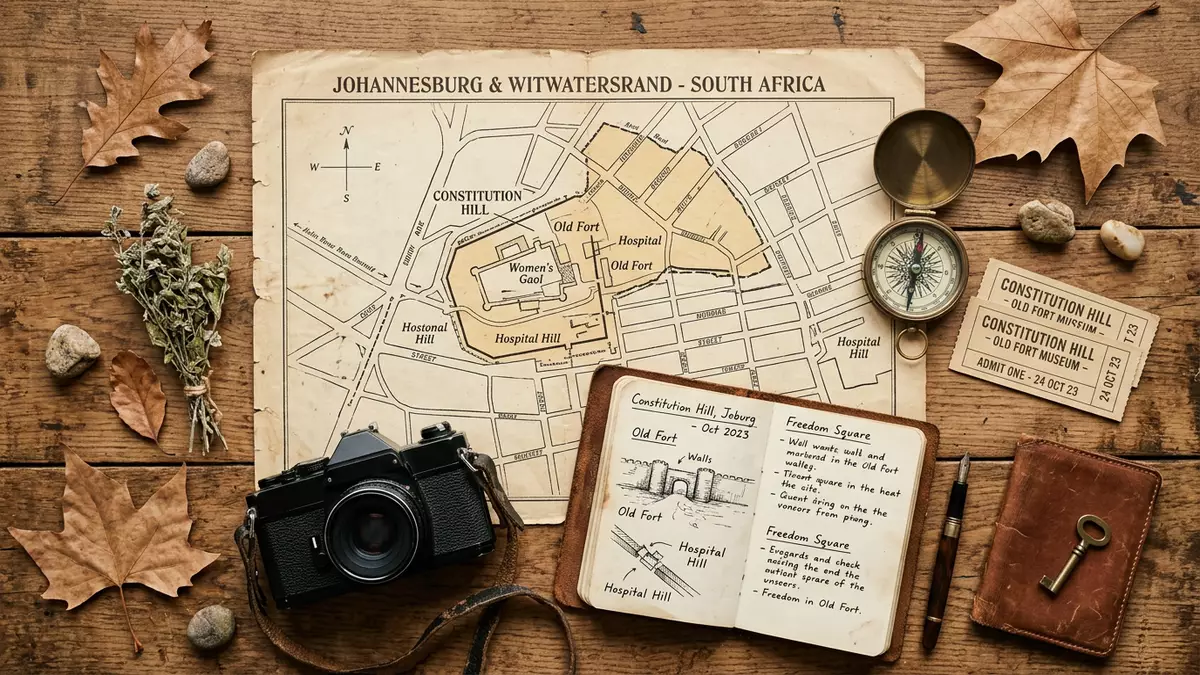
Constitution Hill is a Johannesburg heritage precinct where prison walls, museum spaces and South Africa’s Constitutional Court share one ridge. The site combines the Old Fort, Number Four and the Women’s Jail with a court building that opened in 2004, placing the country’s history of imprisonment beside its constitutional present.
Constitution Hill begins with the Old Fort
The oldest part of Constitution Hill dates from 1893, when the Old Fort opened as a prison for white men. The complex briefly served as a military fort before returning to its long role as a place of incarceration. The name Old Fort describes both the building and its heavy masonry character.
Netherlands-born state architect Sytze Wierda designed the fort. Its grass-covered ramparts, guard positions and enclosed yards remain visible within the precinct. The walls give the building a defensive appearance, while the prison history belongs to the cells and spaces contained inside them. Old Fort architecture records the building’s place within Johannesburg’s early history.
Number Four and the Women’s Jail
Additional prison sections appeared in the early twentieth century. Number Four held black male prisoners, including people detained under segregation and apartheid laws. The building’s name comes from the prison sections known as Four and Five within the wider complex.
The Women’s Jail was built in 1910 as a red-brick Victorian building. It contained separate sections for black and white women. Prisoners associated with the site include Mahatma Gandhi, Nelson Mandela, Winnie Madikizela-Mandela, Albertina Sisulu and Fatima Meer. Their presence forms part of a much larger history involving ordinary prisoners, political detainees and people punished under discriminatory laws. Number Four and the Women’s Jail remain central to the precinct’s museum interpretation.
A constitutional court beside former cells
The prison complex closed in 1983. After South Africa’s transition to democracy in 1994, the site gained a new public function through the Constitutional Court. The court was inaugurated on 21 March 2004, South Africa’s Human Rights Day.
The court building incorporates materials and fragments associated with the former prison complex. Its interior includes courtrooms, public areas and South African artworks. The court’s presence gives Constitution Hill a second architectural language: the older prison buildings rely on walls, yards and controlled passages, while the court forms a civic setting for constitutional law. the Constitutional Court building belongs to the democratic history of the precinct.
Visiting Constitution Hill: what travellers from Western Europe should know
- Constitution Hill stands on a historic ridge in Johannesburg, near Hillbrow. It is reached through the city’s urban road and public-transport network.
- The precinct contains former prison buildings, enclosed yards, ramparts and court spaces. A visit involves walking between separate structures and entering historic interiors.
- The official language is English and the currency is the South African rand.
- Constitution Hill lies near Johannesburg’s central districts, with the Constitutional Court and the former prison complex within the same precinct.
Searching for Constitution Hill on social platforms
These links open searches for Constitution Hill on each platform.
Frequently asked questions about Constitution Hill
Where is Constitution Hill?
Constitution Hill is in Johannesburg, South Africa, on a historic ridge near Hillbrow. The precinct includes former prisons and the Constitutional Court.
What can visitors expect to see?
The site contains the Old Fort, Number Four, the Women’s Jail, museum displays, enclosed prison yards and the Constitutional Court building.
What makes Constitution Hill distinctive?
Its distinctive feature is the combination of former prison buildings and a functioning constitutional court within one heritage precinct. The site connects South Africa’s history of incarceration with its democratic legal order.


