
Constitution Hill, Johannesburg’s hill of justice and memory
Published on 09/17/2026 at 09:18 | Editorial responsibility: Rafael Müller, Editor-in-Chief AD HOC NEWS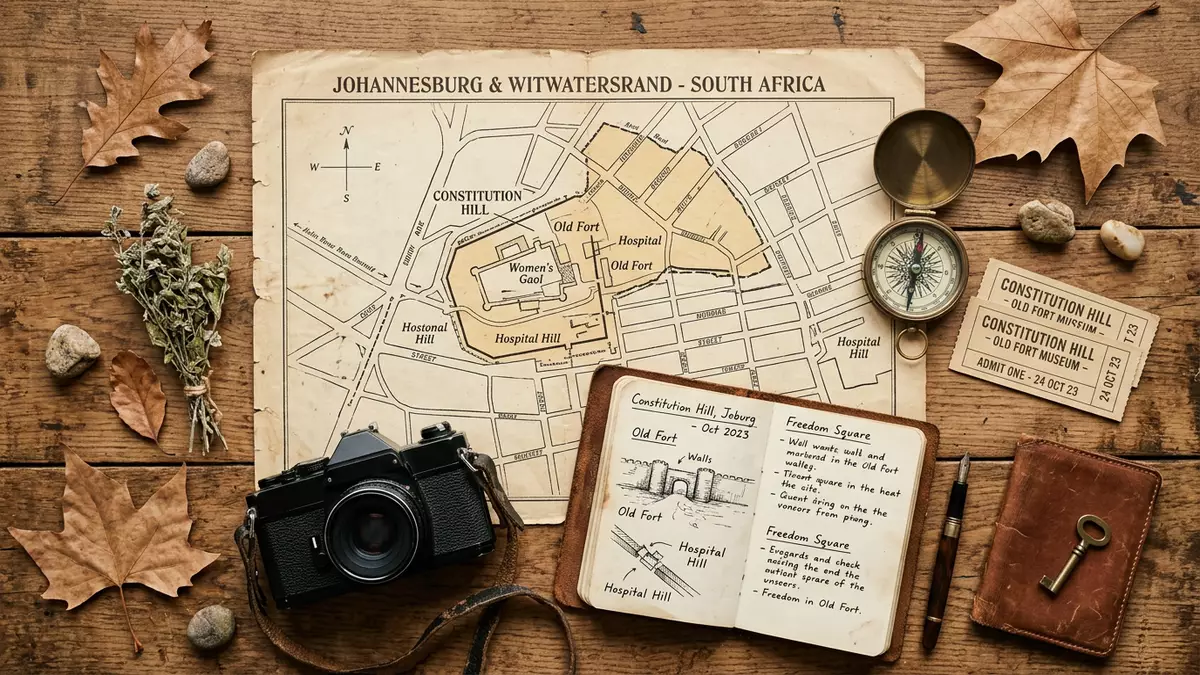
On a ridge above central Johannesburg, Constitution Hill brings South Africa’s constitutional democracy into direct contact with the walls of its former prisons. The precinct grew out of the Old Fort complex, which began operating as a prison for white men in 1893 and later housed some of the country’s most prominent political prisoners. After South Africa became a democracy in 1994, the site was renamed Constitution Hill and the Constitutional Court of South Africa was built here, placing the country’s highest court inside a space marked by incarceration and resistance.
From military fort and prison to constitutional precinct
The story of Constitution Hill begins in the late nineteenth century, when a high-security prison was built on the Braamfontein ridge and was soon encircled by a defensive fort. The Old Fort, associated with President Paul Kruger of the South African Republic, formed part of a system of fortifications erected between 1896 and 1899 in response to the tensions of the era.President Paul Kruger Over time, the fort complex was adapted into a prison, reflecting the political upheavals of Johannesburg’s early decades as a gold-mining city.
The Old Fort originally held white male prisoners, while further buildings were later added to accommodate different categories of inmates. A men’s prison for black prisoners, known as Number Four, an additional section for black male prisoners described as Sections Four and Five, and a Women’s Jail expanded the complex during the first years of the twentieth century.Number Four and the Women’s Jail For around 100 years the ridge functioned as a place of incarceration and punishment, long before it became associated with constitutional rights.
Walls that held giants of South Africa’s freedom struggle
Constitution Hill’s prison buildings are closely tied to the history of South Africa’s liberation movements. The complex confined striking mineworkers, ordinary pass law offenders and prominent figures from different strands of political resistance. Among those detained on the ridge were Mahatma Gandhi, Nelson Mandela, Albert Luthuli, Winnie Madikizela-Mandela, Albertina Sisulu, Ruth First and Fatima Meer, whose time in custody forms part of the narrative now presented in the museum’s exhibitions.leading political activists Their presence anchors the precinct firmly in the history of racial segregation and the struggle against it.
For visitors, the Old Fort, Number Four and the Women’s Jail are preserved as museum spaces that recall harsh prison conditions and the everyday routines of incarceration. Exhibitions inside these structures explore how colonial and apartheid systems treated black people as criminals and how the prison regime operated for men, women and even children.history of incarceration The surviving cells, punishment areas and communal spaces form part of a wider heritage precinct that encourages reflection on the path from imprisonment to democratic rights.
The Constitutional Court: law seated within history
After the end of apartheid, a landmark decision in 1995 located the Constitutional Court of South Africa at Johannesburg’s oldest prison site on the Braamfontein ridge.decision to locate the Constitutional Court The court, created under the country’s new constitutional framework, came to sit at the heart of Constitution Hill, physically connecting the administration of justice with the setting in which many opponents of injustice were once detained.
The current Constitutional Court building incorporates bricks salvaged from an old awaiting-trial block, binding elements of the former prison into the fabric of the court.bricks from the awaiting-trial block The court chambers and public areas stand alongside the museum spaces, turning Constitution Hill into a precinct where heritage, law and contemporary civic life coexist. The site is recognised as a national heritage site and is described as a living museum that tells the story of South Africa’s journey to democracy.national heritage site and living museum
Visiting Constitution Hill: what travellers from Western Europe should know
- Constitution Hill stands on the Braamfontein ridge on the northern edge of Johannesburg’s inner city, with access from central districts by road and public transport.
- The precinct includes multi-storey historic buildings and courtyard spaces, with interior routes that pass through prison blocks, narrow passages and staircases.
- The site forms part of a broader civic area that includes the Constitutional Court building, museum spaces in the Old Fort, Number Four and the Women’s Jail, and outdoor areas on the ridge.
- The official language is Afrikaans and the currency is the South African rand.
- Entry requirements depend on your nationality; UK travellers can check the FCDO travel advice at gov.uk/foreign-travel-advice, Irish travellers the Department of Foreign Affairs at ireland.ie.
Searching for Constitution Hill on social platforms
These links open searches for Constitution Hill on each platform.
Frequently asked questions about Constitution Hill
Where is Constitution Hill in Johannesburg?
Constitution Hill stands on the Braamfontein ridge on the northern side of Johannesburg’s inner city, close to central business districts and civic institutions.
What can visitors expect to see at Constitution Hill?
Visitors encounter preserved prison buildings such as the Old Fort, Number Four and the Women’s Jail, alongside museum exhibitions and the contemporary Constitutional Court building.
What makes Constitution Hill distinctive among South African heritage sites?
Constitution Hill combines a former fort and prison complex with the country’s Constitutional Court, turning a place of incarceration into a national heritage site devoted to democratic rights.


