
Corn Islands, the Caribbean twin isles off Nicaragua
Published on 09/21/2026 at 21:35 | Editorial responsibility: Rafael Müller, Editor-in-Chief AD HOC NEWS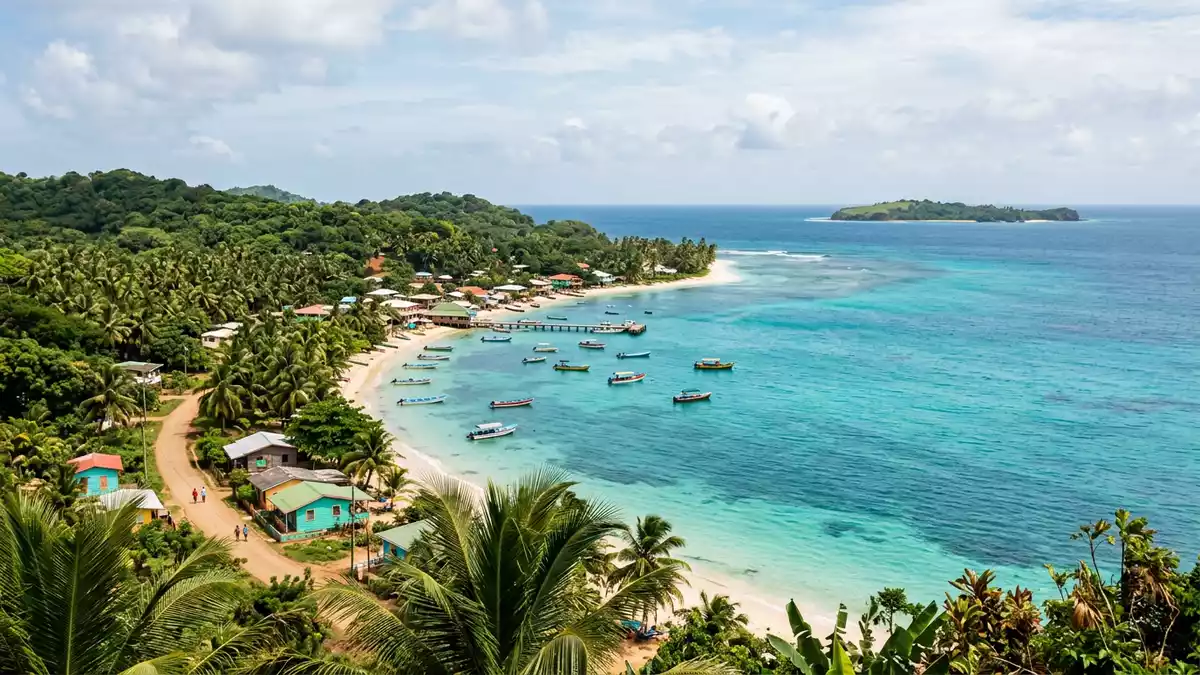
Off the Caribbean coast of Nicaragua, the Corn Islands form a compact pair of low, green islands ringed by pale sand and shallow reefs. Big Corn Island is the larger, inhabited centre, while Little Corn Island lies a short boat ride away, sharing the same lagoon-coloured sea and a history tied to the wider Mosquito Coast.
A small Caribbean municipality with two islands
The Corn Islands constitute a municipality within Nicaragua’s South Caribbean Coast Autonomous Region, made up of Great Corn Island, often called Big Corn Island, and nearby Little Corn Island. Big Corn Island occupies roughly 10 km² (3.9 sq mi) of land, compared with about 3 km² (1.2 sq mi) for Little Corn Island, and most residents live on the larger island, especially around the settlement of Brig Bay.municipality within Nicaragua The pair sits about 70 km (43 mi) east of Bluefields on the mainland, far enough offshore that the horizon is dominated by sea rather than distant land.about 70 km east of Bluefields
On Big Corn Island, the terrain rises gently towards Mount Pleasant Hill in the north, a modest summit reaching 113 m (371 ft) and forming the highest point on the islands.Mount Pleasant Hill at 113 m Low houses line the coastal road, with palms and tropical vegetation behind them and narrow beaches between the road and the water. Little Corn Island, smaller and without roads, is reached by boat from Big Corn and has footpaths in place of vehicles, with settlements scattered close to the shore and interior forest.
Histories from Kukra communities to British rule
Long before Nicaraguan administration, the Corn Islands were part of the historical Mosquitia region and linked to Afro-descendant and Indigenous communities along the south-western Caribbean. Early inhabitants included the Kukra Indians, associated with Pearl Lagoon on Nicaragua’s Caribbean coast, and historical accounts describe their presence on the islands before colonial powers arrived.early inhabitants included the Kukra Indians The islands lie within the broader Mosquito Coast, a belt of shore and offshore lands that connected maritime communities from present-day Nicaragua towards Honduras.integral to the Mosquitia region
European navigators encountered the Corn Islands in the early sixteenth century. On his fourth voyage, dated to 1502, Christopher Columbus passed along this stretch of coast and records state that he sighted Great Corn Island and Little Corn Island, naming them Islas Limonares.Columbus sighted the islands in 1502 During the seventeenth century the islands became linked to British influence on the Mosquito Coast; historical timelines describe the Corn Islands, together with the eastern half of present-day Nicaragua, as under British protectorate status from 1655 until 1860.
From treaty leases to Nicaraguan incorporation
In the nineteenth century the political status of the Corn Islands shifted from British protection to closer ties with Nicaragua. Historical records highlight 1894 as the year when the Corn Islands formally requested incorporation into Nicaragua, ending almost two centuries of British rule and aligning the municipality with the Nicaraguan state.incorporation into Nicaragua in 1894 The islands are now administered within the South Caribbean Coast Autonomous Region, reflecting the multilingual and culturally diverse character of this coastal area.
Earlier, in the twentieth century, the Corn Islands also appeared in international agreements. The Bryan–Chamorro Treaty, signed in 1914 and ratified in 1916, granted the United States a 99-year lease over the Corn Islands for potential use as a naval base, during a period when United States Marines were present in Nicaragua.Bryan–Chamorro Treaty lease That treaty sits alongside a longer maritime heritage reflected in seafaring, fishing and movements of Afro-Caribbean populations around Great Corn Island and Little Corn Island.
Beaches, reef shallows and local life
On the shorelines of Big Corn Island, light-coloured sand curves along bays and points, backed by coconut palms and simple houses. Offshore, reefs and coral shallows frame the islands, with the Caribbean Sea shifting in colour from pale turquoise in the inner lagoons to deeper blue beyond the reef line.white-sand beaches and warm waters Fishing boats, small ferries and local craft move between jetties and anchorages, connecting communities on Big Corn Island with Little Corn Island and with mainland ports.
Around Brig Bay on Big Corn Island there is a compact cluster of municipal buildings, small shops and a baseball stadium, alongside the island’s modest airport facilities.Brig Bay as a local centre Away from this centre, the character changes to quieter stretches of coast road, scattered homes and small guesthouses. Little Corn Island, lacking motor traffic, has paths leading through vegetation and along beaches, with a scale that remains small compared with many Caribbean destinations, and a day’s rhythm shaped by boat schedules and the sea.
Visiting Corn Islands: what travellers from Western Europe should know
- The islands lie in the Caribbean Sea east of mainland Nicaragua, and Big Corn Island is reached by air services from Managua and by sea connections from ports such as Bluefields.
- On Big Corn Island, the coastal road is generally level but Mount Pleasant Hill rises above it; walking inland involves gradual uphill paths and short stairways.
- Little Corn Island has no roads; movement there is on foot along beaches and narrow paths through vegetation, and boat landings can involve stepping between pier and vessel.
- The official language is Spanish and the currency is the Nicaraguan córdoba.
- Entry requirements depend on your nationality; UK travellers can check the FCDO travel advice at gov.uk/foreign-travel-advice, Irish travellers the Department of Foreign Affairs at ireland.ie.
Searching for Corn Islands on social platforms
These links open searches for Corn Islands on each platform.
Frequently asked questions about Corn Islands
Where are the Corn Islands located?
The Corn Islands lie in the Caribbean Sea about 70 km (43 mi) east of Bluefields on Nicaragua’s Caribbean coast, forming a small offshore municipality.
What should visitors expect on a trip to the Corn Islands?
Visitors encounter small-scale settlements, light-coloured beaches, shallow reef waters and low hills, with Big Corn Island offering an airstrip and coastal road and Little Corn Island remaining path-based.
What makes the Corn Islands distinctive among Nicaraguan destinations?
The Corn Islands combine Afro-Caribbean and Indigenous histories linked to the Mosquito Coast with a compact pair of islands, Mount Pleasant Hill as a local summit and a municipality entirely offshore.


