
Cradle Mountain, Australia’s alpine silhouette above Dove Lake
Published on 09/17/2026 at 07:06 | Editorial responsibility: Rafael Müller, Editor-in-Chief AD HOC NEWS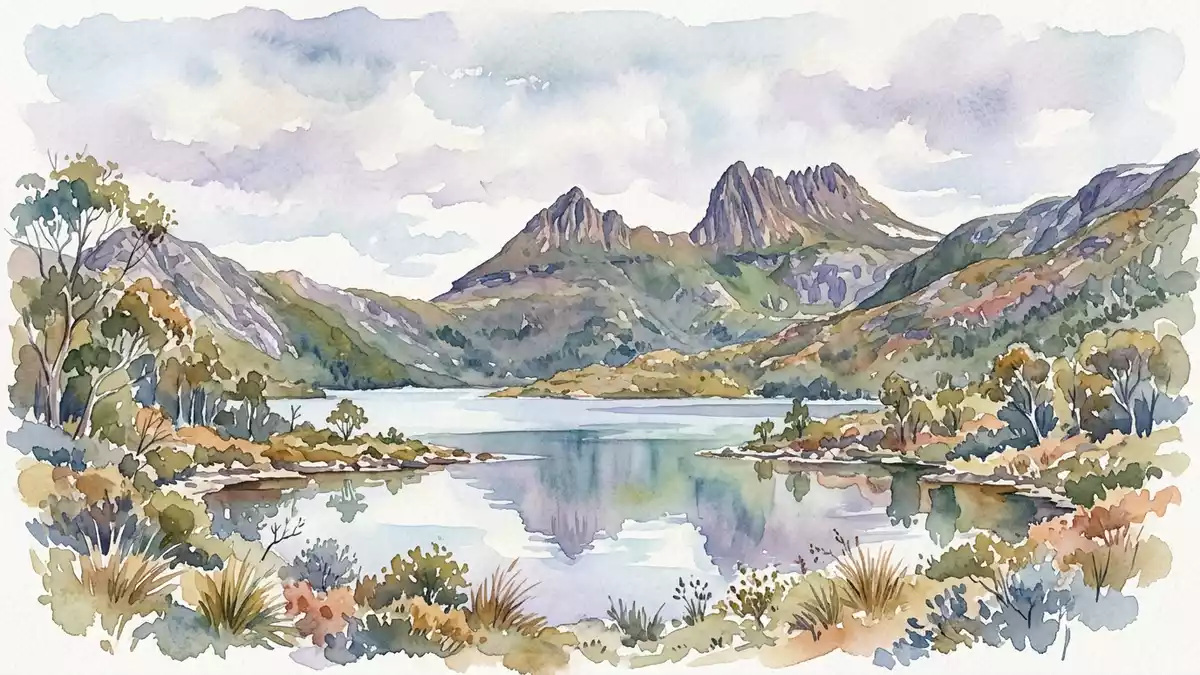
Cradle Mountain in Tasmania’s Central Highlands is a jagged dolerite peak rising above alpine lakes and button grass plains, the northern emblem of a vast protected wilderness. Its summit reaches 1,545 m (5,069 ft), making it one of Tasmania’s higher mountains and a defining feature of Cradle Mountain–Lake St Clair National Park, itself part of the Tasmanian Wilderness World Heritage Area inscribed in 1982.
An alpine ridge at the heart of a World Heritage landscape
Cradle Mountain stands on Tasmania’s central plateau in the island’s north-west, forming the northern boundary of Cradle Mountain–Lake St Clair National Park in Australia. The park is included within the larger Tasmanian Wilderness World Heritage Area, recognised for its natural beauty, glacially carved landforms and ongoing ecological processes.Tasmanian Wilderness World Heritage Area The mountain’s profile is shaped by dolerite cliffs and ridges that rise above slopes of scrub and open grassland, giving it a distinctive silhouette when seen from the surrounding valleys.Central Highlands region of Tasmania
The broader national park extends over more than 1,600 km² (618 sq mi), stretching from Cradle Mountain in the north to Lake St Clair in the south. Within this protected area lie glacial lakes, tarns, expanses of temperate rainforest and areas of alpine heath, reflecting successive glaciations that shaped the plateau.Cradle Mountain–Lake St Clair National Park The World Heritage listing dating from 1982 anchors Cradle Mountain not only as a regional landmark but as part of a globally significant temperate wilderness.inscribed as a World Heritage Area in 1982
Dolerite cliffs, glacial lakes and button grass plains
The summit ridge of Cradle Mountain is composed largely of Jurassic dolerite, a dark, fine-grained igneous rock that forms vertical columns and steep escarpments across Tasmania’s high country.lava basalt peak rises to 1,545 m Erosion and glacial activity have left a serrated skyline above a series of cirques and basins, creating a contrast between the austere rock of the summit and the softer forms of surrounding hills.
At the foot of the mountain lies Dove Lake, a widely photographed glacial lake set among moraine ridges and heath vegetation.Dove Lake beneath Cradle Mountain Around the northern entrance to the park, boardwalks cross button grass plains and lead through patches of temperate rainforest with myrtle and pencil pine, giving visitors a direct view of how different vegetation communities occupy the varied microclimates and soils of the plateau.button grass plains and lakes
Walking the northern gateway to the Overland Track
The locality of Cradle Mountain encompasses both the mountain and the adjacent settlement area that serves as the northern gateway to Cradle Mountain–Lake St Clair National Park.locality and mountain Short walking routes from the visitor facilities lead to viewpoints over the peak and nearby lakes, while longer tracks thread into alpine terrain and forested valleys.
Cradle Mountain marks one terminus of the Overland Track, a multi-day walking route that traverses the park southwards to Lake St Clair.terminus of the Overland Track The area contains a network of day walks, ranging from gentle boardwalk circuits through moorland to ascents that gain substantial elevation. Weather conditions across the plateau can vary quickly, and the combination of altitude, exposed ridges and changeable cloud and precipitation gives the mountain a range of moods that are evident in light, colour and visibility.
Visiting Cradle Mountain: what travellers from Western Europe should know
- Cradle Mountain lies in the northern section of Cradle Mountain–Lake St Clair National Park in central-north Tasmania, reached by road from Tasmanian cities such as Launceston and Hobart.
- The terrain around the mountain includes boardwalks over button grass plains, undulating paths through rainforest and steeper tracks on rocky slopes where sturdy footwear is advisable.
- Higher routes and the summit area are exposed to altitude, wind and rapidly changing weather, and some sections involve sustained uphill walking over uneven ground.
- Snow can fall on the plateau during the colder months, and conditions on tracks and roads reflect the season and elevation.
- The official language is English and the currency is the Australian dollar; entry requirements depend on your nationality; UK travellers can check the FCDO travel advice at gov.uk/foreign-travel-advice, Irish travellers the Department of Foreign Affairs at ireland.ie.
Searching for Cradle Mountain on social platforms
These links open searches for Cradle Mountain on each platform.Frequently asked questions about Cradle Mountain
Where is Cradle Mountain in Australia?
Cradle Mountain is in Tasmania’s Central Highlands in Australia, forming the northern part of Cradle Mountain–Lake St Clair National Park and lying west of the city of Launceston.
What should visitors expect on a trip to Cradle Mountain?
Visitors encounter an alpine environment with a dolerite summit ridge, glacial lakes such as Dove Lake, button grass plains and patches of temperate rainforest connected by boardwalks and walking tracks.
What makes Cradle Mountain distinctive among Tasmanian landscapes?
Its 1,545 m (5,069 ft) elevation, jagged dolerite cliffs above accessible glacial lakes, and role as a gateway to a World Heritage-listed wilderness and the Overland Track give Cradle Mountain a distinct character within Tasmania.


