
Cristo Redentor above Rio de Janeiro’s tropical forest
Published on 08/14/2026 at 14:42 | Editorial responsibility: Rafael Müller, Editor-in-Chief AD HOC NEWS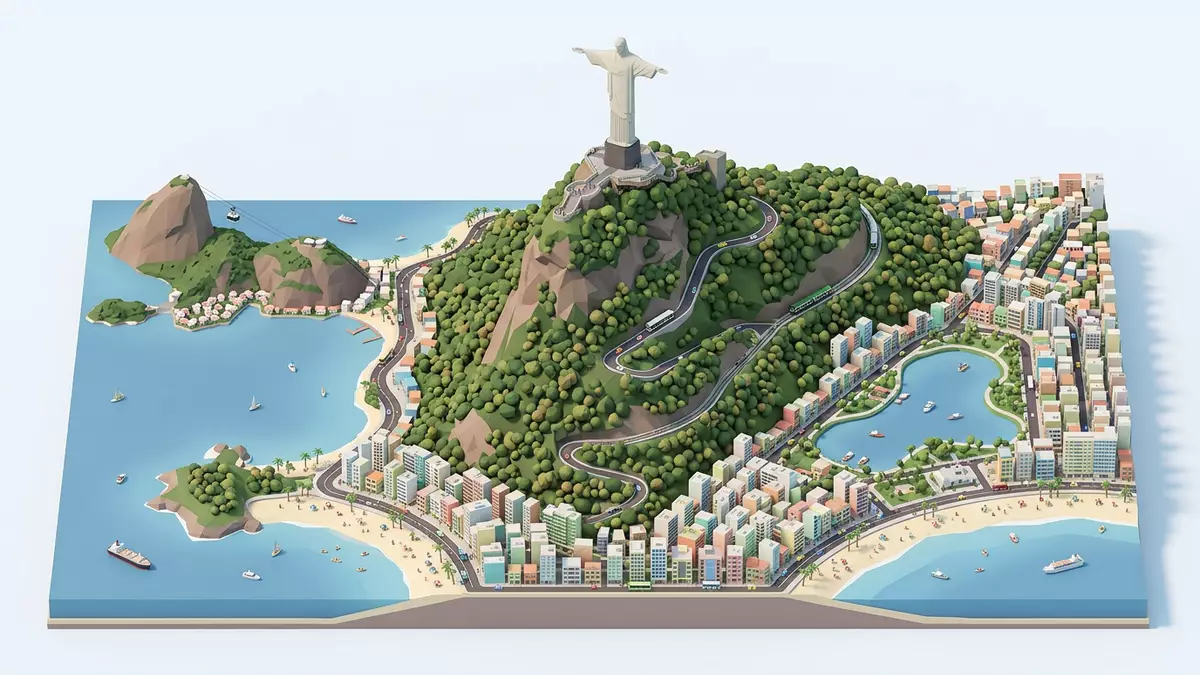
Cristo Redentor, known in English as Christ the Redeemer, stands high above Rio de Janeiro on the summit of Corcovado, combining monumental Art Deco sculpture with tropical mountain forest and broad views over city and sea. Completed in 1931 and depicting Jesus Christ with outstretched arms, it has become a landmark that ties the coast, the hills and the dense greenery of Tijuca National Park into a single panorama.
An Art Deco giant on Corcovado
Cristo Redentor is an Art Deco statue of Jesus Christ made of reinforced concrete and clad with soapstone, a combination that allows fine sculptural detail while protecting the structure from the Atlantic weather.Art Deco statue of Jesus The figure itself is about 30 m (98 ft) tall, standing on a pedestal roughly 8 m (26 ft) high, with arms that stretch about 28 m (92 ft) from fingertip to fingertip, so that the total height and width form a dominant silhouette on the mountain.30 metres tall with wide arms
The statue stands on the summit of Corcovado, a peak rising to roughly 700 m (about 2,300 ft) above sea level within Tijuca National Park, a protected area of Atlantic rainforest inside the urban area of Rio de Janeiro.Corcovado mountain in Tijuca National Park From the terraces around the base, the view drops steeply towards the city’s bays, beaches and dense neighbourhoods, with other peaks such as Sugarloaf Mountain visible across the water.
Design, construction and symbolism
The idea of erecting a monumental figure of Christ on Corcovado dates back to the late nineteenth century, and the project gained momentum in the early twentieth century, with the statue commissioned in the 1920s.project for a figure of Christ Construction work took place through the 1920s and the monument was inaugurated on 12 October 1931, marking the completion of a major engineering and artistic undertaking on a narrow mountain summit.inaugurated on 12 October 1931
The French-Polish sculptor Paul Landowski created the overall sculptural form, while Brazilian engineer Heitor da Silva Costa led the structural design, working with collaborators including French engineer Albert Caquot and Romanian sculptor Gheorghe Leonida, who worked on the face.Paul Landowski and Heitor da Silva Costa The figure is clad in thousands of small soapstone tiles set into a mosaic over the concrete, giving the surfaces a subtly textured finish that catches the changing light above the forest.soapstone mosaic cladding
Cristo Redentor as a viewpoint and sanctuary
The base of Cristo Redentor includes a small chapel dedicated to Our Lady of Aparecida, Brazil’s patron saint, making the monument a recognised sanctuary where religious ceremonies can be held.chapel dedicated to Our Lady of Aparecida Around the pedestal, terraces and walkways form an open platform that circles the statue, allowing visitors to move between views over Guanabara Bay, the Atlantic shoreline and the inland mountains behind the city.
Cristo Redentor stands within Tijuca National Park, a large urban forest of Atlantic tropical vegetation that was replanted in the nineteenth century after earlier deforestation.urban forest of Tijuca National Park The juxtaposition of dense forest, steep rock and the geometric lines of the Art Deco statue gives the monument a setting that combines landscape and architecture at a single viewpoint high above Rio de Janeiro.
Visiting Cristo Redentor: what travellers from Western Europe should know
- Cristo Redentor stands on Corcovado, a peak within Tijuca National Park on the inland side of Rio de Janeiro’s southern bays, reached by mountain transport from the city.
- The summit area is paved and stepped, with terraces around the statue and stairways linking different viewing levels; visitors spend much of their time outdoors at altitude.
- The official language is Portuguese and the currency is the Brazilian real.
- Entry requirements depend on your nationality; UK travellers can check the FCDO travel advice at gov.uk/foreign-travel-advice, Irish travellers the Department of Foreign Affairs at ireland.ie.
Searching for Cristo Redentor on social platforms
These links open searches for Cristo Redentor on each platform.
Frequently asked questions about Cristo Redentor
Where is Cristo Redentor located?
Cristo Redentor stands on the summit of Corcovado in Rio de Janeiro, Brazil, within the Atlantic rainforest of Tijuca National Park above the city’s bays and districts.
What should visitors expect at the monument?
Visitors arrive at a paved summit area with terraces encircling the statue, stairways between levels and open views over Rio de Janeiro, the surrounding forest and nearby peaks.
What makes Cristo Redentor distinctive among monuments?
The combination of a large Art Deco concrete and soapstone figure of Christ, its open-armed stance and its position on a high forested peak above a major coastal city makes it distinctive.


