
Cristo Redentor and the open-armed skyline of Rio de Janeiro
Published on 09/10/2026 at 09:06 | Editorial responsibility: Rafael Müller, Editor-in-Chief AD HOC NEWS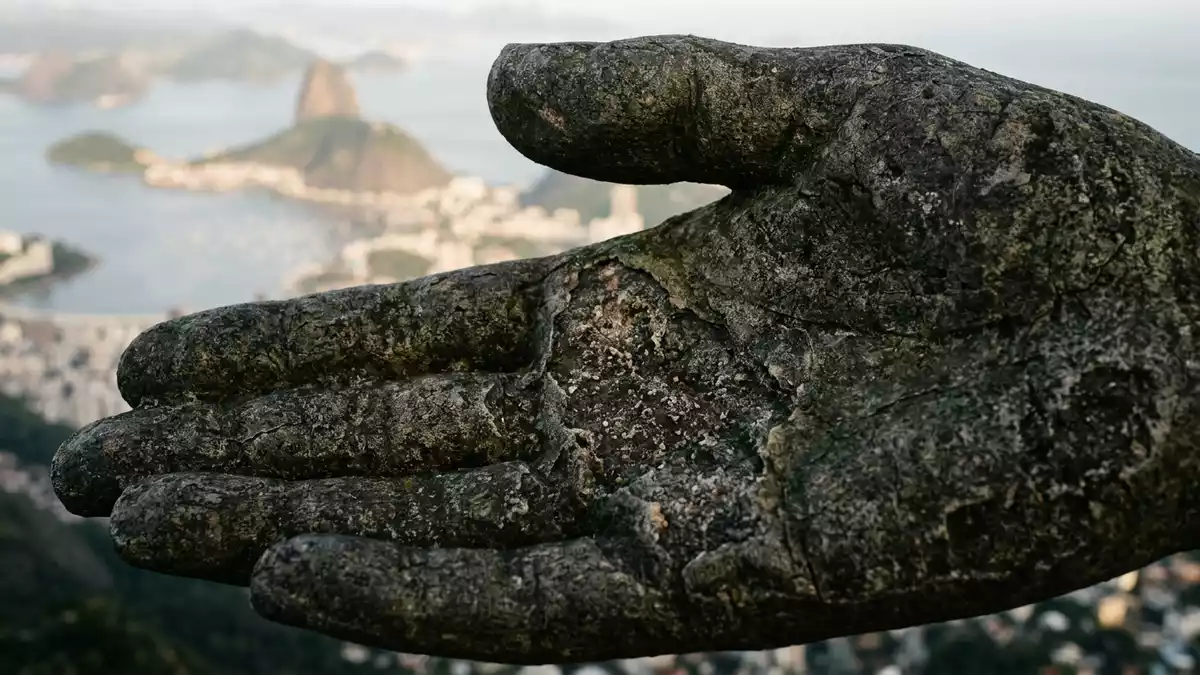
Cristo Redentor stands above Rio de Janeiro as a pale Art Deco figure of Christ with arms outstretched over the city, rising from the summit of Mount Corcovado in the forested hills behind the bay. Completed in 1931 as a monumental statue, it forms a fixed silhouette against the sky and has become a constant presence in views across Brazil’s coastal metropolis.
An Art Deco Christ in reinforced concrete and soapstone
The statue of Cristo Redentor is a tall Art Deco figure of Jesus Christ, standing about 30 m (98 ft) high on its own and reaching roughly 38 m (125 ft) when its pedestal is included.stands 98 feet (30 metres) The horizontally spread arms extend to about 28 m (92 ft) from fingertip to fingertip, forming a straight cross-shaped span when seen from a distance.span from fingertip to fingertip is 28m The figure rises on a square stone pedestal that adds a further 8 m (26 ft) to its height and brings the monument together as a single vertical composition above the ridge.
Cristo Redentor is constructed from reinforced concrete and clad in a mosaic of pale soapstone tiles, a combination that gives the statue its light-coloured surface and crisp Art Deco lines.reinforced concrete clad in a mosaic of soapstone Each part of the figure – head, torso, arms and robes – is shaped in concrete and covered in small geometric pieces of soapstone set closely together, so that from a distance the monument reads as a continuous pale form against the sky. At closer range the surface reveals its fine tiling and the subtle joints between the panels, a reminder that this single figure is assembled from many individual elements.
Designers, dates and the making of the monument
The project that produced Cristo Redentor belongs to the late 1920s and early 1930s, with construction traditionally dated to nine years between 1922 and 1931.a construção durou nove anos (entre 1922 e 1931) Work on the concrete structure and the sculpted figure is recorded as beginning in 1926 on the summit of Corcovado and continuing for five years before the monument’s inauguration on 12 October 1931.carried out on the clifftop for five years, from 1926 to 1931 The opening date appears across Brazilian and international accounts and is widely cited as the moment when the statue entered the city’s skyline as a completed artwork.
Cristo Redentor took shape under the supervision of Brazilian engineer Heitor da Silva Costa, with French sculptor Paul Landowski responsible for the figure of Christ and other specialists contributing to the structure and details.conceived by Heitor da Silva Costa and realised by Paul Landowski The project belongs to the Art Deco period, and the monument is recognised as one of the largest sculptures in that style, combining engineering and sculpture to create a single, legible form high above the city.world’s largest Art Deco monument The engineering of the reinforced concrete frame and the installation of soapstone cladding on a mountain-top site are treated in Brazilian civil engineering accounts as a notable achievement.
Mount Corcovado, Tijuca Forest and the city below
Cristo Redentor stands on Mount Corcovado within the Tijuca Forest National Park, at an elevation of about 710 m (2,329 ft) above sea level.à une altitude de 710 mètres The mountain rises behind the southern zones of Rio de Janeiro, and the statue occupies a terrace near its summit, facing towards the urban core and the bays below. From this position, the outstretched arms and straight vertical axis of the figure align with the ridge, and the monument is visible from multiple districts and viewpoints throughout the city.
The surrounding landscape combines steep rock faces, dense Atlantic forest and distant views of urban neighbourhoods, beaches and islands in Guanabara Bay. Approaches to Cristo Redentor follow the curves of Corcovado’s flanks, with sections of the route crossing wooded slopes before reaching the open terraces beneath the statue. On clear days, the platform below the monument offers extended views across Rio de Janeiro’s hills, bays and lagoons, and the pale form of Cristo Redentor stands against the changing light above the city.
Visiting Cristo Redentor: what travellers from Western Europe should know
- Cristo Redentor stands on Mount Corcovado within Rio de Janeiro’s Tijuca Forest National Park, south-west of the city centre, and is reached by transport services that climb into the hills.
- The monument occupies a high mountain terrace with stepped approaches; visitors encounter stairways and level changes between the transport stops and the viewing areas beneath the statue.
- The surrounding terrain combines steep rock faces and forested slopes, and weather conditions at the summit can differ from those at sea level in central Rio de Janeiro.
- The official language is Portuguese and the currency is the Brazilian real.
- Entry requirements depend on your nationality; UK travellers can check the FCDO travel advice at gov.uk/foreign-travel-advice, Irish travellers the Department of Foreign Affairs at ireland.ie.
Searching for Cristo Redentor on social platforms
These links open searches for Cristo Redentor on each platform.
Frequently asked questions about Cristo Redentor
Where is Cristo Redentor located?
Cristo Redentor stands on Mount Corcovado within the Tijuca Forest National Park in Rio de Janeiro, Brazil, at an elevation of about 710 m (2,329 ft).
What can visitors expect when they reach the monument?
Visitors arrive on a mountain summit terrace beneath the statue, with stairways, platforms and open viewing areas that look out over Rio de Janeiro’s bays, hills and neighbourhoods.
What makes Cristo Redentor distinctive among monuments?
Cristo Redentor is a large Art Deco statue of Christ, standing about 30 m (98 ft) high in reinforced concrete and soapstone, with outstretched arms spanning roughly 28 m (92 ft) above the city.


