
Cristo Rei above the Tagus: Almada’s concrete landmark
Published on 09/22/2026 at 20:57 | Editorial responsibility: Rafael Müller, Editor-in-Chief AD HOC NEWS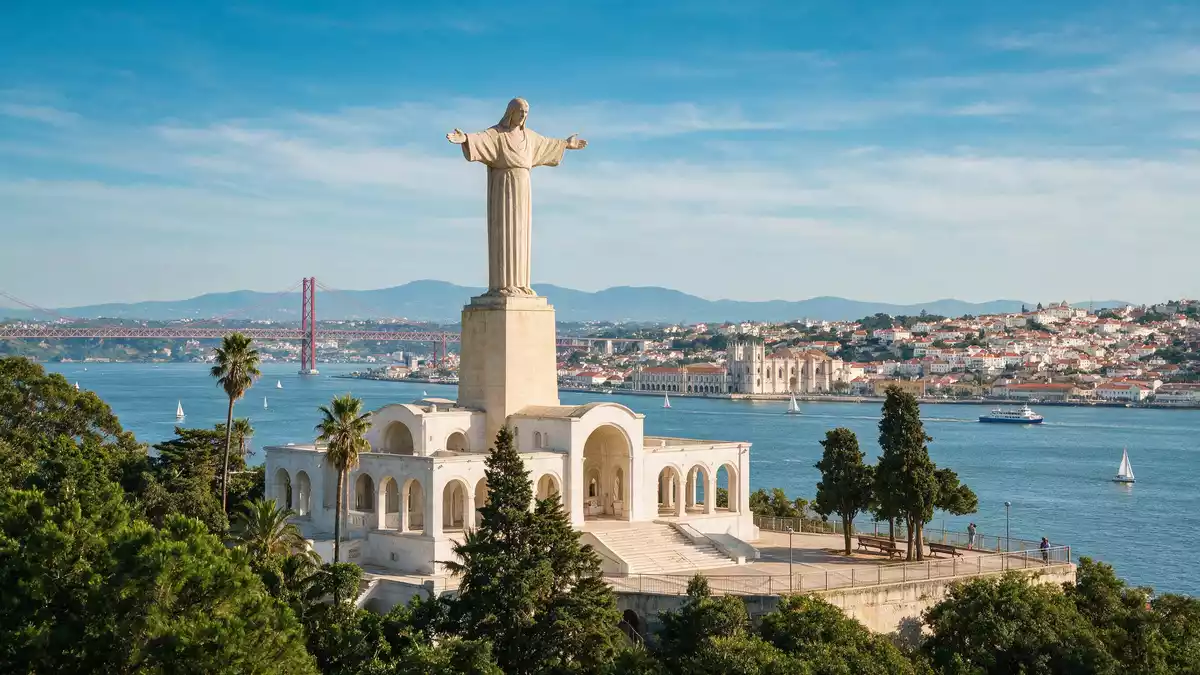
Cristo Rei rises above Almada on the southern bank of the Tagus, with an open-armed figure of Christ above a monumental concrete pedestal. The sanctuary was inaugurated on 17 May 1959, and its height turns the religious complex into a defining element of the river landscape.
Cristo Rei and the vertical form above the Tagus
The monument combines a 28-metre statue with an 82-metre pedestal, reaching 110 metres from its base to the top of the figure. The pedestal is formed by four tall pillars and arches, creating a powerful vertical frame around the statue.
António Lino designed the pedestal, while the Portuguese sculptor Francisco Franco de Sousa created the figure of Christ. Their collaboration joins architectural scale with sculpture: the concrete structure rises from the Almada plateau, while the statue extends its arms towards Lisbon across the estuary.
The monument’s position above the Tagus connects several visible elements of the Lisbon region. Almada occupies the southern bank, Lisbon lies across the water, and the 25 April Bridge passes through the same broad river setting. From the sanctuary, the two banks and the estuary form a single geographical view.
From a 1940 vow to a sanctuary opened in 1959
The history of Cristo Rei begins with a vow made by Portuguese bishops in 1940. The planned monument was dedicated to the Sacred Heart of Jesus, and a national fundraising campaign supported its construction after Portugal remained neutral during the Second World War.
The first stone was laid in 1949, and the sanctuary opened on 17 May 1959. That date places Cristo Rei within the post-war history of Portugal, when religious monuments formed part of the public landscape in several European countries.
The site is a sanctuary rather than a statue standing alone. Between the monument’s pillars is the Chapel of Our Lady of Peace, associated with António Lino and containing sculpture by Leopoldo de Almeida. The chapel adds an interior devotional space to the large external form.
The complex also contains religious artworks connected with the chapel, including stations of the Via Sacra and representations linked to the Ten Commandments. These details give the site a scale that moves from the panorama of the river to the smaller spaces of Catholic devotion.
The view, the chapel and the structure
Cristo Rei presents a sequence of contrasts within one place. The statue has a recognisable human form, while the pedestal is composed of massive concrete lines. The open arms appear above the rigid geometry of the pillars, with the Tagus spreading beyond them.
The monument was inspired by Rio de Janeiro’s Christ the Redeemer, but its Almada setting has a distinct relationship with Lisbon. The figure faces the capital across the river, while the sanctuary occupies a high position above the southern bank.
The Chapel of Our Lady of Peace sits within the lower part of the monument. Its devotional character differs from the exposed scale of the exterior, where the structure is read against the sky, bridge and water. Together, the chapel and statue establish Cristo Rei as both a religious destination and an architectural landmark.
The site’s meaning is also tied to its name. Cristo Rei refers to Christ the King, a Catholic title represented here through the statue’s frontal pose and extended arms. The surrounding sanctuary gives that title a built setting of concrete, pillars, chapel and river-facing outlook.
Visiting Cristo Rei: what travellers from Western Europe should know
- Location and getting there: Cristo Rei stands at Alto do Pragal on Avenida Cristo Rei in Almada, on the southern bank of the Tagus. It is reached from Lisbon by crossing the river to Almada, with road and public-transport connections serving the sanctuary.
- What the terrain demands: The sanctuary occupies elevated ground above the Tagus. The visit combines outdoor paths, the monumental pedestal and the chapel, with views extending across the river towards Lisbon.
- What lies nearby: The 25 April Bridge crosses the Tagus close to the sanctuary, linking the visual setting of Cristo Rei with Lisbon and Almada. The river, bridge and two urban banks remain central features of the outlook.
- The official language is Portuguese and the currency is the euro.
Searching for Cristo Rei on social platforms
These links open searches for Cristo Rei on each platform.Frequently asked questions about Cristo Rei
Where is Cristo Rei?
Cristo Rei is in Almada, on the southern bank of the Tagus in Portugal. The sanctuary stands above the river, across the water from Lisbon.
What can visitors see at Cristo Rei?
The complex includes the monumental statue, its concrete pedestal, the Chapel of Our Lady of Peace and views across the Tagus. The site brings together religious art, architecture and the river landscape.
What makes Cristo Rei distinctive?
Its defining feature is the combination of a 28-metre Christ figure with an 82-metre pedestal. António Lino designed the pedestal, and Francisco Franco de Sousa created the statue inaugurated in 1959.


