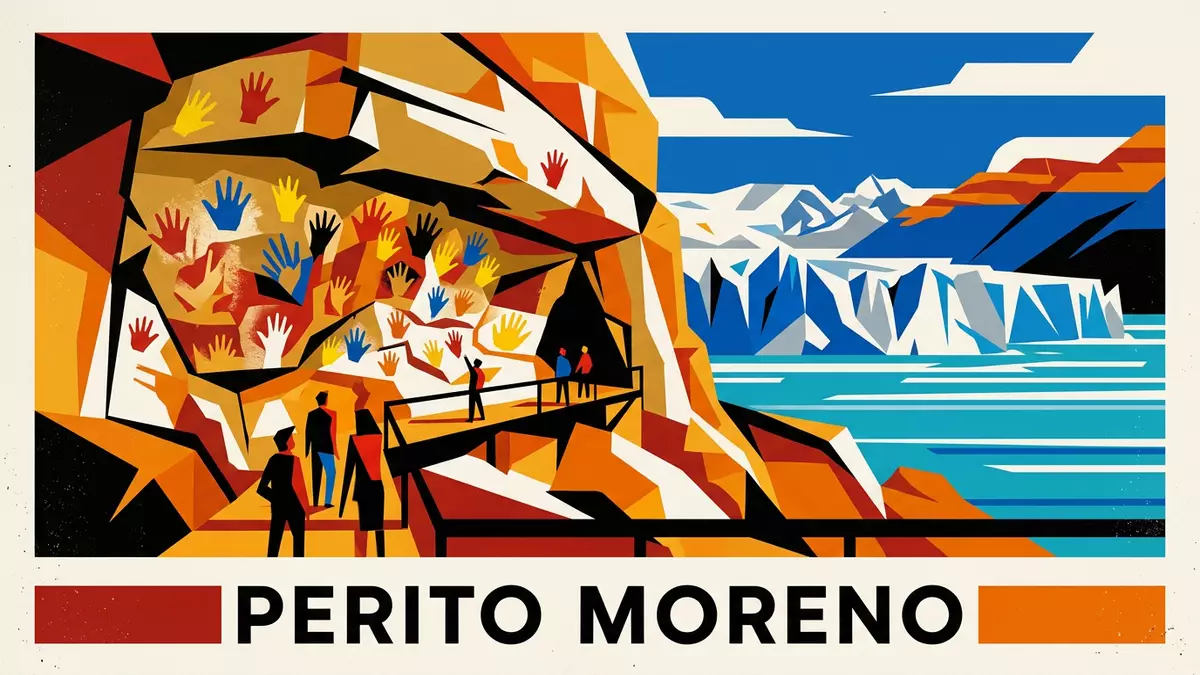
Cueva de las Manos and its painted cliff shelter
Published on 08/08/2026 at 15:10 | Editorial responsibility: Rafael Müller, Editor-in-Chief AD HOC NEWS
Cueva de las Manos near Perito Moreno in Santa Cruz province presents a long rock shelter wall covered in hand stencils and painted figures. The site lies in an Andean gorge, and its art belongs to a prehistoric landscape that still reads clearly in the cliff and river below.
Hand stencils on an Andean cliff
The shelter is known for dense panels of negative handprints, with many small and large hands spread across the rock face. Figures of animals and hunting scenes appear alongside them, giving the wall a layered painted surface rather than a single mural.
The cliff shelter sits within the valley of the Pinturas River. The setting is dry, open and exposed, with the painted rock standing out against the pale gorge walls and sparse Patagonian terrain.
Rock art in the Pinturas valley
The paintings belong to a long indigenous tradition in southern Patagonia. They are commonly linked with hunter-gatherer groups who used pigments on sheltered rock surfaces, leaving images that survive because the site is dry and protected by the overhang.
Red, black, white and ochre tones give the wall its varied surface. The hand outlines are the most immediately striking element, but the animal forms and abstract marks add depth to the composition and show repeated use of the shelter.
Patagonia, archaeology and preserved walls
Cueva de las Manos is one of the best-known archaeological places in Argentina’s far south. Its importance lies in the combination of art, landscape and survival: a cliff shelter, a river valley and paintings that can still be studied in place.
The site is associated with prehistoric occupation of Patagonia and with the wider artistic record of the region. It offers a direct encounter with rock art rather than a reconstructed museum display, and the wall remains the central feature of the visit.
Visiting Cueva de las Manos: what travellers from Western Europe should know
- The site is reached from Perito Moreno by road, with the final approach through the Pinturas valley.
- Admission arrangements and opening hours are set by the site's operator and change with the season; the official website is the only binding source.
- Late spring, summer and early autumn offer the most comfortable conditions for the Patagonian landscape around the shelter.
- The site involves exposed terrain, a gorge setting and walking on uneven ground near the cliff face.
- Spanish is the main language in the area, and cash and cards may not be handled in the same way everywhere.
- Entry requirements depend on your nationality. UK travellers should check the FCDO travel advice at gov.uk/foreign-travel-advice; Irish travellers the Department of Foreign Affairs at ireland.ie; EU and EEA citizens their own national foreign ministry.
Searching for Cueva de las Manos on social platforms
These links open searches for Cueva de las Manos on each platform.
Frequently asked questions about Cueva de las Manos
Where is Cueva de las Manos?
It is in Santa Cruz province in southern Argentina, near Perito Moreno, in the valley of the Pinturas River. The site sits in an Andean gorge.
What should visitors expect?
A rock shelter, painted cliff walls and an archaeological landscape rather than a built monument. The ground is uneven and the setting is open and exposed.
What makes it distinctive?
The hand stencils are the signature feature, set among animal figures and other rock paintings. The combination of the cliff shelter and the surviving wall art gives the place its force.