
Cueva de las Manos and the painted canyon of Río Pinturas
Published on 09/19/2026 at 06:11 | Editorial responsibility: Rafael Müller, Editor-in-Chief AD HOC NEWS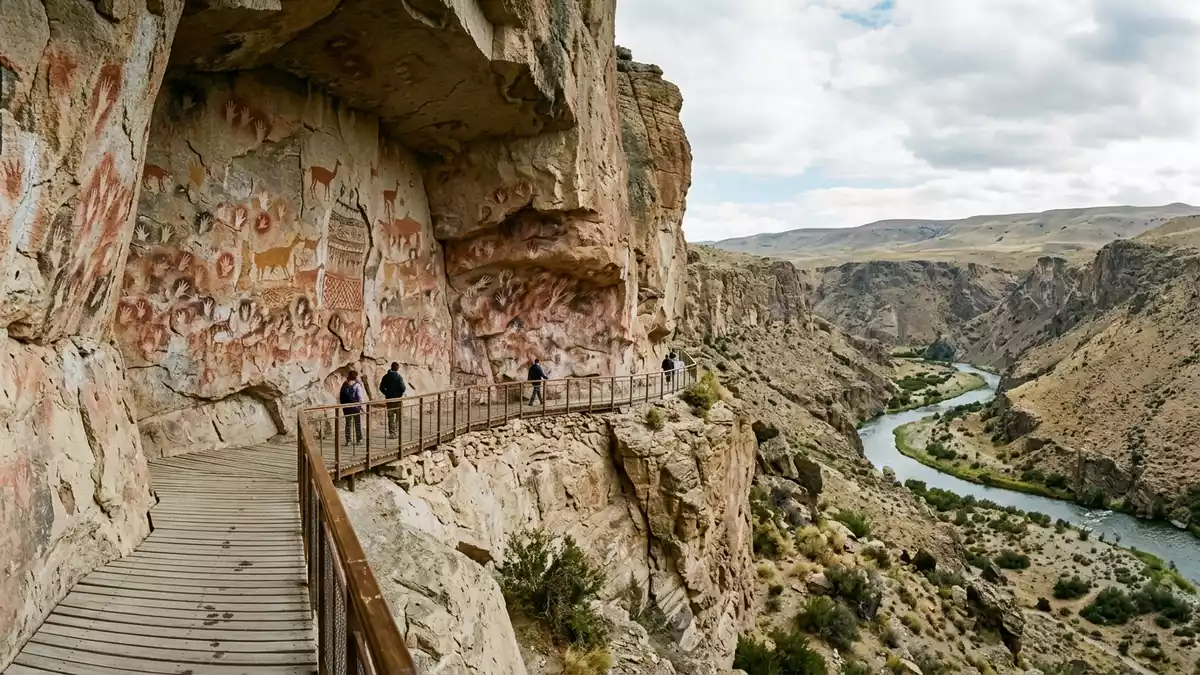
High in the canyon walls of the Pinturas River in Santa Cruz, south of Perito Moreno, Cueva de las Manos preserves a dense field of prehistoric rock paintings in an austere Patagonian landscape. Executed over thousands of years, the images are protected within a cave and on nearby overhangs that form part of a provincial park and the broader Perito Moreno National Park in southern Argentina.
A canyon cave above the Pinturas River
Cueva de las Manos lies in the Alto Río Pinturas area of northwest Santa Cruz province, where the river has carved a deep gorge through the Patagonian steppe. The archaeological site occupies the foot of a cliff along the Pinturas canyon, between the localities of Perito Moreno and Bajo Caracoles, with the cave entrance set above the valley floor on a rock wall that drops steeply to the river below.Alto Río Pinturas location Visitors reach the cave by a road from Ruta Nacional 40 and then a footpath that traverses the canyon side to a series of viewing platforms positioned opposite the painted surfaces.Access from Ruta 40
The cave itself forms part of a larger complex of rock shelters and cliff faces used by hunter?gatherer groups over many generations. Within the hollow and under adjacent overhangs, the walls carry layered motifs in mineral pigments, extending along panels that follow the natural curves and fractures of the rock.Rock art complex Around the site, the surrounding steppe rises in rolling plateaus, with the canyon cutting sharply through them, giving visitors views both along the Pinturas valley and back to the high plains characteristic of inland Patagonia.
Hands, guanacos and layered scenes on the rock
The place takes its Spanish name from the many stencilled outlines of human hands on the cave walls and nearby rock faces. These silhouettes appear in dense clusters, in different sizes and colours, created by spraying pigment around hands held against the stone to leave a negative imprint.Stencilled hand silhouettes Alongside them, the panels include depictions of guanacos, abstract signs and hunting scenes, with animals shown in motion and human figures rendered as simplified shapes.
Archaeological research dates the earliest paintings in Cueva de las Manos to between about 13,000 and 9,500 years ago, with continued additions over millennia by different groups of hunter?gatherers in the region.Late Pleistocene paintings The pigments derive from local minerals, and the long span of activity has produced layers where older images sit beneath later ones, giving the canyon walls a palimpsest quality that reflects changing practices while retaining recognisable motifs such as the hands and guanaco herds.Hunter-gatherer art tradition
From remote site to protected World Heritage landscape
In 1993 the Argentine state declared Cueva de las Manos a National Historic Monument, recognising the significance of its rock art within the country’s archaeological heritage.National Historic Monument 1993 Six years later, in 1999, UNESCO inscribed “Cueva de las Manos, Río Pinturas” on the World Heritage List under cultural criterion (iii), highlighting the site as an exceptional testimony to ancient South American hunter?gatherer communities.World Heritage inscription 1999
The protected area today forms part of Parque Provincial Cueva de las Manos and overlaps with the wider Perito Moreno National Park, extending over several hundred hectares along the Pinturas canyon where further archaeological sites are documented.Provincial park designation The combination of formal protection and the site’s remote canyon setting has helped preserve the panels, with guided visits organised along fixed routes on the opposite side of the gorge so that travellers can view the paintings without approaching the fragile surfaces directly.Managed visit routes
Visiting Cueva de las Manos: what travellers from Western Europe should know
- Cueva de las Manos lies in northwest Santa Cruz province, inland from the Atlantic coast, and is reached by road from the town of Perito Moreno along Ruta Nacional 40 and a signed side road into the Pinturas canyon.
- The approach to the viewing platforms includes a walk on a prepared path along the canyon side, with sections over uneven ground and near exposed drops above the river.
- The surrounding area forms part of a protected landscape with other archaeological sites and open Patagonian steppe, so travel plans often combine the visit with time in Perito Moreno National Park and nearby viewpoints over the Pinturas valley.
- The official language is Spanish and the currency is the Argentine peso.
- Entry requirements depend on your nationality; UK travellers can check the FCDO travel advice at gov.uk/foreign-travel-advice, Irish travellers the Department of Foreign Affairs at ireland.ie.
Searching for Cueva de las Manos on social platforms
These links open searches for Cueva de las Manos on each platform.
Frequently asked questions about Cueva de las Manos
Where is Cueva de las Manos in relation to Perito Moreno?
The site lies south of the town of Perito Moreno in northwest Santa Cruz province, in the canyon of the Pinturas River, reached via Ruta Nacional 40 and a branch road.
What should travellers expect during a visit?
Travellers follow a guided route along the canyon side to viewing platforms opposite the painted cave and rock shelters, with time to observe the hand stencils, animal figures and wider Patagonian landscape.
What makes Cueva de las Manos distinctive among rock art sites?
Its long sequence of paintings from around 13,000 to 9,500 years ago, the dense fields of hand stencils and the guanaco hunting scenes, combined with the protected canyon setting, mark it out as a major prehistoric art site in Patagonia.


