
Cueva de las Manos and the painted walls of Patagonia
Published on 09/24/2026 at 10:10 | Editorial responsibility: Rafael Müller, Editor-in-Chief AD HOC NEWS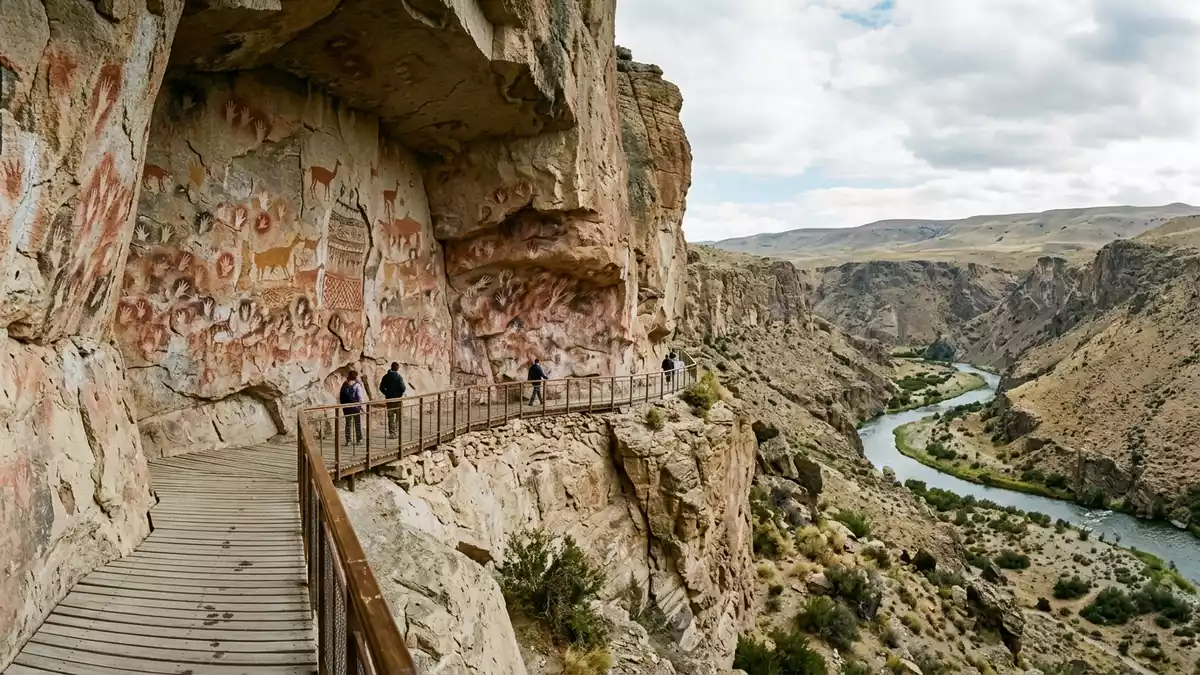
Cueva de las Manos lies in the canyon of the Pinturas River in Santa Cruz, Argentina. Its sheltered rock walls carry hand stencils, animal figures and hunting scenes made across thousands of years.
The paintings belong to a wider archaeological complex, not a single chamber. Red, black, white and yellow pigments cover overhangs and rock shelters beneath the canyon walls, giving the place a visual record of early communities in Patagonia.
Painted hands above the Pinturas River
The site occupies the Alto Río Pinturas, between Perito Moreno and Bajo Caracoles. The river runs through a deep canyon, where cliffs, ledges and shallow shelters form the setting for the rock art.
The hand images are the most recognisable feature. Many are stencils, created when pigment was applied around a hand held against the rock. The walls also contain guanacos, rheas, geometric marks and human figures associated with hunting scenes.
The paintings extend across several shelters. Their arrangement links the images to the shape of the canyon, with art appearing on vertical surfaces and beneath natural rock projections. The result is a site composed of landscape, shelter and painted stone.
From early hunter-gatherers to World Heritage
The pictographs date from a long period between about 9,300 and 1,300 years ago. This span places the earliest images among the oldest known evidence of human activity in South America.
The makers were hunter-gatherer communities. Guanacos and rheas appear among the painted subjects, reflecting animals found in the Patagonian environment. The images preserve traces of movement, hunting and symbolic expression without written records.
Argentina declared Cueva de las Manos a National Historic Monument in 1993. The property entered the UNESCO World Heritage List in 1999 as Cueva de las Manos, Río Pinturas, for its exceptional prehistoric rock art and archaeological importance. UNESCO World Heritage listing records the site as a cultural property.
The formal designation covers the archaeological complex and its surrounding landscape. It also recognises the continuity of artistic activity represented by the painted shelters, rather than treating the hand stencils as isolated images.
Colours, animals and a canyon setting
Cueva de las Manos is made distinctive by the combination of repeated hand stencils and figurative scenes. The hands vary in colour and size, while animal forms appear in groups, profiles and running poses.
Natural rock surfaces remain visible between the painted areas. Cracks, ledges and changes in the cliff face divide the shelters into separate panels. Pigment follows the available surfaces, producing a close relationship between the artwork and the canyon geology.
The archaeological site is associated with the Río Pinturas basin in north-western Santa Cruz. Its location within a dry Patagonian landscape gives the paintings a setting of exposed rock, sparse vegetation and a river corridor below.
The place is also connected with the wider history of Indigenous Patagonia. The art belongs to communities that lived through changing climatic and ecological conditions, while retaining recurring visual forms across generations.
The site lies south of Perito Moreno and is reached from National Route 40. The approach continues towards the Pinturas River canyon, where the archaeological shelters sit below the surrounding plateau.
Visiting Cueva de las Manos: what travellers from Western Europe should know
- Cueva de las Manos lies in Santa Cruz Province between Perito Moreno and Bajo Caracoles. Access from the north uses National Route 40, followed by a route towards the Río Pinturas canyon.
- The archaeological complex is set below canyon cliffs. Reaching the painted shelters involves uneven ground and walking through a rugged landscape.
- The official language is Spanish and the currency is the Argentine peso.
- Entry requirements depend on your nationality; UK travellers can check the FCDO travel advice at gov.uk/foreign-travel-advice, Irish travellers the Department of Foreign Affairs at ireland.ie.
Searching for Cueva de las Manos on social platforms
These links open searches for Cueva de las Manos on each platform.
Frequently asked questions about Cueva de las Manos
Where is Cueva de las Manos?
Cueva de las Manos is in the Alto Río Pinturas area of Santa Cruz Province, south of Perito Moreno and near the Pinturas River canyon.
What can visitors expect to see?
The shelters contain hand stencils, guanacos, rheas, geometric marks and hunting scenes painted on natural rock surfaces.
What makes the site distinctive?
Its distinctive character comes from the concentration of hand stencils and figurative rock art created across a period extending from about 9,300 to 1,300 years ago.


